Owner’s manual
 Error Codes



Do I need 10 2 or 10 3 for a water heater?
For the Kenmore 153321842 electric water heater on a 240-volt supply, 10/2 with ground is the typical choice for a standard two-wire connection. Use 10/3 with ground when your setup requires a third conductor (commonly for a time clock or off-peak meter); otherwise the extra conductor is capped.
What the wiring choice means
- 10/2 with ground: two insulated conductors plus a ground; used for most 240V water heater hookups.
- 10/3 with ground: three insulated conductors plus a ground; used when the heater is wired for special metering or control.
- Your water heater must be connected and grounded as shown in the wiring diagrams in the 153321842 owner’s manual.
Quick decision guide
- Choose 10/2 with ground if:
- You have a standard 240V, 2-pole breaker feed
- No time clock, load control, or off-peak meter is involved
- The heater is wired as a common two-wire connection
- Choose 10/3 with ground if:
- Your utility uses a time clock or off-peak control/metering setup
- Your wiring diagram calls for a three-wire connection
- You want the option to support that type of control later
Typical electrical requirements (what to match)
The manual guidance for higher-wattage operation calls out 240 volts, 10 AWG wiring, and 30-amp overcurrent protection. Always confirm the rating plate on the tank and follow the manual.
| Item | Typical for this setup | What to verify |
|---|---|---|
| Supply voltage | 240V | Rating plate voltage matches |
| Circuit size | 30A (common) | Breaker/fuse rating per manual/rating plate |
| Wire gauge | 10 AWG (common) | Conductor type and temperature rating per manual |
Why it matters
Using the correct conductor count and wire size helps the heater operate safely at its rated wattage, supports proper grounding, and prevents nuisance breaker trips or overheated wiring.
Last updated: January 2026
Can you change a water heater element without draining?
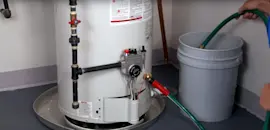
Yes, on the Kenmore 153321842 electric water heater we can often replace the upper heating element with only minimal water loss by shutting off power and water, relieving pressure, and working quickly. For the lower element, we drain the tank down below the element opening to prevent a major spill.
Safe approach (recommended)
- Turn electrical power OFF at the breaker before removing access panels.
- Close the cold water supply valve.
- Open a nearby hot water faucet to relieve pressure and let air in.
- Drain water until the level is below the element you are removing (especially for the lower element).
- Replace the element and always install a new gasket to prevent leaks.
For model-specific cautions and the fill procedure, follow the 153321842 owner's manual.
Quick decision guide
| Element location | Can you avoid draining? | What we recommend |
|---|---|---|
| Upper element | Sometimes | Keep water supply off, relieve pressure, expect some water loss |
| Lower element | No (practically) | Drain to below the lower element opening |
Parts that commonly go with an element swap
Using the correct parts helps prevent leaks and repeat repairs.
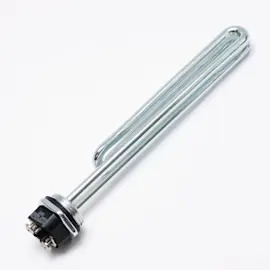
- Element 3800 100108346 (heating element option for this model)
- Water heater heating element gasket 100108379 (replace every time)
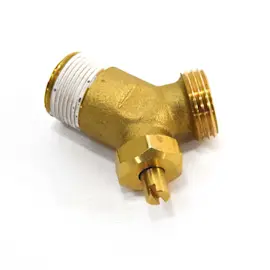
- Water heater drain valve 100109106 (helpful if the old valve will not shut off cleanly)
Why it matters
If you restore power before the tank is completely full, the element can burn out quickly. We always confirm the tank is full by running hot water until it flows steadily (no air sputtering) before turning power back on.
Last updated: January 2026
Are electric water heater elements universal?
No. For Kenmore water heater model 153321842, the heating element is not universal; the replacement must match the heater’s voltage and wattage. This model uses 240V elements, with 3800W standard operation and an optional 5500W lower-element conversion noted on the rating plate (if converted). See the 153321842 owner’s manual.
What “not universal” means for this model
Electric water heater elements can look similar, but they vary by electrical rating and fit. For model 153321842, we match the element to what the tank is set up to run.
- Match voltage first (this model is designed for 240V operation)
- Match wattage to how the heater is configured: 3800W or 5500W
- Use the rating plate near the lower access panel to confirm whether it was converted
- Replace the element gasket when you remove an element to help prevent leaks
- Turn off power at the breaker before opening access panels or touching wiring
Which replacement element should I use?
Your correct element depends on whether the lower element was converted to 5500W.
| Heater configuration | What to order | Where it’s used |
|---|---|---|
| Factory setup | Element 3800 100108346 | Upper element (and lower if not converted) |
| Converted lower element | Element 5500 100093526 | Lower element only (when converted) |
Why it matters
Using the wrong element (wrong voltage or wattage) can cause poor heating performance, nuisance breaker trips, damaged wiring, or unsafe operation. Matching the element rating to the model’s configuration keeps recovery time and electrical load where they belong.
Related repair help
Last updated: January 2026
How to tell if an electric water heater element is bad?
On Kenmore electric water heater model 153321842, a bad heating element causes no hot water, lukewarm water, or slow recovery. Confirm it with a power-off multimeter test: an open circuit, a short to ground, or an abnormal ohms reading means the element has failed.
Quick signs that point to a failed element
- No hot water or hot water runs out fast
- Slow heating or long recovery time
- Breaker trips when the heater calls for heat
- Popping or sizzling sounds (sediment on the element)
- Water leaking at the element seal (often a gasket issue)
How we test the element (safe checklist)
- Turn power OFF at the breaker.
- Remove the access panel and insulation to reach the element terminals.
- Remove the wires from the element screws.
- Test with a multimeter:
- Across the two screws: steady resistance is normal; open/infinite indicates failure.
- Each screw to the metal tank: any continuity indicates a grounded element.
Typical resistance readings at 240V
| Element rating | Typical resistance | Bad result |
|---|---|---|
| 3800W | ~13 to 17 ohms | Open/infinite, near 0, or grounded |
| 5500W | ~9 to 12 ohms | Open/infinite, near 0, or grounded |
Model-specific notes for 153321842
This model is factory set for 3800 watts, and the lower element can be converted to 5500 watts on a 240V system. Use the 153321842 owner's manual for the conversion details and wiring requirements.
Parts that commonly fix it
- Failed element: element 3800 100108346 or element 5500 100093526 (match your configuration)
- Leaking at the element: replace the seal with water heater heating element gasket 100108379
Why it matters
A failed or grounded element causes cold showers and can trip the breaker. Also, never energize the heater until the tank is completely full of water to prevent element damage.
Last updated: January 2026