Installation guide
 Owner’s manual
 Error Codes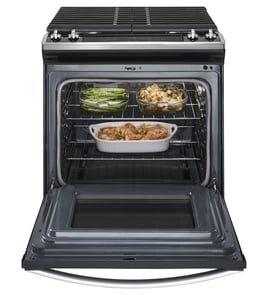




How do I tell what model my Frigidaire stove is?
For your Frigidaire FGGF3054MFG gas range, the model number is printed on the appliance’s serial plate. We typically find that plate in the storage drawer area (or behind the lower front panel on some versions), and it lists both the model and serial number.
Where to look on the range
Check these common serial plate locations first:
- Open the storage drawer and look along the frame area around the drawer opening
- If your range has a lower front panel instead of a drawer, remove that panel and look behind it
- Look for a label that includes both Model and Serial fields
- Use a flashlight; the print can be small or lightly stamped
- Write the model number exactly as shown (letters and numbers)
What the label should show
Most Frigidaire range serial plates include the same key fields.
| Label item | What it’s used for | Why it matters |
|---|---|---|
| Model number (example: FGGF3054MFG) | Identifies the exact range design | Ensures correct parts fit and correct troubleshooting steps |
| Serial number | Identifies your specific unit | Helps match production details when ordering parts |
| Electrical and gas ratings | Confirms supply requirements | Helps avoid installation and performance issues |
Tips to avoid common mix-ups
These quick checks prevent ordering the wrong Frigidaire parts:
- Copy the model number character-for-character; don’t drop suffix letters
- Watch for look-alikes such as 0 (zero) vs O (letter O)
- If the label is greasy, wipe it gently with a damp cloth and mild cleaner, then dry
- Use the model number (not just “Frigidaire gas range”) when searching for igniters, sensors, and burner parts
Why it matters
Frigidaire ranges often share similar styling across multiple models, but parts like an oven igniter, temperature sensor, or spark module can vary by model. Using the exact FGGF3054MFG model number keeps your parts match accurate the first time.
For the official location guidance and product information fields, use the FGGF3054MFG owner’s manual.
Last updated: February 2026
How to replace the igniter on a Frigidaire gas stove?
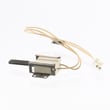
On the Frigidaire FGGF3054MFG gas range, replacing an igniter typically means shutting off power and gas, accessing the burner area, removing the old igniter from its mounting screws, and installing the correct replacement igniter in the same position so it can glow and light the gas within about 30 to 60 seconds.
Before you start (safety and setup)
- Unplug the range or switch off the circuit breaker.
- Shut off the gas supply valve to the range.
- Let the oven and grates cool completely.
- Use a work light; avoid pulling on wires by the connector.
- Follow the access steps and fastener locations in the FGGF3054MFG owner’s manual.
Which igniter are you replacing?
Use the symptoms to identify the right area before you disassemble.
| What is not lighting | What you usually see/hear | Most common suspect |
|---|---|---|
| Oven bake burner | No heat; igniter does not glow, or glows but no flame | Bake igniter or gas valve circuit |
| Broil burner | No broil heat; similar glow/no-glow behavior | Broil igniter |
| Surface burner | Clicking/sparking but no flame | Burner cap alignment, electrode/igniter, spark module |
Oven igniter replacement (bake or broil)
- Remove oven racks and the oven bottom panel to access the burner area.
- Locate the igniter mounted to the burner tube; remove the mounting screws.
- Disconnect the igniter wire connector (do not cut wires unless your replacement requires it).
- Install the new igniter in the same orientation and secure it firmly.
- Reassemble panels and racks.
Model-specific parts that commonly apply:
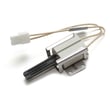
- For bake ignition issues, we often see the tappan range oven burner igniter 316489403 used on this model.
- For broil ignition issues, check the range oven igniter 5304506545.
Verify operation after replacement
The installation instructions describe what “normal” ignition looks like:
- Restore power and gas.
- Set Bake to 300°F.
- The igniter should glow like a light bulb; the burner should ignite within 60 seconds.
- For surface burners, turn a knob to LITE; the burner should light within about 4 seconds after air is purged from the line.
Why it matters
A weak or failed igniter can prevent the oven gas valve from opening, so the burner never lights. Confirming proper ignition timing after the repair helps ensure safe, consistent heating and avoids repeated no-heat problems.
Last updated: February 2026
What is the error code F3 on a Frigidaire range?
On the Frigidaire FGGF3054MFG gas range, error code F3 points to an oven temperature sensing problem, most often a failing oven temperature sensor or a wiring issue between the sensor and the oven control. Start by inspecting the sensor harness and connections, then test the sensor.
What to check first (fast, no parts yet)
- Turn off power at the breaker for 1 minute, then restore power and see if F3 returns.
- Inspect the sensor connector at the rear of the oven cavity (or behind the back panel, depending on access).
- Look for loose plugs, pinched wires, melted insulation, or corrosion at terminals.
- Make sure the sensor probe is not bent into the oven wall or touching a rack.
- If the code appears during preheat, note whether the oven heats at all or stops early.
Test the oven temperature sensor
We recommend following the access and test steps in the FGGF3054MFG owner’s manual. With power off, disconnect the sensor harness and measure resistance across the sensor leads.
Typical sensor readings (most Frigidaire-style RTD sensors):
| Oven temperature | Typical resistance (approx.) | What it suggests |
|---|---|---|
| Room temp (70°F) | ~1050 to 1100 Ω | Normal baseline |
| 350°F | ~1650 Ω | Normal hot reading |
| Very high/low or open | 0 Ω, OL, or far off range | Sensor or wiring fault |
If the sensor tests out of range, replacement is the next step.
Parts that commonly fix F3 on this model
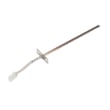
- Frigidaire range oven temperature sensor 316490000 (primary suspect for F3)
- Wiring/connector repair (burnt or loose terminals at the sensor plug)
- Oven control (less common; consider only after sensor and wiring test good)
Why it matters
The oven control relies on the sensor signal to regulate bake and broil temperatures. When the signal is missing or inaccurate, the range may shut down heating, overheat, or display F3 to prevent unsafe temperature operation.
Last updated: February 2026
How to manually light a Frigidaire gas oven?
On the Frigidaire FGGF3054MFG gas range, the oven uses an electric glow igniter to light the bake and broil burners; it normally is not designed for manual lighting. If the oven will not ignite, we focus on restoring the igniter and gas valve operation rather than trying to light the oven by hand (use the FGGF3054MFG installation guide and FGGF3054MFG owner's manual for the correct checks and operating steps).
What you can do safely right now
- Confirm the range has electrical power (the oven igniter needs power to glow and open the gas valve).
- Set Bake to 300°F and wait 30 to 60 seconds for ignition; a short delay is normal.
- Look for the igniter glow through the oven bottom openings; no glow usually points to an igniter or wiring issue.
- If you smell gas and it is not lighting, turn the oven OFF, ventilate the room, and stop troubleshooting until the gas clears.
- If the cooktop lights but the oven does not, the oven igniter circuit is the most common place to start.
How the oven ignition works (why manual lighting is different)
When you start Bake or Broil, current flows to the oven igniter, it glows like a light bulb, then the oven gas valve opens and the burner lights. This cycle repeats to hold temperature.
| What you observe | Most likely cause | What to check next |
|---|---|---|
| No igniter glow | Failed igniter, loose wire, control issue | Inspect connections; test igniter circuit |
| Igniter glows but no flame after 60 seconds | Weak igniter or gas valve issue | Replace igniter first in most cases |
| Flame lights, then cycles off/on | Normal operation | No repair needed |
Parts that commonly fix “won’t light” oven symptoms
If the oven is not igniting reliably, these model-matched parts are common fixes:
- Tappan range oven burner igniter 316489403 (bake ignition)
- Range oven igniter 5304506545 (broil ignition)
- Frigidaire range oven gas valve 316031501 (opens to feed gas when igniter is hot)
Why it matters
Trying to manually light an oven that is designed for electric ignition can create delayed ignition, flare-ups, or unburned gas buildup. Getting the igniter and valve system working correctly restores normal, predictable lighting and temperature control.
Last updated: February 2026