Owner’s manual
 Error Codes



Can I replace fridge parts myself?
Yes. On the GE DFE28JSKISS bottom-mount refrigerator, we can safely replace many user-accessible items ourselves (bins, shelves, some door hardware, filters, and basic cleaning-related parts). For electrical, wiring, or sealed-system repairs, we use a qualified service professional and follow the safety guidance in the DFE28JSKISS owner's manual.
- Water filter (then flush the system after replacement)
- Shelves, drawers, and door bins
- Door handles (if your handle design uses accessible set screws)
- Door gasket (if it is a press-in style and you can fully seat it)
- Air filter (if equipped)
- Ice bucket and dispenser trim pieces (cosmetic or snap-in parts)
- LED light replacement (this model uses LED lighting that requires an authorized technician)
- Power cord replacement (a damaged cord should be replaced by a qualified service professional)
- Control board, wiring, or internal electrical troubleshooting
- Sealed refrigerating system work (compressor, evaporator, condenser, refrigerant tubing)
- Unplug the refrigerator by gripping the plug (do not pull the cord)
- Use a properly grounded 3-prong outlet; do not use an adapter or extension cord
- Protect the power cord when moving the refrigerator away from the wall
- Tape shelves and drawers in place if you need to move the unit
- Keep the refrigerator upright during moving
| Task | Typical time | What to expect |
|---|---|---|
| Replace water filter | 5 to 15 min | Flush about 2 gallons of water through the dispenser afterward |
| Fix door seal issues | 20 to 60 min | Cleaning, warming, and reseating the gasket often restores sealing |
| Dispenser/ice chute cleaning | 30 to 90 min | Removing trim and clearing ice buildup can restore operation |
| Door alarm reset | 1 to 5 min | Usually a control setting or door-closure issue |
DIY-friendly repairs can restore cooling performance, reduce leaks and odors, and improve ice and water dispensing without the cost of a service call. Knowing which jobs are safe also helps prevent electrical shock hazards and avoid damage to the refrigerator.
- How to replace the water filter in a GE refrigerator
- How to reset the door alarm on a GE refrigerator
- How to disassemble the ice and water dispenser on a GE refrigerator
Last updated: February 2026
How do I find the right GE part number?
For your GE bottom-mount refrigerator model DFE28JSKISS, the right part number comes from matching the model number and the exact component location in the parts diagram; then confirm the part description and any revision notes in the DFE28JSKISS owner's manual before ordering.
- Confirm the model number on the rating label inside the fresh food compartment (or on the cabinet wall near the crisper area).
- Identify the system you are repairing (ice maker, water filter, dispenser, door, evaporator fan, etc.).
- Use the exploded-view diagram for DFE28JSKISS to locate the part by section and reference number.
- Match the part by name and location, not just by appearance.
- Cross-check for common “look-alike” parts (left vs. right door parts, upper vs. lower hinges, different shelf styles).
- Verify any maintenance or usage notes in the manual (for example, filter and water system guidance).
| Common mistake | What to do instead |
|---|---|
| Searching by “GE refrigerator” only | Always search by DFE28JSKISS first |
| Ordering by a photo match | Match the diagram position and part description |
| Mixing up door-side parts | Confirm left/right orientation with the door open |
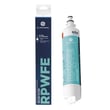
| Ignoring water filter compatibility | Confirm the filter model listed for your unit (often RPWFE on many GE units) and follow how to replace the water filter in a GE refrigerator |
GE refrigerators often use multiple versions of similar parts across close model families. Using the exact DFE28JSKISS model number and confirming the diagram callout prevents ordering a part that fits physically but does not mount, seal, or connect correctly.
Last updated: February 2026
How to find GE appliance parts?
For your GE DFE28JSKISS bottom-mount refrigerator, the fastest way to find the right replacement parts is to use the model number (DFE28JSKISS) and match parts by the exact section and description shown for your refrigerator; we also recommend confirming details in the DFE28JSKISS owner's manual.
When you search for parts, the model number is the key that filters out look-alike parts that do not fit.
- Use the full model number: DFE28JSKISS (letters and numbers must match exactly)
- Match the part by location (fresh food section, freezer drawer, dispenser area, rear machine compartment)
- Compare appearance and connections (wire plugs, water line fittings, mounting tabs)
- If your refrigerator has a label with additional codes, keep those handy for reference
- Confirm any special features (ice maker, water dispenser, door alarm) so you land in the right parts group
| What to check | Why it matters |
|---|---|
| Exact model number (DFE28JSKISS) | Ensures correct fit and compatibility |
| Part category (ice maker, water filter, door gasket, fan) | Narrows results to the right system |
| Symptoms (no ice, warm fridge, leaking water, door alarm) | Helps identify the most likely part |
| Visual match | Prevents ordering a similar-looking but incorrect part |
These are the most frequent “wear and tear” areas we see on GE bottom-freezer models like DFE28JSKISS:
- Refrigerator water filter and filter housing components
- Ice maker and dispenser components
- Door gasket and door alignment hardware
- Evaporator fan and airflow parts (cooling performance)
- Water inlet valve and water line fittings (leaks, no water)
Using the exact GE model number and cross-checking the part details prevents returns and downtime, especially for water system parts (filters, valves, dispenser components) where fittings and revisions can vary.
For related help while you troubleshoot, use GE refrigerator error codes to identify issues before ordering parts.
Last updated: February 2026
How to remove bottom grille on GE refrigerator?
On the GE DFE28JSKISS bottom-mount refrigerator, the bottom grille (base grille) typically comes off by removing any retaining screws (if present) and then pulling the grille straight out to release the tabs. Reinstall by aligning it and sliding it back into place.
- Unplug the refrigerator or switch off power at the breaker if you will reach near wiring.
- Open both fresh food doors for better access.
- Look along the top edge of the bottom grille for screws; remove them with a Phillips screwdriver if your unit uses them.
- Grip the grille near both ends and pull straight outward to pop the retaining tabs free.
- If it feels stuck, pull evenly from both sides; do not twist the grille.
- To reinstall, line up the tabs, slide the grille into position, then reinstall screws (if used).
| Bottom grille style | What holds it in | How it releases |
|---|---|---|
| Screw-retained | 2 to 4 Phillips screws | Remove screws, then pull out |
| Tab-retained | Plastic locking tabs/clips | Pull straight out to release tabs |
| Mixed | Tabs plus a couple screws | Remove screws first, then pull out |
We remove the bottom grille to access the condenser area for cleaning, to check for debris, and to reach components near the lower front of the cabinet. A grille that is not seated correctly can rattle or sit unevenly.
If you are also moving the refrigerator to clean behind it, raise the front leveling legs first and pull the unit straight out to avoid floor damage. For handling and care guidance, follow the DFE28JSKISS owner’s manual.
Last updated: February 2026
What does a GE model number tell me?
A GE model number identifies the refrigerator’s product family and key design details so we can match the correct parts and documentation. For GE bottom-mount models like DFE28JSKISS, the prefix helps indicate the style and depth category, and the full model number ties to the exact configuration.
Your GE model number is the best starting point for parts lookup and feature identification; the serial number is what you use to pinpoint the manufacturing date.
- Appliance type and series (for example, DFE is used on certain GE Profile bottom-freezer models)
- Depth category: GE documentation groups models that start with DFE as standard depth (SD)
- Configuration match for parts and diagrams (doors, dispenser, ice maker setup, controls)
- Correct manual and troubleshooting info for your exact platform
- Serial number: used to determine the manufacture date and can help with warranty timing
For label location on this model, GE places the model and serial label on the left side, near the middle of the refrigerator compartment (inside the fresh food section). See the DFE28JSKISS owner's manual for the exact label description and other identification tips.
This is a practical way to think about what you are seeing.
| Item | What it tells you | Example for this model |
|---|---|---|
| Model prefix | Product family/style grouping | DFE bottom-freezer platform |
| Depth grouping | Standard depth vs. counter depth grouping | DFE = standard depth (SD) |
| Full model number | Exact configuration for parts matching | DFE28JSKISS |
| Serial number | Manufacturing date code | Found on the same ID label |
Using the full model number prevents ordering the wrong door gasket, water filter, control board, or ice maker component for a similar-looking GE refrigerator.
- Match parts to the exact platform (DFE vs. other GE families)
- Avoid fit issues with doors, mullion/flipper, and dispenser trim
- Improve troubleshooting accuracy when checking error codes and symptoms
If you are troubleshooting alarms or controls while identifying your unit, use how to reset the door alarm on a GE refrigerator and GE refrigerator error codes.
Last updated: February 2026
What is the average life expectancy of a GE refrigerator?
Most GE refrigerators, including the GE DFE28JSKISS bottom-mount refrigerator, typically last 12 to 15 years with normal household use. Regular maintenance (clean airflow, good door sealing, and on-time filter changes) is what most often separates an average lifespan from a longer one.
A refrigerator’s life is mainly driven by compressor run time, heat removal, and how well the doors seal.
- 12 to 15 years: typical range for many modern refrigerators
- 10 years or less: more likely with dirty condenser coils, poor ventilation, or frequent door openings
- 15+ years: more common when temperatures are stable and maintenance is consistent
- Water and ice features can add wear if filters are ignored or water flow is restricted
Use these habits to reduce strain on the sealed system (compressor, condenser, evaporator) and keep temperatures steady.
- Keep the refrigerator level so doors close fully
- Clean dust from condenser coils and vents regularly
- Keep door gaskets clean and sealing tightly
- Avoid overpacking; leave space for air circulation
- Replace the water filter about every 6 months (or sooner if flow slows), as described in the DFE28JSKISS owner’s manual
| What you notice | What it usually means | What to do |
|---|---|---|
| Runs most of the day | Heat not leaving efficiently | Clean coils, improve airflow around cabinet |
| Frost buildup or warm spots | Airflow issue or door sealing issue | Check vents, inspect gasket seal |
| Weak water dispenser flow | Filter restriction or supply issue | Replace filter, verify water supply |
| Door alarm keeps sounding | Door not closing or misaligned | Check bins, gasket, hinges; see how to reset the door alarm on a GE refrigerator |
A refrigerator that runs longer to hold temperature wears the compressor and fans faster. Simple upkeep (especially airflow and sealing) reduces run time, helps food stay safer, and extends the practical life of your GE DFE28JSKISS.
Last updated: February 2026
What is the most common problem with GE Profile refrigerators?
The most common GE Profile refrigerator problems are ice maker and water dispenser issues, followed closely by temperature control complaints (warm fridge, warm freezer, or uneven cooling). On the GE DFE28JSKISS, these symptoms usually trace back to airflow/defrost problems, sensors, or electronic controls; use the DFE28JSKISS owner's manual to match symptoms to the correct checks.
- Ice maker not making ice or slow ice production: small cubes, hollow cubes, or no harvest
- Water dispenser problems: weak flow, sputtering, or no water
- Cooling issues: fresh food section warm, freezer OK (or the reverse)
- Frost buildup: heavy frost on the back wall or in the freezer
- Door alarm and door sealing complaints: alarm sounds even when doors seem closed
- Confirm temperatures: setpoint is not the same as actual temperature; give changes 24 hours.
- Check door sealing and alignment: look for gaps, torn gasket, or doors sitting uneven.
- Listen for the evaporator fan: a failed fan often causes warm spots and poor airflow.
- Inspect for frost patterns: heavy frost points to a defrost system or airflow restriction.
- For ice and water: replace the filter on schedule and purge air after filter changes.
| Symptom | Most likely area | What to check first |
|---|---|---|
| No ice, dispenser works | Ice maker system | Ice maker fill, freezer temp, ice bin jams |
| No water, ice also stops | Water supply path | Filter, supply valve, inlet valve function |
| Fridge warm, freezer cold | Airflow/evaporator | Evaporator fan, damper, frost buildup |
| Both sections warm | Sealed system or controls | Condenser airflow, compressor run, error codes |
Ice maker and cooling complaints often share the same root cause: temperature stability. If the freezer is even a few degrees too warm, ice production drops fast and food quality suffers.
- GE refrigerator error codes
- How to replace the water filter in a GE refrigerator
- How to reset the door alarm on a GE refrigerator
Last updated: February 2026
What's better, top mount or bottom mount fridge?
A bottom-mount refrigerator like the GE DFE28JSKISS is better when you want fresh-food items at eye level and a more ergonomic daily layout; a top-mount is better when you want a simpler design that’s often easier to service and typically costs less. The “better” choice depends on how you shop and use the doors and freezer.
| Feature | Top-mount (freezer on top) | Bottom-mount (freezer on bottom) |
|---|---|---|
| Everyday access | Freezer is easiest to reach | Refrigerator section is easiest to reach |
| Organization | Often fewer drawers/bins | Typically more drawers and better fresh-food organization |
| Ergonomics | More bending for fresh food | Less bending for fresh food |
| Freezer use | Great if you use freezer daily | Great if you use fresh food daily |
- You use the freezer more than the refrigerator
- You want a straightforward layout with fewer moving parts
- You prefer a lighter door feel and simpler storage
- You want a budget-friendly option in many lineups
- You want produce, drinks, and leftovers at comfortable reach
- You like pull-out freezer drawers for stacking and visibility
- You want easier access when loading groceries into the refrigerator section
- You prefer a layout that supports frequent fresh-food use
The “best” fridge style is the one that matches your habits. If you open the refrigerator door far more than the freezer, a bottom-mount reduces bending and makes daily use feel easier. If you rely heavily on frozen foods, a top-mount keeps that section at the most convenient height.
- Keep door seals clean and closing tightly to protect temperature stability
- Avoid overloading door bins; door loading can affect alignment over time
- If you have door-alarm issues on a GE unit, follow how to reset the door alarm on a GE refrigerator
- Use DFE28JSKISS owner’s manual for model-specific features, controls, and care guidance
Last updated: February 2026