Installation guide
 Owner’s manual
 Error Codes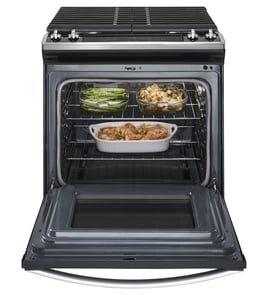




What kind of gas does a gas stove use?
The GE JGB735SP1SS gas range is shipped from the factory set up for natural gas. It can be converted to propane (LP) gas, but that conversion should be done by a qualified installer following the JGB735SP1SS installation guide.
What this means for your GE JGB735SP1SS
Most homes with a piped utility gas supply use natural gas; homes using a tank typically use propane. Your range can work with either fuel, but it must be set up for the correct one.
- Natural gas (NG): factory setting for JGB735SP1SS
- Propane (LP): requires a conversion (orifices and setup steps)
- Never mix parts/settings: wrong fuel setup can cause poor flames and unsafe operation
- Use the shut-off valve: know where the range gas shut-off valve is located
Quick comparison: natural gas vs propane
| Item | Natural gas (NG) | Propane (LP) |
|---|---|---|
| Typical home supply | Utility line | Storage tank |
| Range setup on delivery | Factory default | Must be converted |
| Normal flame look | Soft blue | Blue with some yellow tips |
If you are not sure what gas you have
Check these common clues before connecting or converting:
- You have a gas meter outside: usually natural gas
- You have a propane tank on the property: propane
- Your utility bill lists “natural gas”: natural gas
- Your installer can confirm inlet pressure and fuel type during hookup
Why it matters
Using the correct fuel type and conversion setup helps your burners ignite properly, keeps flames stable, and prevents soot, yellow flames, and performance problems.
Last updated: January 2026
What is the life expectancy of a GE gas stove?
A GE gas range like model JGB735SP1SS has a typical life expectancy of 13 to 15 years in normal household use. Regular cleaning, correct burner flame, and fixing ignition issues early help you reach that range and avoid premature failures.
What most affects lifespan on the JGB735SP1SS
- Burner cleanliness: clogged ports and spillovers strain ignition and combustion
- Ignition health: repeated clicking or delayed lighting wears components faster
- Oven soil and grease: heavy buildup increases smoke and heat stress during cooking and self-clean
- Ventilation and heat exposure: excess heat around the control area can shorten electronics life
- Gas setup and flame quality: steady flames and correct gas type reduce soot and overheating
For model-specific cleaning and operating guidance, use the JGB735SP1SS owner’s manual.
Common wear items vs. longer-life components
| Area | Typical wear items | What you may notice | What to do first |
|---|---|---|---|
| Cooktop ignition | spark module, electrodes | constant clicking, weak/no spark | clean and dry burner parts, check electrode area |
| Oven ignition | oven burner igniter | oven won’t heat or heats very slowly | schedule diagnosis; igniter is a common fix |
| User controls | knobs, switches, control board | erratic temps, unresponsive keys | verify settings, then test components |
| Burner hardware | burner caps, burner heads | uneven flame, delayed lighting | clean ports, reseat caps correctly |
Maintenance that helps you hit 13 to 15 years
- Clean burner caps and heads regularly; keep ports clear and parts seated correctly
- Wipe up boilovers promptly so residue does not bake on
- Match cookware size to the burner so flames do not wrap up the sides
- Use self-clean only as needed; remove heavy grease first to reduce smoke and stress
- Replace failed wear parts instead of repeatedly attempting ignition
Parts that are often replaced during ownership
- Range oven burner igniter WB13X40206 (helps the oven burner light)
- Range spark module WB13X24741 (creates spark for surface burner ignition)
Why it matters
Knowing the expected lifespan helps you decide whether a repair makes sense. If your JGB735SP1SS is approaching 13 to 15 years and needs multiple major repairs, comparing repair cost versus replacement is usually the best next step.
Last updated: January 2026
What are common problems with GE ranges?
Common problems we see on the GE JGB735SP1SS gas range include surface burners that won’t light or heat evenly, oven bake or broil not igniting, oven temperature complaints, and control/display issues such as “LOC ON” or error codes. Many fixes start with cleaning, settings checks, and basic ignition troubleshooting.
Most common symptoms on JGB735SP1SS (and what they often mean)
- Surface burner won’t light or keeps clicking: wet/dirty burner parts, clogged ports, dirty electrode, or a spark issue
- Burner flame is uneven: burner cap not seated correctly, wrong cap on the burner, or ports clogged
- Oven won’t heat (bake or broil): igniter not lighting the burner, oven gas shut-off not open, or a control/sensor issue
- Oven temperature seems off: cookware/rack position differences, normal performance differences vs. older ranges, or temperature offset setting
- Display shows “LOC ON” or keys don’t respond: control lockout enabled or a power interruption
Quick checks we recommend first (safe, no tools)
- Confirm the range is plugged into a working outlet; ignition and controls need power.
- Make sure burner caps are fully seated and matched to the correct burner.
- Clean and dry burner caps/heads; keep the electrode area free of residue.
- If surface burners work but bake/broil do not, verify the oven gas shut-off lever on the regulator is open.
- Use the troubleshooting charts in the JGB735SP1SS owner’s manual to match your symptom to the right next step.
Parts that commonly solve these problems (when testing confirms failure)
| Symptom | What commonly fails | Example part for this model |
|---|---|---|
| Oven won’t heat or is slow to ignite | Oven burner igniter | Range oven burner igniter WB13X40206 |
| Oven temperature inaccurate | Oven temperature sensor | Range oven temperature sensor WB20K10027 |
| Burners keep clicking or won’t spark reliably | Spark module | Range spark module WB13X24741 |
Why it matters
Ignition and temperature-control problems can cause poor cooking results and can create unsafe conditions if gas doesn’t ignite properly. Starting with cleaning, correct burner assembly, and the manual’s troubleshooting steps helps you avoid replacing the wrong part.
Last updated: January 2026