Owner’s manual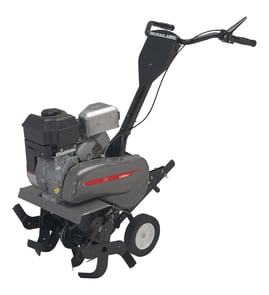



Which is better, a front tine or rear tine tiller?
A front-tine tiller like the Yard Machines 21A-24MK020 is better for maintaining established garden beds and working in tighter spaces. A rear-tine tiller is better for larger areas, tougher soil, and breaking new ground because it typically has more traction and digging power.
Quick comparison
| Feature | Front-tine tiller (like 21A-24MK020) | Rear-tine tiller |
|---|---|---|
| Best for | Existing gardens, seasonal soil mixing | New ground, compacted soil, larger plots |
| Handling | Lighter, easier to maneuver | Heavier, steadier under load |
| Digging feel | Can “pull” forward in hard soil | Tracks drive the machine; tines bite more consistently |
| Typical cost and upkeep | Usually lower | Usually higher |
Choose a front-tine tiller when you want
- Easier turning and control in smaller gardens
- Lighter machine for transport and storage
- Mixing compost, fertilizer, and amendments into already-loose soil
- A simpler setup for routine spring and fall tilling
For operating and safety basics (starting controls, choke/primer, and pre-operation checks), follow the owner's manual.
Choose a rear-tine tiller when you need
- To break sod or hard-packed soil for a new garden
- More consistent depth control in heavy clay or rocky ground
- Better traction and stability on longer passes
- Less operator effort when the soil fights back
Why it matters
Matching the tiller style to your soil and garden size saves time and reduces wear on key drive and tine components. In hard soil, a machine that is underpowered for the job can strain the clutch, belt/pulley system, and tine assemblies.
Last updated: February 2026
What tiller is made in the USA?
Some tillers are made in the USA, but it depends on the brand and the specific model. For your Yard Machines 21A-24MK020 front-tine tiller, the best place to confirm country-of-origin details and product labeling guidance is the owner's manual.
What we can say for the 21A-24MK020
The documentation for this model shows it was printed in the USA, which is not the same as the tiller being manufactured in the USA. Use the identification labels on the tiller (and the manual’s model and serial number section) to confirm the exact origin for your unit.
Quick checks to confirm where a tiller is made
- Look for a “Made in …” statement on the engine shroud, frame tag, or handlebar label
- Check the model and serial number tag and any nearby compliance markings
- Review the packaging or original paperwork if you still have it
- If the tiller has a separate engine model, check the engine’s ID plate as well
- Match what you find to the model identification info in the owner's manual
Why this matters
“Made in the USA” claims are model-specific and sometimes component-specific (tiller vs. engine). Verifying the label on your exact unit helps you avoid confusion when ordering parts like tine assemblies, pulleys, and hardware.
Common outcomes (what you may find)
| What the label says | What it usually means |
|---|---|
| Made in USA | Final assembly and manufacturing meet the claim for that product |
| Assembled in USA | Assembly occurred in the USA; parts may be sourced globally |
| No origin statement | Origin may be listed only on a tag, carton, or separate engine label |
Last updated: February 2026
What are the benefits of a front tine tiller?
A front-tine tiller like the Yard Machines 21A-24MK020 is built for easy handling in typical home gardens; it’s lighter and more compact than many rear-tine designs, so it’s simpler to maneuver, transport, and store while still breaking up soil for planting.
Key benefits for most home gardeners
- Easier to maneuver in tighter spaces like raised beds, small plots, and around landscaping.
- Lighter weight makes it simpler to load, unload, and reposition.
- More compact storage footprint in a shed or garage.
- Good for routine soil prep such as loosening topsoil and mixing in compost.
- Simpler controls on many models, which helps new operators build confidence.
What you can expect it to do best (and where it struggles)
Front-tine tillers are a strong fit for maintained garden soil and seasonal prep. They can struggle more in hard-packed ground, heavy clay, or areas with lots of roots.
| Task | Front-tine tiller performance | Tip for better results |
|---|---|---|
| Loosening existing garden soil | Very good | Make 2 passes at a slower pace |
| Mixing compost or amendments | Very good | Till shallow first, then slightly deeper |
| Breaking new ground (sod, compacted soil) | Fair | Pre-water soil and do multiple shallow passes |
| Working around obstacles | Very good | Keep the tine area clear of debris |
Why it matters
Choosing a front-tine tiller is usually about control and convenience. For many yards, the ability to steer easily and store the machine without hassle means you use it more often and keep beds healthier.
Safety and upkeep reminders we recommend
The operator guidance for this model emphasizes safe operation and basic engine care. Use the owner's manual to review controls (choke, primer, fuel cap, oil fill) and safe starting and adjustment practices.
- Clear the area of sticks, stones, and wire before tilling.
- Wear sturdy, rough-soled shoes; avoid loose clothing.
- Disengage clutch controls before starting.
- Never adjust the machine while the engine is running (except as the manual directs).
- Keep the air filter installed; running without it causes rapid engine wear.
Last updated: February 2026