Owner’s manual
 Error Codes


Where is the model number on a Kenmore side by side refrigerator?
On Kenmore side-by-side refrigerator model 25353723300, the model number is printed on the serial plate located inside the refrigerator (fresh food) compartment. Use that label to record both the model and serial number for parts lookup and service reference; see the owner's manual.
Where to look (fast checklist)
- Open the fresh food (refrigerator) door, not the freezer door
- Look along the inside walls of the refrigerator compartment
- Check near the upper area of the compartment where labels are commonly placed
- Find the serial plate and read the line that starts with Model Number
- Write down the full model number exactly as shown (for this unit, it begins with 253)
What you will see on the label
The serial plate typically includes both identifiers. Use this quick guide:
| Item on label | What it’s used for | Example for this unit |
|---|---|---|
| Model number | Ordering the correct parts and matching diagrams | 25353723300 |
| Serial number | Production details and service identification | Varies by unit |
Why it matters
We use the model number to match your refrigerator to the correct Kenmore parts list (gaskets, water filter, ice maker parts, controls). Even small model-number differences can change which parts fit.
Last updated: February 2026
What's the size of a side-by-side refrigerator?
Most side-by-side refrigerators are about 30 to 36 inches wide, 67 to 70 inches tall, and 29 to 35 inches deep; your Kenmore 25353723300 will fall in that general range, but the exact cabinet and door-swing dimensions are best confirmed in the owner's manual.
Typical side-by-side size ranges
These ranges cover the majority of Kenmore and similar side-by-side refrigerator designs:
- Width: 30 to 36 inches
- Height: 67 to 70 inches
- Depth (cabinet): 29 to 35 inches
- Depth with doors/handles: often a few inches deeper than cabinet depth
- Required clearance: space around the cabinet for airflow and hookups
Installation clearances to plan for (important)
Even if the refrigerator fits the opening, you still need clearance for ventilation and connections. For this model family, the Use & Care Guide calls out these minimum clearances:
| Clearance location | Typical minimum clearance |
|---|---|
| Sides and top | 3/8 inch |
| Back | 1 inch |
How to measure your space correctly
Use a tape measure and check these points before ordering a replacement refrigerator or moving the unit:
- Measure width at the front and back of the opening (walls are not always square).
- Measure height to the lowest overhead cabinet or trim.
- Measure depth from the back wall to the front edge of counters.
- Confirm door opening space so both doors can fully open (needed for drawers and baskets).
- Plan for water line space if you use an ice maker or water dispenser.
Why it matters
Correct sizing prevents poor airflow (warm temperatures), doors that cannot open fully, and crushed water lines. Leaving the right clearance also makes service access easier for parts like the refrigerator water inlet valve assembly 242252702 or a water filter.
Last updated: February 2026
Where is the water filter on a Kenmore side by side refrigerator?
On Kenmore model 25353723300, the water filter is located inside the fresh food (refrigerator) compartment, in the upper right front corner. Open the filter housing/cover to access the cartridge; you do not need to shut off the water supply to change it.
How to find it quickly
- Open the refrigerator (fresh food) door, not the freezer door
- Look at the top front area on the right-hand side
- Find the filter housing in the upper right corner
- Open the housing cover/door to expose the cartridge
- Avoid dispensing ice or water while you are installing or removing the filter
What to expect when you replace the filter
Most side-by-side Kenmore units like this use a twist-in or push-in cartridge in the housing. After replacement, you typically need to flush air and carbon fines by dispensing water for a short period (follow the steps in the owner's manual).
| Item | What it means for you |
|---|---|
| Filter location | Upper right front corner of fresh food compartment |
| Water shutoff needed | No (but do not dispense during the swap) |
| Typical change interval | Every 6 to 9 months |
| Status light trigger (if equipped) | Often turns red after about 400 gallons |
Which replacement filter fits
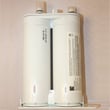
For this model’s Kenmore ice and water front filter setup, the matching replacement cartridge is commonly listed as 46 9911. On our parts list, that corresponds to the genuine Kenmore refrigerator water filter WF2CB.
Why it matters
A correctly located and properly seated water filter helps prevent slow water flow, weak ice production, and off-taste or odor in drinking water. Replacing it on schedule also reduces strain on the water inlet valve and dispenser system.
Last updated: February 2026
How to tell cubic feet of Kenmore refrigerator by model number?
For Kenmore model 25353723300, the model number by itself usually does not directly state the exact cubic-foot capacity. The most reliable way is to check the capacity/specifications section in the owner's manual, or calculate capacity from the interior compartment measurements.
Fast ways to find the cubic feet
- Check the manual specs: Look for “capacity” or “cubic feet” in the specifications section of the owner's manual.
- Look for the serial plate: The manual notes the model/serial plate is inside the refrigerator compartment; that label sometimes lists capacity or a related spec.
- Measure and calculate: Measure the usable interior space and convert cubic inches to cubic feet.
- Use the product type as a clue: Side-by-side refrigerators commonly fall in the 20 to 26 cu. ft. range, but the exact number varies by configuration.
How to calculate cubic feet (measurement method)
- Empty the section you are measuring (fresh food and freezer are usually calculated separately).
- Measure height x width x depth (in inches) of the usable interior space.
- Multiply to get cubic inches.
- Divide by 1,728 to convert to cubic feet.
Quick conversion table
| What you have | What to do | Result |
|---|---|---|
| Interior measurements in inches | H x W x D | Cubic inches |
| Cubic inches | Divide by 1,728 | Cubic feet |
Tips so your calculation is realistic
- Measure usable space, not the outside cabinet size.
- Exclude areas blocked by the ice maker housing, air ducts, or fixed interior panels.
- If you want “total capacity,” add fresh food + freezer results.
Why it matters
Knowing cubic feet helps us match the right refrigerator parts and accessories (like shelves, bins, and filtration items) and helps you compare storage capacity accurately when planning kitchen space.
Last updated: February 2026
Why is my Kenmore side by side icemaker not working?
If your Kenmore 25353723300 side-by-side refrigerator ice maker isn’t making ice, the most common causes are the ice maker being switched OFF (wire signal arm up), the household water valve being closed or restricted, or the freezer not being cold enough. We use the checks below to pinpoint the exact failure.
Quick checks first (most common fixes)
- Make sure the ice maker wire signal arm is down (ON).
- Confirm the freezer door closes fully and seals tightly.
- Verify the household water supply valve is fully open.
- Check whether the water dispenser flow is normal; slow or no flow points to a supply or filter restriction.
- Make sure the freezer is cold enough to freeze water (target 0°F).
Step-by-step troubleshooting
Confirm freezer temperature
- Set the freezer to about 0°F and give it time to stabilize.
- If the freezer is warm, the ice maker will not cycle.
Check water supply and filter restriction
- If the dispenser is slow or not dispensing, the manual points to a clogged ice and water filter cartridge.
- Replace the filter with genuine Kenmore refrigerator water filter WF2CB.
Look for a restricted saddle valve (common plumbing issue)
- Self-piercing saddle valves can clog and restrict flow.
- If you suspect restriction, correct the water supply setup before replacing ice maker parts.
Inspect for ice jams and clumps
- Dump the bin and break up clumped cubes.
- If cubes are hollow or small, that typically indicates low water flow (often filter or valve related).
What “normal” ice production looks like
| Ice maker condition | Typical output | What it suggests |
|---|---|---|
| Normal operation | ~4 to 5 lb per 24 hours | System is working normally |
| “Extra Ice” feature (if equipped) | Up to ~8 lb per 24 hours | Higher demand mode |
| Low output | Less than expected | Freezer too warm or water flow restricted |
Parts that commonly solve “no ice” on this model
- Genuine Kenmore refrigerator water filter WF2CB (clogged filter restricts flow)
- Refrigerator water inlet valve assembly 242252702 (valve not opening or restricted)
- Ice maker mold 241798231 (ice maker assembly issues)
Why it matters
An ice maker needs two things to work: cold enough freezer temperature and steady water flow. A warm freezer or restricted water supply can stop ice production completely and can also cause small or hollow cubes.
For model-specific operating details and the exact troubleshooting chart, follow the owner's manual.
Last updated: February 2026