Installation guide
 Owner’s manual
 Error Codes


What size gas line for a Frigidaire gas stove?
For the Frigidaire FFGF3011LWJ gas range, we use a 1/2-inch or 3/4-inch inside-diameter (I.D.) gas supply line. For a flexible connector, a new CSA-certified flexible metal appliance conduit is typically used in a 4 to 5 foot length; see the installation guide for the exact connection requirements.
Most installations for this model use these common sizes:
- Gas supply line: 1/2-inch or 3/4-inch I.D.
- Flexible connector: 1/2-inch NPT x 3/4-inch or 1/2-inch I.D. (CSA design certified)
- Connector length: 4 to 5 feet (recommended for new installs and reinstalls)
- Shut-off valve: external manual gas shut-off valve in an accessible location
- Sealant: pipe joint sealant rated for LP/Propane gas (used on male pipe threads)
| What you are choosing | Typical spec for FFGF3011LWJ | Notes |
|---|---|---|
| House gas supply line | 1/2-inch or 3/4-inch I.D. | Either size is acceptable for supply to the range |
| Flexible range connector | 1/2-inch NPT x 3/4-inch or 1/2-inch I.D. | Use a new CSA-certified connector |
| Connector length | 4 to 5 feet | Helps you pull the range out for service |
Correct gas line sizing helps your Frigidaire range maintain proper burner flame and oven heat. An undersized or kinked connector can restrict gas flow, leading to weak flames, slow preheat, or ignition problems.
- Use pipe joint sealant on all male (outside) pipe threads to help prevent leaks.
- Keep the pressure regulator connected in series with the gas supply line.
- Make sure the shut-off valve is accessible so you can quickly turn gas off for service.
Last updated: February 2026
What does F11 mean on a gas stove?
On a Frigidaire FFGF3011LWJ gas range, an F11 (or any “F-code”) means the oven control detected a fault condition. We clear it by stopping the beeping, then retrying Bake or Broil; if it returns, the issue is typically in the control circuit (keypad/control board) or a related wiring/temperature input.
- Press Clear/Off to stop the beeping and clear the code.
- Try Bake or Broil again.
- If the code returns, turn power off to the range (breaker or unplug), wait 5 minutes, restore power, and set the clock.
- Retry Bake/Broil.
- If the code repeats, record F11 and when it happens (right away, after preheat, when pressing a specific pad).
These steps match the “Before You Call” guidance in the FFGF3011LWJ owner’s manual.
F11 is most often triggered by a problem the control interprets as an input or control failure. Typical causes include:
- Stuck or shorted keypad input (some models integrate this with the overlay)
- Failing oven control board
- Loose, pinched, or damaged wire harness connections at the control
- Temperature feedback issues (less common, but can contribute)
| Symptom with F11 | Most likely area | Example part for FFGF3011LWJ |
|---|---|---|
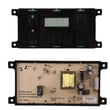
| Beeps immediately, random beeping | Keypad/overlay or control | Range oven control overlay 316220728 |
| F11 after using oven, intermittent | Control board or wiring | (inspect connectors and harness) |
| Erratic temps plus F-code | Sensor circuit | Range oven temperature sensor 316233903 |
When the control detects an internal fault, it can disable heating for safety and to prevent runaway temperatures. Clearing the code without fixing the cause usually leads to repeat errors and unreliable baking or broiling.
- You smell gas, see sparking where it should not, or the breaker trips repeatedly.
- The code returns immediately after the 5-minute power reset.
- You find heat-damaged wiring or melted connectors behind the control panel.
Last updated: February 2026
How long should a Frigidaire gas stove last?
A Frigidaire gas range like model FFGF3011LWJ typically lasts 13 to 15 years with normal household use. With consistent care and timely repairs (especially ignition and temperature-control issues), many gas ranges run closer to 15 to 20 years.
Most gas ranges wear based on heat exposure, cleaning habits, and how often the oven and surface burners are used.
- Average expected life: 13 to 15 years
- Often achievable with good maintenance: 15 to 20 years
- Biggest life-shorteners: heavy spills left to bake on, blocked burner ports, and delayed repairs
- Most common “end-of-life” symptoms: weak oven ignition, uneven baking, gas odor, repeated control problems
On the FFGF3011LWJ, these are common service parts that can restore normal heating and performance instead of replacing the whole appliance:
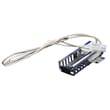
- Range oven igniter 5304509706 (fixes slow or no oven ignition)
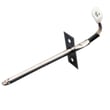
- Range oven temperature sensor 316233903 (helps correct inaccurate oven temperatures)
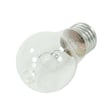
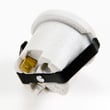
- Appliance light bulb, 40-watt 316538904 and range light socket 316116400 (restores oven light)
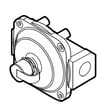
- Range pressure regulator 5304521339 (supports proper gas pressure regulation)
| If your range has this issue | Most likely fix | Typical outcome |
|---|---|---|
| Oven takes a long time to light | Igniter replacement | Restores reliable baking heat |
| Oven temperature is off | Temperature sensor check/replace | Improves baking accuracy |
| Burner flames look weak/uneven | Cleaning and gas supply checks | Better cooking performance |
We recommend following the cleaning and care routines in the owner's manual. These habits make the biggest difference:
- Keep burner caps and ports clean and dry
- Wipe up oven spills promptly (after the range cools)
- Avoid lining the oven bottom with foil (it can disrupt heat and airflow)
- Confirm racks are seated correctly and not warped
- Address ignition delays early to prevent secondary damage
A gas range often stays in service longer when you handle small problems early. Replacing an igniter, sensor, or regulator can restore safe, consistent heating and delay the cost and hassle of replacing the entire range.
Last updated: February 2026
How do I reset a Frigidaire gas range?
To reset your Frigidaire FFGF3011LWJ gas range, power-cycle it: turn the range OFF, then switch OFF the circuit breaker (or unplug the cord) for about 1 minute, restore power, and set the clock. This clears many control glitches and some error conditions.
- Turn all surface burner knobs to OFF.
- Turn the oven control OFF/Cancel (if applicable).
- Switch the range’s circuit breaker OFF (or unplug the range).
- Wait 60 seconds.
- Restore power; set the clock and test Bake and a surface burner.
If you recently installed or moved the range, follow the startup checks in the installation guide.
A reset will not fix ignition or temperature issues. Use these checks instead:
- Surface burners: Each burner should light within about 4 seconds when the knob is turned to LITE. If it does not, check for clogged burner ports, moisture, or a weak spark.
- Oven bake ignition: When set to Bake (example: 300°F), the oven burner should ignite within about 60 seconds. If it does not, the igniter is a top suspect.
- Flame quality: A steady flame with a sharp blue cone indicates proper air adjustment; yellow flames usually need more air at the shutter.
| Symptom | Most likely area | Example part on this model page |
|---|---|---|
| Oven will not ignite, no bake heat | Ignition system | Range oven igniter 5304509706 |
| Oven temperature seems off | Temperature sensing | Range oven temperature sensor 316233903 |
| Weak/incorrect gas flow symptoms | Gas regulation/valve | Range pressure regulator 5304521339 |
Power-cycling resets the electronic control and restores normal operation after a brief power surge or control lockup. If ignition timing or flame quality is the real issue, focusing on the igniter, sensor, or gas/air setup gets you to a lasting fix.
Last updated: February 2026