Owner’s manual
 Error Codes



How to remove bottom grille on GE refrigerator?
On the GE GFE28GSKESS bottom-mount refrigerator, the bottom grille (base grille/toe grille) typically comes off by removing any retaining screws and then pulling the grille straight out to release the clips. Reinstall by aligning it and sliding it back into place.
- Unplug the refrigerator or switch off power at the breaker if you will be working near wiring.
- If you need more room, raise the front leveling legs slightly before pulling the unit forward.
- Protect the floor; pull the refrigerator straight out (not sideways) to avoid damage.
- Keep track of screws so the grille sits flush when reinstalled.
- Look along the top edge or ends of the grille for screws.
- If screws are present, remove them with a Phillips screwdriver.
- Grip the grille at both ends.
- Pull the grille straight toward you to pop it free from the retaining clips.
- If it resists, pull evenly from both sides; do not twist hard (plastic tabs can crack).
- Line up the grille with the mounting slots/clips.
- Slide or press it into place until it seats evenly.
- Reinstall the screws (if used) and snug them down.
| What you see | Most likely cause | What we do |
|---|---|---|
| Grille moves but will not release | Hidden screws still installed | Recheck both ends and the top edge for screws |
| One side pops free, other side stuck | Clip/tab binding | Pull straight out while supporting the stuck side |
| Grille removed but will not sit flush | Misaligned tabs or missing screws | Reseat tabs first, then reinstall screws |
We remove the bottom grille to access the condenser area for cleaning, leveling-leg adjustments, and some service checks. A properly seated grille helps protect components and keeps airflow where it belongs.
For model-specific handling and safety notes, use the GFE28GSKESS owner's manual. For ordering replacement parts by model number, use Sears PartsDirect.
Last updated: February 2026
What is the most common problem with a GE refrigerator?
The most common issue we see with GE refrigerators like model GFE28GSKESS is inadequate cooling (fresh food too warm, freezer not holding temperature). In most cases, the root cause is restricted airflow or heat not being released properly, which makes the compressor run longer.
- Dirty condenser coils: dust buildup reduces heat transfer and raises cabinet temperatures.
- Blocked air vents: overpacked shelves can block return vents and stop circulation.
- Evaporator fan problem: weak or failed fan reduces cold-air movement to the refrigerator section.
- Defrost system issue: frost buildup on the evaporator restricts airflow.
- Door not sealing: warm air leaks in and creates temperature swings.
- Set temperatures to normal (avoid the coldest setting while troubleshooting).
- Make sure vents inside the refrigerator and freezer are not covered.
- Clean the condenser area (unplug first).
- Confirm both doors close fully and the gaskets are clean and making full contact.
- If the door alarm keeps sounding, reset it and confirm the doors are shutting correctly using how to reset the door alarm on a GE refrigerator.
| Symptom | Most likely direction | What to do next |
|---|---|---|
| Fridge warm, freezer OK | Airflow issue to fresh food section | Check vents, evaporator fan, frost buildup |
| Both sections warm | Heat rejection or compressor not running right | Clean coils, check condenser fan (if equipped) |
| Frost on back wall/freezer panel | Defrost problem | Defrost check and airflow inspection |
| Door alarm, moisture, or sweating | Door not sealing or door alignment | Inspect gasket, level unit, align doors |
Cooling problems are the most common because a refrigerator depends on steady airflow and clean heat-transfer surfaces. When airflow is restricted or coils are dirty, temperatures rise, food spoils faster, and the sealed system has to work harder.
For control settings, alarm behavior, and care and cleaning guidance specific to GE GFE28GSKESS, use the GFE28GSKESS owner's manual. You can also look up replacement parts by model number on Sears PartsDirect.
Last updated: February 2026
What is the average lifespan of GFE28GSKESS?
A GE bottom-mount refrigerator like model GFE28GSKESS typically lasts 13 years with normal household use. Consistent cleaning, correct temperature settings, and on-time water filter changes help you reach that lifespan and avoid premature compressor or fan wear.
Most full-size refrigerators fall into a predictable range; how hard the unit works day to day is what moves you up or down.
- Typical range: 10 to 15 years
- Average expectation: 13 years
- Biggest lifespan drivers: kitchen temperature, door-opening frequency, condenser cleanliness, and airflow
- Water system care: replace the filter on schedule to protect the dispenser and ice maker
- Temperature targets: keep fresh food near 37°F and freezer near 0°F (common recommended settings)
Use these habits to reduce compressor run time and prevent cooling problems.
- Keep vents inside the fresh-food section unblocked for steady airflow
- Clean dust from the condenser area regularly (more often with pets)
- Confirm door gaskets seal tightly; replace if torn or warped
- Set stable temperatures and avoid frequent large adjustments
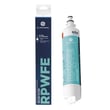
- Replace the water filter as directed; many GE systems use RPWFE cartridges
| Component | Common service life | What you notice when it’s failing |
|---|---|---|
| Compressor (sealed system) | 10 to 15 years | Warm temps, long run times, clicking, poor cooling |
| Evaporator/condenser fan | 5 to 10 years | Noise, warm fridge, frost or uneven temps |
| Ice maker/dispenser parts | 3 to 7 years | No ice, small cubes, leaks, slow fill |
| Door gaskets | 5 to 10 years | Moisture, frost, warm spots near doors |
Knowing the expected lifespan helps you decide whether to maintain, repair, or plan for replacement. For GFE28GSKESS, routine maintenance often prevents the most expensive failures (cooling system strain and airflow issues).
For model-specific care intervals, temperature guidance, and filter instructions, use the [GFE28GSKESS owner's manual].
Last updated: March 2026