Installation guide
 Owner’s manual


Where is my dryer part number?
On your Whirlpool dryer model LEQ8000JQ4, the information you need is on the model and serial number label, located at the top inside the dryer door well. Use that model number and serial number to match the correct replacement part for your exact dryer.
How to find the label quickly
- Open the dryer door fully.
- Look along the inside door opening (the door well).
- Check the top edge of that opening for a sticker or metal tag.
- Write down the complete model number (LEQ8000JQ4) and the serial number.
- Keep the numbers with your paperwork for future repairs.
What to do with the numbers
Once you have the model and serial number, you can confidently choose parts that fit your dryer’s configuration (for example, electric heat and the correct drum size).
| What you find | What it’s used for | Example |
|---|---|---|
| Model number | Ensures parts fit your exact dryer design | LEQ8000JQ4 |
| Serial number | Helps identify production details when needed | Varies by unit |
| Part number (on the part) | Identifies the specific component to replace | Printed on the old part |
Why it matters
Many Whirlpool dryers look similar, but small design changes affect fit and wiring. Using the model/serial label prevents ordering the wrong item and helps you pick the right repair parts the first time.
Common examples of “part numbers” customers mean
- The dryer’s model number (used to look up diagrams and compatible parts): see the LEQ8000JQ4 owner’s manual.
- A number printed on the failed part (used to confirm the exact component).
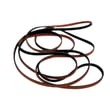
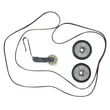
- A Sears PartsDirect part ID (used to order the part online), such as the dryer drum belt 341241 if your drum won’t turn.
Last updated: February 2026
What are the common problems with whirlpool dryers?
Common Whirlpool dryer problems (including model LEQ8000JQ4) are: the dryer will not start, the drum turns but there is no heat, the dryer will not tumble, and loud thumping or vibration. Most issues trace back to power supply, door/Start/cycle settings, airflow restrictions, or worn drive components; see the LEQ8000JQ4 owner's manual troubleshooting section for model-specific checks.
Most common symptoms and what they usually mean
- Dryer will not run: door not fully closed, Start not pressed, cycle not selected, or a tripped breaker/blown fuse
- No heat (drum may still turn): one of the two 240V fuses/breakers is open, or a heat safety device opened due to overheating
- Not spinning/tumbling: worn or broken belt, idler pulley issue, or motor problem
- Unusual sounds or vibration: items caught at drum edge, load balled up, or dryer not level (legs not set)
- Long dry times: restricted venting or lint buildup reducing airflow
Quick checks we recommend first (fast, no parts)
- Confirm the dryer has the correct 240V power supply (electric dryers need 240V).
- Reset both household fuses/breakers; electric dryers typically use two.
- Close the door firmly; verify the door switch clicks.
- Select a cycle and press Start firmly; move the dial past OFF (Wrinkle Guard position can prevent starting).
- Check venting and lint screen for blockage; clean lint from the exhaust path.
Parts that commonly fix these problems on LEQ8000JQ4
| Symptom | Common cause | Example part for this model |
|---|---|---|
| Won’t tumble | Broken/worn belt | Dryer drum belt 341241 |
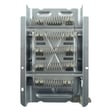
| No heat | Failed heating circuit component | Dryer element 279838 |
| Won’t start when door closes | Door switch not closing | Dryer door switch WP3406107 |
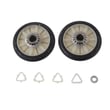
| Squealing, rumbling, poor tumbling | Worn rollers/idler/belt wear items | Dryer repair kit 4392065 |
Why it matters
A dryer that will not heat or takes too long to dry often points to an airflow or overheating condition. Fixing venting and replacing worn parts helps drying performance, reduces nuisance shutdowns, and prevents repeat failures of thermal safety parts.
Last updated: February 2026
What's the average lifespan of a whirlpool dryer?
A Whirlpool dryer typically lasts 10 to 13 years with normal household use. For your Whirlpool LEQ8000JQ4, consistent airflow (good venting), routine cleaning, and avoiding overloads are the biggest factors that help you reach the high end of that range.
What affects dryer lifespan the most
- Vent airflow: long or kinked venting makes the dryer run hotter and longer
- Lint control: a clogged lint screen or internal lint buildup strains the blower and heater
- Load size: chronic overloading wears the drum belt, idler pulley, and motor faster
- Heat stress: restricted exhaust can overheat safety devices (thermal cut-off, high-limit thermostat)
- Electrical health: loose connections can cause intermittent heat or cycling issues
Maintenance that extends life (high impact)
Use these habits as your baseline, then follow any model-specific guidance in the LEQ8000JQ4 owner’s manual.
- Clean the lint screen every load
- Check the outside exhaust hood for strong airflow
- Keep venting rigid metal when possible and minimize 90° turns
- Avoid crushing the vent when pushing the dryer back
- Once or twice per year, clean lint from the vent run and the dryer interior (unplug first)
Venting choices and why they matter
Poor venting is one of the fastest ways to shorten dryer life because it increases run time and heat.
| Vent setup choice | Typical result | Lifespan impact |
|---|---|---|
| Rigid metal vent, short run | Best airflow, shortest dry times | Best |
| Flexible metal vent, fully extended | Acceptable if accessible for cleaning | Good |
| Kinked, sagging, or long vent run | Slow drying, hotter operation | Worst |
When a “worn” dryer is really just a fixable part
If the dryer still runs but performance is slipping, these common wear items often restore normal operation:
- Dryer drum belt 341241 (drum won’t turn or slips)
- Dryer idler pulley WP691366 (squealing, belt tension issues)
- Dryer thermal cut-off fuse kit 279816 (no heat after overheating event)
- Dryer element 279838 (no heat or weak heat)
Why it matters
A dryer that takes longer to dry is not just inconvenient; it usually indicates restricted airflow or a heating/drive issue that increases heat stress and energy use. Fixing the root cause early helps protect the motor, heater box, and safety thermostats.
Last updated: February 2026
What does F4 E4 mean on a Whirlpool dryer?
On Whirlpool dryers, F4 E4 is an electronic diagnostic code used on certain control platforms; it is not a standard code set for the Whirlpool LEQ8000JQ4. For LEQ8000JQ4, we use the troubleshooting and diagnostics listed in the LEQ8000JQ4 owner’s manual to match the exact code and the correct fix.
How to handle the code on LEQ8000JQ4
Start by confirming you are reading the display correctly and that the dryer is actually showing F4 E4 (some displays make letters and numbers look similar).
- Unplug the dryer for 1 minute, then restore power and try a timed heated cycle.
- Recheck the code format shown (for example, “F4E4” vs “F-4” style codes).
- Confirm the model number on the door opening or cabinet label is LEQ8000JQ4.
- If the dryer runs but does not heat, focus on airflow and heating circuit checks.
- If the dryer will not start, focus on door switch and control inputs.
Most common issues that get mistaken for “voltage” or “control” codes
Even when a code is unclear, these are the highest-frequency causes of no-heat or poor-dry complaints on electric Whirlpool dryers.
| Symptom you notice | Most likely area | Example part to inspect on this model |
|---|---|---|
| Runs but no heat | Heating circuit safety opens | Dryer thermal cut-off fuse kit 279816 |
| Runs but weak heat or long dry times | Restricted venting | Vent duct, outside hood, lint buildup |
| Intermittent heat | Heating element or connections | Dryer element 279838 |
| Will not start when door closes | Door switch circuit | Dryer door switch WP3406107 |
Electrical and venting checks that apply to this model
Your LEQ8000JQ4 installation requirements (cord type, grounding, and connection options) are covered in the LEQ8000JQ4 installation guide. Use it to verify the correct 3-wire or 4-wire setup and safe grounding.
- Electric dryers require a proper 120/240V supply to heat.
- A tripped breaker can leave the drum running but stop heat.
- Poor airflow can overheat the heater housing and open safety devices.
Why it matters
Using the wrong error-code chart leads to the wrong repair. Matching the code set to LEQ8000JQ4 keeps you focused on the correct diagnostics, especially for no-heat problems tied to venting, the heating element, and thermal safety parts.
Last updated: February 2026