Owner’s manual


How to read Kenmore washer model numbers?
Kenmore washer model numbers are structured so the first 3 digits identify the manufacturer, the next set of digits identifies the base model design, and the remaining digits indicate feature or production variations. For your Kenmore washer model 11018522790, the 110 prefix is the key identifier.
What each section of a Kenmore model number means
Most Kenmore washer model numbers break down like this:
- Prefix (first 3 digits): identifies who built the washer for Kenmore (example: 110)
- Base model digits (middle group): identifies the core platform or design family
- Suffix digits (last group): identifies version details such as color, feature package, or production change
How to use the model number when ordering parts
Using the full model number helps us match the correct diagrams and parts list for your exact washer.
- Use the entire model number when searching parts: 11018522790
- Match parts by both part name and part ID when possible
- Confirm fit using the exploded view diagrams and notes in the owner's manual
Common examples (quick reference)
| Model number section | Example from 11018522790 | What it tells you |
|---|---|---|
| Manufacturer prefix | 110 | Who built it for Kenmore |
| Base model | 18522 | Core design family |
| Variation/suffix | 790 | Version or production variation |
Where to find the model number on the washer
On Kenmore washers like model 11018522790, the model and serial number are printed on the Model and Serial Number Plate. We recommend recording both numbers for future parts lookups and service reference (details are shown in the owner's manual).
Why it matters
Kenmore washers can look similar across multiple model variations, but internal parts like the drive system, drain pump, or agitator components can differ. Using the full model number helps prevent ordering the wrong replacement part.
Last updated: February 2026
How to unclog drain hose on Kenmore washer?
To unclog the drain hose on your Kenmore washer model 11018522790, unplug the washer, remove as much water as possible, then check for kinks and clear blockages in the hose and pump path. Reinstall the hose correctly to prevent leaks and repeat clogs (see the 11018522790 owner's manual).
Quick steps to clear the clog
- Unplug the washer to prevent shock.
- If the tub is full, bail water out or use a wet/dry shop vacuum at the standpipe/laundry tub to pull water out.
- Inspect the external drain hose for kinks, crushing, or a tight bend behind the washer.
- Remove the drain hose from the washer connection and flush it with hot tap water; push out debris with a small drain snake or flexible brush.
- Check the drain path at the pump inlet for lint, coins, socks, or small items; clear the obstruction.
- Reconnect the hose using the clamp method described in the manual (twist and push the hose fully onto the drain connector, then position the clamp at the marked area).
Drain hose setup checks (prevents “won’t drain” repeats)
A clog often comes back when the hose is installed in a way that restricts flow.
| Setup item | What to do | Why it matters |
|---|---|---|
| Standpipe height | Keep the drain hose at 96 inches or less above the floor | Too high can cause “won’t drain/won’t spin” symptoms |
| Air gap at standpipe | Keep a loose fit; do not tape/seal the hose into the standpipe | Prevents siphoning and “cycle stuck draining” |
| Hooked end | Do not straighten the hooked end or force excess hose into the standpipe | Reduces kinks and backflow |
When a part is likely involved
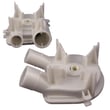
If the hose is clear but the washer still drains slowly, hums, or leaves wet loads, the drain pump can be jammed or failing. For this model, the replacement pump is the washer drain pump WP3363394.
Why it matters
A restricted drain hose or blocked pump prevents proper draining and can stop the washer from spinning after neutral drain. Fixing the restriction and setting the correct hose height and air gap protects floors from leaks and helps the washer complete the cycle normally.
Last updated: February 2026
What is the average lifespan of a Kenmore washer?
Most Kenmore washers average 10 to 15 years of service life with normal household use. For your Kenmore model 11018522790, consistent maintenance (proper loading, leveling, and periodic cleaning) is what most directly determines whether it lands closer to 10 years or closer to 15.
Typical lifespan by use and care
A washer’s lifespan is mainly driven by load size, cycle frequency, and how well the drive and drain systems are protected from strain.
- Normal use (3 to 5 loads/week): 10 to 15 years
- Heavy use (daily loads, large families): closer to 8 to 12 years
- Light use (1 to 2 loads/week): often 12 to 15 years
- Frequent overloading or chronic out-of-balance loads: shortens life quickly
- Good maintenance habits: extends life by reducing wear on the clutch, gear case, and drain pump
What to do to reach the high end of the range
We recommend these habits for Kenmore top-load washers like model 11018522790:
- Keep the washer level to reduce vibration and suspension wear
- Avoid overloading; it strains the drive system and clutch
- Use the right amount of detergent to reduce residue buildup
- Check pockets and wash small items in a bag to help prevent drain clogs
- Address new noises early (grinding, squealing, or banging)
Common wear items that affect longevity
If performance drops, replacing a worn part can often restore normal washing and spinning and help the washer last longer.
| Symptom | Commonly involved part | What it impacts |
|---|---|---|
| Agitator not moving well | Agitator dog 80040 | Agitation action and turnover |
| Won’t drain or drains slowly | Washer drain pump WP3363394 | Draining and spin performance |
| Loud spin, poor spin, burning smell | Clutch 285785 | Basket engagement during spin |
| Leaking at tub area | Washer tub gasket W10814296 | Sealing and water containment |
Why it matters
A washer near the end of its lifespan often shows up as weak agitation, poor draining, or unstable spinning. Catching those symptoms early helps prevent secondary damage to higher-cost components like the gear case.
For model-specific operating and care guidance, follow the maintenance and troubleshooting sections in the owner's manual.
Last updated: February 2026
What parts fail in a washing machine?
In a Kenmore washer like model 11018522790, the parts that fail most often are the ones that move water, transfer power, or stabilize the tub. Typical failures show up as no drain, no spin/agitate, leaks, or loud vibration; routine care and correct hose setup from the owner's manual helps prevent repeat problems.
Most common failed parts (and what you notice)
- Drain system: won’t drain, water left in tub, humming or grinding; check the washer drain pump WP3363394.
- Drive coupling: motor runs but washer won’t agitate or spin; inspect the coupling 285753A.
- Agitation components: weak or no agitation, clothes not moving; common wear items include the agitator dog 80040 and agitator cam 285748.
- Clutch and spin drive: slow spin, burning smell, poor water extraction; inspect the clutch 285785.
- Water fill controls: wrong water temperature or slow/no fill; check the mixing valve 285805 and the temperature switch WPW10168263.
- Suspension and balance parts: banging, walking, out-of-balance loads; inspect the washer suspension spring WP63907 and counterweight spring (red) WPW10250667.
Quick symptom-to-part checklist
| Symptom | Most likely area | Parts to check on this model |
|---|---|---|
| Won’t drain | Drain pump or blockage | Washer drain pump WP3363394 |
| Won’t agitate | Agitator drive parts | Agitator dog 80040, agitator cam 285748 |
| Won’t spin | Coupling or clutch | Coupling 285753A, clutch 285785 |
| Leaks | Hoses, tub seal, pump | Inlet hoses (inspect), washer tub gasket W10814296 |
| Excess vibration | Suspension/balance | Washer suspension spring WP63907, counterweight spring (red) WPW10250667 |
Why it matters
Catching a failing pump, coupling, or suspension part early prevents secondary damage (like water leaks, stripped drive components, or repeated out-of-balance spinning). The manual also calls out hose practices that reduce leak risk, including inspecting hoses and replacing inlet hoses after about 5 years of use.
Practical prevention steps we recommend
- Empty pockets to prevent coins and hardware from damaging the tub or pump.
- Keep the drain hose routed without kinks and avoid forcing excess hose into the standpipe.
- Inspect inlet hoses for bulges, cracks, and leaks; replace on a 5-year schedule.
- Clean the washer interior periodically (hot cycle with detergent and bleach, as directed).
- Stop using the washer if you smell burning or hear grinding; check drive and spin components.
Last updated: February 2026