Owner’s manual
 Error Codes




How big is the Kenmore Coldspot refrigerator?
Kenmore Coldspot model 10657572790 is a full-size side-by-side refrigerator. For exact exterior height, width, and depth (with hinges and handles), use the dimensions listed in the 10657572790 owner’s manual; those are the measurements to rely on for doorway fit and cabinet cutouts.
What to measure (so you get the right “big” number)
When people ask “how big,” they usually mean one of these:
- Overall height: floor to top of hinge cover
- Overall width: cabinet width (and handle-to-handle if applicable)
- Overall depth: cabinet depth vs. depth including handles
- Door swing clearance: space needed to open doors and pull bins/drawers out
- Ventilation clearance: space around the cabinet for airflow
Installation clearance guidelines for this model
The manual for this refrigerator calls out these placement clearances:
- Leave 1/2 inch of space on each side and at the top for ventilation
- Leave extra space at the back if an ice maker water line is connected
- If installed next to a fixed wall, allow at least 2 inches minimum on each side (depending on setup) so doors can swing open
For the full placement notes and diagrams, follow the 10657572790 owner’s manual.
Quick fit checklist
| Fit situation | Measure this | Tip |
|---|---|---|
| Getting it into the house | Doorway height and width | Remove doors/handles if needed for tight openings |
| Sliding into a cabinet opening | Cutout width and depth | Handles and hinges change the “real” depth |
| Next to a wall | Hinge-side clearance | You need room for door bins and drawers |
Why it matters
Using the correct model-specific dimensions prevents blocked airflow (warm temperatures), doors that cannot open fully, and water line kinks for the ice maker.
Last updated: February 2026
How to identify a refrigerator model?
To identify your refrigerator model, look for the model and serial number label on your Kenmore 10657572790. On this side-by-side style, the label is typically on an inside side wall; record the full model and serial number exactly as shown for parts and service.
Where to look on model 10657572790
On this Kenmore refrigerator, the model and serial number label is commonly found inside the fresh food section on a side wall. If you do not see it right away, check these other common spots.
- Inside the refrigerator compartment on a side wall (often near the crisper area)
- Inside the freezer compartment on a side wall
- On the inner door frame (refrigerator or freezer side)
- Behind the base grille or near the kick plate area
- Behind the lower crisper drawer area (label may be on the wall behind it)
For the diagram and the exact label location callout, use the 10657572790 owner's manual.
What to write down (and why)
Copy the information exactly as it appears on the label. This prevents ordering the wrong Kenmore or Whirlpool-made replacement part.
| What to record | Example format | Why it matters |
|---|---|---|
| Model number | 106.57572790 (varies by label) | Matches the correct parts list |
| Serial number | Letters and numbers | Helps confirm production details |
| Purchase date | Month/day/year | Useful for service history |
Tips to avoid mix-ups
- Use the full model number, including any dots or extra digits shown on the tag.
- Take a clear photo of the label before it fades or gets damaged.
- If you are ordering parts, match the part by description and ID, not just by looks.
Why it matters
Kenmore model numbers can look similar across different refrigerator designs; using the exact model and serial number ensures the right fit for items like an ice maker assembly, door gasket, thermostat, or shelves.
Last updated: February 2026
How to tell cubic feet of Kenmore refrigerator by model number?
For Kenmore model 10657572790, the most accurate way to get cubic feet is to look up the capacity in the specifications section of the 10657572790 owner's manual. Model numbers can hint at a series, but they do not reliably encode the exact cubic-foot capacity.
Fast ways to find the capacity
- Check the specifications pages in the 10657572790 owner's manual (capacity is typically listed as “total capacity” in cubic feet).
- Look for the model and serial number label inside the fresh food section (the manual notes this label is on the side wall); some versions list capacity on or near the rating information.
- If you are comparing refrigerators, measure the usable interior space (shelves and bins installed) rather than the empty cabinet size.
Why the model number alone is not enough
Kenmore model numbers (including the 106 prefix used on many side-by-side units) identify a model family and configuration, but manufacturers change features and interior layouts over time. That means two similar-looking models can have different usable space even if the model numbers look close.
What “cubic feet” means (and what it does not)
| Spec you see | What it tells you | What it does not tell you |
|---|---|---|
| Total capacity (cu. ft.) | Overall storage volume | How much fits with shelves, ice bin, and drawers installed |
| Refrigerator capacity | Fresh food space | Freezer space |
| Freezer capacity | Frozen storage space | Ice maker bin volume impact |
Why it matters
Knowing the correct cubic feet helps you choose the right replacement parts and accessories (like shelves, bins, and ice storage) and set realistic expectations for storage, especially if your unit has an ice maker and filtration system.
Last updated: February 2026
How to tell if a Kenmore refrigerator compressor is bad?
On Kenmore model 10657572790, a bad compressor usually shows up as poor or no cooling while the unit keeps trying to run, often with repeated clicking or overheating. Before condemning the compressor, we rule out airflow, dirty condenser coils, and door seal problems listed in the 10657572790 owner's manual.
Quick symptoms that point toward a compressor problem
- Refrigerator and freezer both warm, even though the lights and fans work
- Compressor is very hot to the touch after running (give it time to cool before touching)
- Repeated clicking every few minutes (start device trying and failing)
- Fridge runs “all the time” but temperatures do not recover
- Little to no vibration or sound from the compressor when it should be running
Checks to do first (common non-compressor causes)
These items can make the refrigerator run longer and cool poorly, and they are specifically called out in the manual.
- Dirty condenser coils: reduced heat transfer makes the compressor work harder
- Doors not closing fully: warm air leaks in and cooling never catches up
- Door gaskets not sealing: causes long run times and temperature issues
- Controls not set correctly: can mimic a cooling failure
- Normal sounds vs. problem sounds: buzzing, clicking, gurgling, and fan noise can be normal operation
What a technician tests (how “bad compressor” is confirmed)
A compressor diagnosis is electrical and sealed-system based; these tests separate a failed compressor from a start device or control issue.
| Test/observation | What it helps confirm | Typical outcome if compressor is bad |
|---|---|---|
| Amp draw at startup and while running | Hard-start or locked rotor | High amps, then trip/click off |
| Continuity/resistance of compressor windings | Internal electrical failure | Open or shorted winding readings |
| Start device/capacitor inspection | Not a compressor failure | Burnt/failed start parts with compressor OK |
| Temperature pattern on lines | Sealed-system performance | Poor heat exchange, weak pumping |
Why it matters
The compressor is part of the sealed refrigeration system; misdiagnosing it can lead to unnecessary parts costs. On this model, basic maintenance items (coil cleaning and door sealing) are frequent causes of “not cooling” complaints and should be checked first.
Last updated: February 2026
What are the most common problems with Kenmore refrigerators?
The most common problems we see on Kenmore refrigerators like model 10657572790 are poor cooling, ice maker issues, water leaks, and unusual noises. Many of these trace back to airflow restrictions (dirty condenser coils, iced-up evaporator area), door sealing problems, or a defrost system fault.
Quick checks that solve many complaints
- Make sure the doors close fully and the gaskets seal all the way around.
- Clean the condenser coils; dirty coils make the compressor run longer and cool worse.
- Confirm the temperature controls are set correctly for your kitchen conditions.
- Reduce frequent door openings; the unit will run longer when doors are opened often.
- If the ice maker is slow after setup, allow 24 hours for initial ice and up to 72 hours for full production.
Common symptoms and likely causes
| Symptom | Most common cause | What to do first |
|---|---|---|
| Not cooling well | Dirty condenser coils, airflow blocked, defrost issue | Clean coils; check for frost buildup in freezer |
| Ice maker not making ice | Freezer not cold enough, shutoff arm off, water valve closed | Verify freezer temp, arm down, water valve on |
| Ice maker makes too little ice | New install, heavy use, clogged filter | Wait 72 hours; reduce demand; check filter |
| Noisy operation | Normal operating sounds, fan or airflow issue | Compare to “normal sounds” section in manual |
| Water leaking | Clogged defrost drain, door not sealing | Clear drain path; inspect gasket seal |
Ice maker problems (very common on side-by-side models)
If your ice maker stops or under-produces, we focus on the basics first: freezer temperature, the shutoff arm position, and water supply.
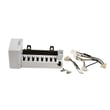
- For a complete ice maker replacement that fits this model, use the ice maker assembly 4317943.
- If cubes are jammed, clear the ejector area with a plastic utensil (avoid metal tools).
Why it matters
Cooling, ice production, and leak issues often share the same root cause: restricted airflow or moisture that is not being cleared during defrost. Fixing the underlying airflow or defrost problem prevents repeat failures and helps protect food quality.
For model-specific operating and troubleshooting steps, use the 10657572790 owner's manual.
Last updated: February 2026
What is the average lifespan of a Kenmore Elite refrigerator?
A Kenmore Elite refrigerator typically lasts 10 to 15 years. For a Kenmore side-by-side like model 10657572790, consistent cleaning, good airflow around the cabinet, and keeping the defrost and door-seal systems working properly are the biggest factors in reaching the high end of that range.
Typical lifespan and what affects it
Most refrigerators wear out due to cooling-system strain, airflow problems, or moisture intrusion. The biggest lifespan drivers are:
- Condenser cleanliness (dust buildup makes the compressor work harder)
- Door gasket condition (warm air leaks cause longer run times and frost)
- Defrost performance (heavy frost reduces airflow and cooling)
- Stable temperatures (avoid frequent warm-ups from propped doors)
- Power events (surges and repeated outages can stress components)
Quick maintenance checklist (high impact)
Use this as a simple routine to extend service life:
- Vacuum the condenser area and grille regularly
- Keep food from blocking interior air vents
- Clean door gaskets with mild soap and water; dry fully
- Confirm doors close and seal evenly all the way around
- Replace failed interior lights promptly to avoid heat buildup near lenses (see 10657572790 owner's manual)
Common “end-of-life” symptoms vs. fixable issues
| Symptom | Often fixable? | Common area to check |
|---|---|---|
| Warm refrigerator, freezer still cold | Yes | Airflow/evaporator frost pattern |
| Heavy frost on freezer back wall | Yes | Defrost system |
| Water under crisper drawers | Yes | Defrost drain |
| Loud buzzing or clicking at rear | Sometimes | Condenser fan, start components |
| Poor ice production | Yes | Ice maker and water supply |
If ice production is the main complaint, a common replacement on this platform is the ice maker assembly 4317943.
Why it matters
A refrigerator that runs longer to hold temperature uses more energy and wears key components faster. Simple upkeep, especially keeping airflow and seals in good shape, is the most reliable way to get a full 10 to 15 years from a Kenmore Elite.
Last updated: February 2026