Installation guide
 Owner’s manual
 Error Codes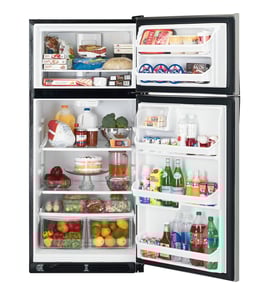



Are top mount or bottom mount fridges better?
Top-mount and bottom-mount refrigerators are both “better” depending on how you use them. For a Frigidaire top-mount like model FFHT1826LS5, a top freezer typically costs less and is simpler to maintain; a bottom freezer usually puts fresh food at eye level for easier daily access.
Quick comparison (what most homeowners notice)
- Top-mount (top freezer): lower purchase cost, fewer complex features, easy freezer access
- Bottom-mount (bottom freezer): easier access to fresh food, less bending for everyday items
- Either style: performance depends more on airflow, door sealing, and temperature settings than freezer location
| Feature | Top-mount (like FFHT1826LS5) | Bottom-mount |
|---|---|---|
| Fresh food access | More bending | More eye-level access |
| Freezer access | Easier | More bending |
| Typical price | Lower | Higher |
| Repair complexity | Often simpler | Often more components |
How to choose the better style for your kitchen
- Choose top-mount if you use the freezer often, want a simpler layout, or want strong value.
- Choose bottom-mount if you cook frequently and want refrigerator shelves and crisper drawers at a more comfortable height.
- If you have tight clearances, confirm spacing and leveling requirements in the FFHT1826LS5 installation guide.
Why it matters (performance and day-to-day reliability)
No matter which style you pick, the biggest real-world differences come from setup and upkeep. A refrigerator that is level, has good airflow clearances, and has doors that seal fully will cool more consistently and waste less energy. The installation checklist for this model emphasizes door seals, leveling, and proper clearances. Use the FFHT1826LS5 owner’s manual for control-setting guidance and normal operating sounds.
Last updated: February 2026
What are the disadvantages of a top mount fridge?
A top-mount refrigerator like the Frigidaire FFHT1826LS5 is reliable and efficient, but its main disadvantages are convenience and ergonomics: you bend more to reach fresh-food items, and the freezer is less accessible for kids or shorter users. Layout and door-clearance needs can also be limiting.
Common disadvantages (what most owners notice)
- More bending for daily items: The refrigerator section is lower, so produce, drinks, and leftovers often require bending.
- Freezer access is higher: Reaching bulky frozen items can be awkward, especially on taller units.
- Less “wide-open” storage: Compared with side-by-side or French door designs, shelves and bins can feel narrower for platters.
- Door swing and clearance needs: You still need space for doors to open fully; installation clearances matter.
- Fewer convenience features on many models: Top-mounts often have simpler controls and fewer specialty zones.
Installation and space tradeoffs
Your FFHT1826LS5 needs basic clearance for airflow and easier installation. A common drawback is that tight alcoves can restrict door opening and reduce usable shelf access.
Typical clearance targets (from installation guidance):
| Location | Typical minimum clearance |
|---|---|
| Sides and top | 3/8 in |
| Back | 1 in |
For model-specific setup steps (leveling, door sealing, control settings), use the FFHT1826LS5 installation guide.
When a top-mount is still the better choice
Top-mount refrigerators often win when you want straightforward cooling with fewer parts to maintain.
| If you prioritize... | Top-mount usually... |
|---|---|
| Lower purchase cost | Costs less than many French door models |
| Energy efficiency | Runs efficiently for its size |
| Simple maintenance | Has fewer complex features |
Why it matters
Most “disadvantages” come down to how you use the refrigerator every day: if you access fresh food far more than frozen food, bending and shelf reach become the deciding factors. If you are installing in a tight space, clearances and door swing can matter as much as capacity.
Last updated: February 2026
Why is my Frigidaire top mount freezer not freezing?
If your Frigidaire FFHT1826LS5 top-mount freezer is not freezing, the most common causes are incorrect temperature control settings, poor airflow from overpacking, warm air leaking past the door gasket, or a defrost system problem causing frost buildup. Start with control settings and door sealing, then check for frost and fan operation.
Quick checks we recommend first
- Confirm the freezer control was not accidentally set too warm; after any change, wait 24 hours before adjusting again (per the installation guide).
- Make sure the freezer door closes fully and seals to the cabinet on all sides.
- Avoid blocking vents with food packages; leave space for air circulation.
- Listen for the evaporator fan running when the compressor is on (you may hear airflow).
- Look for heavy frost on the freezer back wall; that points to a defrost problem.
What the symptoms usually mean
| What you notice | Most likely cause | What to do next |
|---|---|---|
| Freezer is cool but not freezing | Control set too warm | Set colder; wait 24 hours |
| Frost/ice sheet on back wall | Defrost system issue | Inspect defrost heater/thermostat |
| Door pops open or gaps | Door not level or gasket not sealing | Level cabinet; warm and reshape gasket |
| Fridge warm and freezer warm | Airflow or sealed system issue | Check fans, condenser area, then service |
Parts that commonly fix “not freezing” on this model
If you find heavy frost buildup or no airflow, these model-matched parts are common suspects:
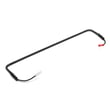
- Refrigerator defrost heater 242044008 (failed heater can allow the evaporator to ice over)
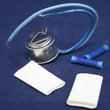
- Refrigerator defrost bi-metal thermostat 5303918202 (can stop the heater from turning on)
- Refrigerator evaporator fan blade 5308000010 (a damaged blade can reduce airflow)
Why it matters
A freezer that is not freezing is often an airflow problem first (settings, door seal, frost blockage). Fixing the root cause quickly helps protect food, prevents excessive frost, and reduces compressor run time.
Last updated: February 2026
What is the most common problem with Frigidaire refrigerators?
The most common Frigidaire refrigerator problem is a cooling issue caused by restricted airflow or a defrost system problem, which can show up as a warm fresh-food section, frost buildup on the freezer back wall, or inconsistent temperatures. For your Frigidaire FFHT1826LS5, start with control settings and airflow checks from the FFHT1826LS5 installation guide.
Most common symptoms we see
- Fresh-food section warm but freezer seems cold
- Frost or ice buildup on the freezer rear panel
- Loud fan noise, then temperatures rise
- Water puddles from defrost drain icing over
- Food freezing in the refrigerator section
Quick checks that fix many “not cooling right” complaints
- Confirm temperature controls: After changing controls, wait 24 hours before adjusting again.
- Check door sealing and leveling: Doors should seal on all sides; the cabinet should be level side-to-side and tilted about 1/4 inch front-to-back.
- Improve airflow: Do not block vents with packages; leave space around the evaporator cover area.
- Clean condenser area: Dust on condenser coils and the condenser fan area can reduce cooling.
- Listen for the evaporator fan: If the fan is noisy or not running, cooling performance drops fast.
Parts that commonly relate to cooling and frost issues
If your symptoms match, these model-compatible parts are often involved:
| Symptom | Common area | Example part for FFHT1826LS5 |
|---|---|---|
| Heavy frost, warming temps | Defrost system | Refrigerator defrost heater 242044008, refrigerator defrost bi-metal thermostat 5303918202 |
| Warm temps, weak airflow | Evaporator fan | Refrigerator evaporator fan blade 5308000010 |
| Poor cooling, hot cabinet sides | Condenser fan area | Refrigerator condenser fan motor 242018301 |
Why it matters
Cooling problems usually get worse over a few days; food safety and compressor run time are the big concerns. A simple door seal or airflow correction can prevent longer run times and temperature swings.
Helpful DIY reference
Last updated: February 2026