Owner’s manual
 Error Codes


Where is the model number on a Kenmore side by side refrigerator?
On Kenmore side-by-side refrigerator model 10657206600, the model number is printed on the appliance identification label (the same label that lists the serial number). We typically see this label inside the fresh food compartment, around the cabinet frame near the door opening.
Where to look first (fast checks)
- Open the refrigerator (fresh food) door and inspect the cabinet frame around the opening
- Check the side wall just inside the door area
- Look near the top front edge of the liner where the door gasket seals
- If you do not see it, check the freezer compartment door opening frame
- Use a flashlight; the label can be small and easy to miss
What the label looks like
The ID label usually includes both a model number and a serial number. The serial number format varies by production run, so the most reliable identifier for parts is the full model number.
| Item on label | What it’s used for | Example (format) |
|---|---|---|
| Model number | Matching parts and diagrams | 10657206600 |
| Serial number | Identifying production details | Letters and numbers |
Why it matters
We use the exact model number to match the correct Kenmore parts for your side-by-side refrigerator. Even small model number differences can change which items fit, such as a water inlet valve, ice maker, or door switch.
Tip for ordering the right part
When you find the label, copy the model number exactly as printed, then compare it to the model shown on the parts list for 10657206600. For water and ice issues, common matches on this model include the refrigerator water inlet valve W10408179 and the refrigerator ice maker WPW10190965. For diagrams and label-location guidance specific to this unit, use the owner's manual.
Last updated: February 2026
How many cubic feet is my Kenmore refrigerator by model number?
Your Kenmore side-by-side refrigerator model 10657206600 has its exact cubic-foot capacity listed on the model and serial rating label inside the fresh food compartment (and it is also shown in the specifications section of the owner's manual). Using the rating label is the fastest, most accurate way to confirm capacity for your exact configuration.
Where to find the cubic-foot capacity on model 10657206600
Check these common locations:
- Inside the refrigerator section on a side wall near the top front
- On the ceiling of the fresh food compartment near the light housing
- Behind the crisper drawers on the side wall
- Inside the freezer section on a side wall (less common)
What the number looks like
Capacity is usually shown as one of these:
- Total capacity (example format: “Total: XX.X cu. ft.”)
- Refrigerator capacity and freezer capacity listed separately
- A “Product data” or “Specifications” line in the manual
Quick checks if you are comparing models
If you are trying to match a replacement refrigerator or confirm you have the right unit, use this checklist:
- Confirm the full model number is 10657206600 (not a partial)
- Compare door style (side-by-side), dispenser features, and shelf layout
- Verify the rating label matches your serial number and electrical ratings
Typical capacity range (for context)
Most Kenmore 106-series side-by-side refrigerators fall into a similar size class. Use this only as a rough comparison, not as the official spec for your unit.
| Refrigerator type | Typical total capacity |
|---|---|
| Side-by-side (common household size) | 20 to 26 cu. ft. |
| Compact / apartment | 10 to 18 cu. ft. |
| Large side-by-side | 26 to 30+ cu. ft. |
Why it matters
Cubic-foot capacity helps you choose correctly sized replacement shelves, bins, and storage accessories, and it is also useful when troubleshooting temperature complaints (overpacking can restrict airflow).
Last updated: February 2026
How to tell if a Kenmore refrigerator compressor is bad?
A bad compressor on your Kenmore side-by-side refrigerator model 10657206600 usually shows up as poor cooling with long run times, unusual clicking or repeated start attempts, or a compressor that is extremely hot after trying to run. Use the sound and cooling checks below, then confirm with electrical testing.
What you can check first (no tools)
- Listen for normal vs. abnormal sounds: a high-pitched or pulsating sound can be normal as the compressor and fans adjust; repeated clicking followed by silence points to a start problem.
- Check temperatures: freezer should be near 0°F and fresh food near 37°F after 24 hours of stable operation.
- Look for airflow: weak airflow from vents can mimic compressor failure (evaporator fan or frost buildup issues).
- Note run behavior: a high-efficiency compressor can run longer than older units; constant running with warming temps is a red flag.
- Rule out door seal issues: warm air leaks can cause nonstop running and poor cooling.
Quick symptom-to-likely-cause guide
| What you notice | Most likely cause | What to check next |
|---|---|---|
| Clicking every few minutes, little or no cooling | Start device/capacitor issue or compressor locked | Test start components; inspect wiring; consider run capacitor WPW10662129 |
| Runs a lot, temps slowly rise | Sealed system restriction, low refrigerant, weak compressor | Check condenser cleanliness and airflow; technician sealed-system diagnosis |
| Compressor hot to the touch and shuts off | Overload tripping from hard start or overheating | Clean condenser area; verify condenser fan operation |
| No compressor sound at all | Control, thermostat, or power issue | Check settings; consider refrigerator thermostat WP2198202 or control diagnostics |
Why it matters
Replacing a compressor is a major repair; many “bad compressor” symptoms are actually caused by airflow problems, controls, or start components. Using the checks above helps you avoid replacing the wrong part and restores proper cooling faster.
Where to confirm model-specific checks
Use the troubleshooting and sound descriptions in the owner's manual for model 10657206600 to compare normal operating noises (buzzing water valve, gurgling refrigerant flow, evaporator fan sound) versus true failure symptoms.
Last updated: February 2026
What are the most common problems with Kenmore refrigerators?
The most common issues we see on Kenmore refrigerators like model 10657206600 are cooling problems (often airflow or defrost related), water leaks, ice maker and dispenser failures, and unusual noises. Many of these start with basic maintenance checks and a few high-wear parts.
Most common symptoms and what usually causes them
- Not cooling or warm temperatures: dirty condenser coils, evaporator airflow problems, or a defrost system issue (ice buildup)
- Water leaking or puddles: clogged defrost drain, loose water line connections, or a leaking valve
- Ice maker not making ice: water supply restriction, failed ice maker module, or a bad inlet valve
- Water dispenser slow or not dispensing: filter or housing restriction, frozen reservoir/tube, or valve issue
- Noises (buzzing, clicking, rattling): fan blade interference, failing motor, or normal ice maker cycling
Quick checks we recommend first (before replacing parts)
- Set temperatures to typical targets: 37°F fresh food and 0°F freezer.
- Confirm doors seal and close fully; sticky gaskets often improve after cleaning (see owner's manual).
- Allow proper ventilation clearance: about 1/2 inch at the sides and top, and extra space behind for the water line if equipped (see owner's manual).
- If the unit wobbles or doors don’t align well, level the refrigerator; poor leveling can affect door sealing.
- If you recently had a power interruption, give the refrigerator time to stabilize and recheck temps.
Parts that commonly solve these problems on 10657206600
If your troubleshooting points to a failed component, these are common fixes for this model:
| Problem area | Common part to check | What it affects |
|---|---|---|
| Water to ice maker/dispenser | Refrigerator water inlet valve W10408179 | No ice, no water, weak fill |
| Ice production | Refrigerator ice maker WPW10190965 | No ice or irregular ice cycles |
| Defrost/ice buildup | Refrigerator defrost bi-metal WPW10225581 | Frost buildup, warm fridge |
| Water filtration path | Refrigerator water filter housing WP2186443 | Slow flow, leaks at filter area |
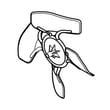
| Fan noise/airflow | Refrigerator evaporator fan blade WP2169142 | Rattling, poor airflow |
Why it matters
Most “big” refrigerator complaints trace back to airflow, sealing, or water delivery. Catching a dirty gasket, restricted water path, or early defrost trouble helps prevent food spoilage, recurring leaks, and ice maker damage.
Last updated: February 2026
What causes a side-by-side refrigerator to stop cooling?
A Kenmore 10657206600 side-by-side refrigerator usually stops cooling because airflow is blocked, the temperature controls are set incorrectly (including being set to OFF), or a cooling-system component is not running. Start with vents, door use, and control settings before moving to parts testing. See the 10657206600 owner's manual for control and airflow details.
Quick checks we recommend first
- Confirm the refrigerator control is not set to OFF (the unit will not cool in OFF).
- Check that air vents are not blocked in either compartment; clear packages away from vents.
- Limit frequent door openings; warm air loads can make temperatures rise quickly.
- If you just added a lot of food, allow several hours for temperatures to recover.
- For models with digital controls, turn the unit OFF then ON to reset.
Most common causes (symptom-based)
| What you notice | Likely cause | What to do next |
|---|---|---|
| Freezer cold, fresh food warm | Blocked return/upper vent or poor air circulation | Clear vents; reorganize shelves for airflow |
| Both sections warm | Controls set wrong or cooling system not running | Verify settings; listen for fans/compressor |
| Temps drift warmer after door use | Normal warm-air load plus long run times | Reduce door openings; wait for recovery |
| Buzzing during ice maker fill | Water valve opening (normal sound) | No repair needed unless leaking/no fill |
When a part is often involved
If the basic checks do not restore cooling, these model-compatible parts are commonly involved in no-cool or warm-temperature complaints:
- Refrigerator thermostat WP2198202: If it fails, the compressor may not cycle correctly.
- Refrigerator electronic control 4388932: Can affect defrost timing and temperature control.
- Refrigerator defrost bi-metal WPW10225581: A defrost problem can lead to frost buildup that blocks airflow.
- Refrigerator evaporator fan blade WP2169142: If the evaporator fan is not moving air, the refrigerator side warms.
Why it matters
This refrigerator depends on airflow from the freezer to the refrigerator section. When vents are blocked or defrost issues create frost buildup, cold air cannot circulate, so one or both compartments stop cooling properly.
Last updated: February 2026