Installation guide
 Owner’s manual
 Error Codes


Where is the model number on a Kenmore side by side refrigerator?
On Kenmore side-by-side refrigerator model 10653559202, the model number is printed on the model and serial number label inside the refrigerator compartment, typically on an inside wall. You can confirm the exact label location and what it looks like in the 10653559202 owner's manual.
How to find it quickly
- Open the fresh food (refrigerator) door, not the freezer door.
- Look along the inside walls of the refrigerator compartment.
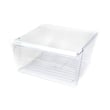
- Check near the crisper area and side walls where labels are commonly placed.
- Use a flashlight; the label can be easy to miss in low light.
- Write down both the model number and serial number for parts lookup and service records.
What you should record (and why)
The label includes key identification details we use to match diagrams and replacement parts.
| Item to record | Example format | What it’s used for |
|---|---|---|
| Model number | 10653559202 | Ensures you get the correct Kenmore parts list |
| Serial number | Letters + numbers | Helps identify production details and correct revisions |
| Purchase date | Month/day/year | Useful for your own records and maintenance planning |
Why it matters
Kenmore model numbers can look similar across 106-series refrigerators, but small design changes affect fit and compatibility for parts like a water inlet valve, door gasket, or defrost components. Using the exact model number from the label helps us match the right diagrams and parts the first time.
If you’re ordering parts, start with the parts list for model 10653559202 on this page; for broader model searches, use Sears PartsDirect.
Last updated: February 2026
How to clean the coils on a Kenmore side by side refrigerator?
For Kenmore side-by-side refrigerator model 10653559202, cleaning the condenser coils means removing dust and pet hair so the refrigerator can release heat efficiently. Dirty coils make the compressor run longer and can cause warm temperatures; follow the safety steps in the 10653559202 owner's manual before you start.
Quick steps to clean the condenser coils
- Unplug the refrigerator (or disconnect power at the breaker).
- Pull the refrigerator out carefully to access the back or lower rear area.
- Use a coil brush to loosen packed dust on the coils.
- Vacuum the loosened debris with a crevice tool.
- Clean the floor area and the lower rear cover area, then reinstall any cover/grille.
- Restore power and confirm the refrigerator is cooling normally.
What to use (and what to avoid)
Use tools that remove dust without damaging tubing or wiring.
| Use | Avoid | Why |
|---|---|---|
| Coil-cleaning brush | Abrasive pads | Abrasives can damage finishes and nearby components |
| Vacuum with crevice tool | Flammable cleaners/fluids | We use nonflammable cleaning methods around appliances |
| Soft cloth for nearby surfaces | Soaking electrical areas | Moisture can cause shorts or corrosion |
How often we recommend cleaning
Most households do best with coil cleaning every 6 months. If you have pets, heavy dust, or the refrigerator is in a tight enclosure, clean coils about every 3 months.
Signs the coils need cleaning
- Refrigerator seems to run most of the day
- Freezer or fresh food temperatures drift warmer
- Cabinet sides feel hotter than normal
- You see visible dust buildup behind the unit or at the lower rear
Why it matters
The manual notes that dirty condenser coils reduce heat transfer and make the motor work harder. Keeping coils clean helps your Kenmore 10653559202 cool more consistently, reduces run time, and can help prevent temperature swings.
If you are already cleaning and the refrigerator still runs constantly, we typically check airflow and cooling components next, such as the refrigerator condenser fan W10181323. You can also find model-specific troubleshooting and code guidance in the Kenmore 106 model refrigerator error codes.
Last updated: February 2026
How can I tell how many cubic feet my Kenmore refrigerator is?
For Kenmore model 10653559202, the most reliable way to confirm cubic feet is to read the refrigerator’s rating plate inside the fresh food compartment; it typically lists total capacity as “Total volume” or “Cu. Ft.” If the label is missing, we can calculate capacity by measuring the interior.
Where to find the capacity label
Check these common rating plate locations:
- Inside the refrigerator section on a side wall
- Behind or beside the crisper drawers
- Near the ceiling of the fresh food compartment
- On the cabinet frame just inside the door opening
If you need help identifying panels and drawers to access the label, use the 10653559202 owner's manual.
How to calculate cubic feet (if the label is unreadable)
Measure the usable interior of each compartment (refrigerator and freezer), then convert cubic inches to cubic feet.
- Measure height x width x depth (in inches)
- Multiply to get cubic inches
- Divide by 1,728 to get cubic feet
Quick conversion table
| What you have | What to do | Result |
|---|---|---|
| Inches (H x W x D) | Multiply | Cubic inches |
| Cubic inches | Divide by 1,728 | Cubic feet |
| Two compartments | Add both cubic feet | Total capacity |
Tips to get an accurate number
- Measure to the inside walls, not the door bins.
- Subtract space taken by fixed components (ice maker housing, air ducts) only if they significantly reduce usable space.
- Keep shelves and drawers installed while measuring depth; that reflects real storage space.
Why it matters
Knowing cubic feet helps us match the right replacement parts and accessories for your side-by-side refrigerator, and it also helps when comparing storage capacity across models.
If you’re ordering parts for this model, use the parts list for 10653559202 first; for broader model searches, use Sears PartsDirect.
Last updated: February 2026
What are the most common problems with Kenmore refrigerators?
The most common problems we see on Kenmore refrigerators like model 10653559202 are cooling issues (often airflow or defrost related), water and ice dispenser troubles, leaks, and unusual noises. Many fixes start with cleaning, checking door seals, and inspecting the defrost and water supply systems in the owner's manual.
Most common symptoms and what usually causes them
- Not cooling or warm temperatures: dirty condenser coils, failed evaporator fan, iced-up evaporator from a defrost problem
- Ice maker not making ice: clogged or misinstalled water filter, low water pressure, inlet valve issue
- Water leaking or puddles: clogged defrost drain, cracked water tubing, door not sealing
- Noisy operation: fan blade hitting ice, worn fan motor, items vibrating against the cabinet
- Door not closing or door pops open: worn hinge/cam parts, misalignment, overloaded door bins
Quick checks we recommend first (fast, no parts guessing)
- Confirm the controls are set correctly and allow time for temperatures to stabilize after changes.
- Clean condenser coils and make sure airflow around the refrigerator is not blocked.
- Check door gaskets for gaps, tears, or areas that do not grip a sheet of paper.
- If ice is off-tasting or gray, discard the first batches after new plumbing or after long storage; clean the bin and freezer as needed.
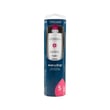
- If the refrigerator has a water filter, make sure it is installed correctly and not clogged (a clogged filter can reduce ice production).
Parts that commonly solve these problems on 10653559202
If troubleshooting points to a failed component, these are common replacements for this model:
| Problem area | What you may replace | Example part for this model |
|---|---|---|
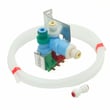
| No ice, weak fill, dispenser issues | Water inlet valve | Refrigerator inlet valve W10408179 |
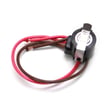
| Frost buildup, warm fridge section | Defrost thermostat (bi-metal) or heater | Refrigerator defrost bi-metal WPW10225581, refrigerator heater WP2323198 |
| Poor airflow, noise from freezer | Fan blade (inspect for damage or rubbing) | Refrigerator evaporator fan blade WP2169142 |
| Door not closing smoothly | Door cam | Refrigerator door cam (black) WP2182179 |
Why it matters
Cooling, ice maker, and leak complaints usually trace back to airflow (fans, coils, defrost) or water flow (filter, valve, tubing). Fixing the root cause protects food temperatures, reduces ice buildup, and prevents water damage.
You can order replacement parts from the parts list for model 10653559202, or search by model number on Sears PartsDirect.
Last updated: February 2026
What causes a side-by-side refrigerator to stop cooling?
A Kenmore side-by-side refrigerator like model 10653559202 usually stops cooling because cold air cannot circulate (blocked vents or doors left open), the controls need a reset, or a cooling-system component is failing (fans, defrost system, or compressor). Use the owner's manual to confirm airflow and control settings.
Quick checks we recommend first
- Make sure the refrigerator has power and the interior lights turn on.
- Confirm the temperature controls are set correctly for your kitchen conditions.
- Check that air vents are not blocked by food in either compartment.
- Close doors fully and check for gaps around the gasket.
- If your model has digital controls, turn the unit OFF then ON to reset.
Most common causes (and what you will notice)
| Likely cause | What you will notice | What to do next |
|---|---|---|
| Blocked air vents | Freezer may be colder than fridge, or temps swing | Clear items away from vents; restore airflow |
| Doors opened often or not sealing | Temps rise, moisture buildup, longer run times | Reduce door openings; inspect gasket contact |
| Control needs reset (digital models) | Cooling stops or temps stay warm after a change/outage | Power cycle OFF then ON |
| Defrost problem (frosted evaporator area) | Warm fridge, weak airflow, possible sizzling during defrost | Check for heavy frost; consider defrost parts |
| Fan or sealed-system issue | Little to no airflow, unusual running pattern | Diagnose fans and cooling components |
Parts that commonly relate to “not cooling” symptoms
If airflow is weak or temperatures are too warm, these model-compatible parts are often involved:
- Refrigerator defrost bi-metal WPW10225581 (helps protect and control defrost heating)
- Refrigerator heater WP2323198 (melts frost during defrost cycles)
- Refrigerator evaporator fan blade WP2169142 (moves cold air through compartments)
- Refrigerator condenser fan W10181323 (removes heat from the condenser area)
- Refrigerator compressor W10309994 (drives the cooling cycle)
Why it matters
This refrigerator depends on steady airflow from the freezer to the fresh-food section. When vents are blocked or frost builds up, the temperature controls cannot regulate properly, so the refrigerator warms even if the unit seems to be running.
Last updated: February 2026