Installation guide
 Owner’s manual


How do I tell what model my Kenmore dryer is?
Your Kenmore dryer’s model number is printed on the model and serial number label; on model 11064962300, that label is located at the top inside the dryer door well. Once you have the full model number, we can match the correct parts, diagrams, and specifications.
Where to look first (fastest method)
Check these common Kenmore dryer label locations in this order:
- Top inside the dryer door well (most common for 110-series dryers)
- Inside the door opening on the cabinet frame
- On the back panel of the dryer
- Behind the lower access panel (on some designs)
Use the location diagram and wording in the 11064962300 owner's manual to confirm the exact label position for your unit.
What to write down (and why)
Record these items exactly as shown on the label:
- Model number (example format: 110XXXXXXXX)
- Serial number
- Purchase date (if available)
Why it matters
The model number identifies the exact Kenmore configuration (controls, drum size, heater style, and wiring). That prevents ordering the wrong items like a heating element, door switch, or timer.
Quick check: model number vs. part number
| Item | What it identifies | Example from this model page |
|---|---|---|
| Model number | The entire dryer | 11064962300 |
| Part ID | The specific replacement part listing | WP3387747 |
| Part number | Manufacturer’s part number | 3387747 |
If the label is hard to read
Try these practical steps:
- Wipe the label gently with a damp cloth; dust can hide digits
- Use a phone flashlight at an angle to make faint printing stand out
- Take a close-up photo and zoom in to confirm each digit
- Copy the model number exactly; avoid adding spaces or punctuation
Last updated: February 2026
How much does it cost to replace a heating element in a Kenmore dryer?
For Kenmore electric dryer model 11064962300, replacing the heating element typically costs $70 to $120 for the part plus $0 to $250+ for labor, so most total repairs land around $100 to $350 depending on who does the work and whether any wiring or thermostats also need replacement.
Typical cost breakdown
- DIY (parts only): usually $70 to $120
- Service call + labor: commonly $100 to $250+
- Extra parts sometimes needed: $10 to $50+
| Scenario | What you pay for | Typical total |
|---|---|---|
| DIY replacement | Heating element (and possibly connectors) | $70 to $150 |
| Pro repair | Part + labor + service call | $150 to $350 |
| Heat issue not the element | Diagnostics + different part | $100 to $300 |
Parts that commonly affect “no heat” repairs
If the dryer runs but does not heat, we check power first, then the heating circuit parts. These are common suspects on this model family:
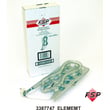
- Heating element: Dryer heating element WP3387747
- Thermal cut-off or high-limit protection: Cut-off kit 279769
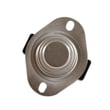
- Operating thermostat: Dryer operating thermostat WP3387134
- Burned terminals at the heater: Dryer heating element wire kit 279457
Quick checks before you buy parts
The installation instructions for this 27-inch electric dryer note that a “no heat” complaint can be a power supply issue (the dryer can run on 120V but needs full 240V to heat). Use these checks first:
- Confirm both house fuses are good or both breakers are on
- Make sure the cord is fully seated and the terminal connections are tight
- Run the dryer about 5 minutes, then carefully check for heat
- If power is correct and there is still no heat, move to heater and thermostat testing
For model-specific electrical and venting requirements, use the installation guide.
Why it matters
A failed heating element is common, but restricted venting, a tripped breaker, or a failed thermal cut-off can cause the same symptom. Verifying power and airflow first helps prevent buying the wrong part and helps the new heater last longer.
Last updated: February 2026
What does F40 mean on a Kenmore dryer?
On Kenmore electric dryer model 11064962300, an F40 display points to an electronic control problem that stops normal operation. We fix it by resetting power, then checking for loose wiring connections and heat-related shutdown conditions that can trigger control faults. Use the troubleshooting section in the 11064962300 owner's manual.
What to do first (quick, safe checks)
- Turn the dryer off; unplug it or switch the breaker off for 5 minutes, then restore power.
- If F40 returns, stop using the dryer until you complete the checks below.
- Clean the lint screen and confirm strong airflow at the outside vent hood.
- Make sure the exhaust duct is not crushed, kinked, or packed with lint.
- Confirm the door closes firmly and the drum turns freely by hand.
What we check next (most common causes)
- Power supply and cord/terminal connections: a loose connection can cause control glitches.
- Wire harness plugs: reseat connectors at the control area and at the motor/blower area.
- Overheating triggers: restricted venting can open safety devices and interrupt the cycle.
- Heat circuit components: if the dryer runs but has no heat, test heater and thermostats.
Parts that commonly relate to heat shutdown symptoms
| Symptom you notice | What it usually points to | Model-matched part example |
|---|---|---|
| Runs but no heat | Open heater circuit | Dryer heating element WP3387747 |
| Overheats, shuts down, or short cycles | Cycling thermostat issue or poor airflow | Dryer operating thermostat WP3387134 |
| Heats then quits and will not reheat | Thermal cut-off opened from overheating | Cut-off kit 279769 |
Why it matters
F40 often shows up after a power interruption, a loose electrical connection, or an overheating event from poor venting. Correcting airflow and heat-safety issues prevents repeat shutdowns and protects the heater and motor.
Last updated: February 2026