 Installation guide
 Owner’s manual

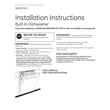
Are all GE dishwashers the same size?
No. GE dishwashers are not all the same size. Your GE GLD6700N10BB is a standard built-in style, and most built-in GE dishwashers are designed for a 24-inch-wide opening, but GE also makes compact 18-inch models and other configurations.
Most GE dishwashers fall into a few fit categories. Always confirm the required cabinet opening and hookup locations in the GLD6700N10BB installation guide.
- Standard built-in: typically fits a 24-inch-wide opening
- Compact built-in: typically fits an 18-inch-wide opening
- Portable or countertop: varies widely; not intended for a standard built-in cutout
- Panel-ready/custom front: same basic opening size as standard built-in, but door thickness and clearances can change
Even when the width is “standard,” depth and height can vary by model and installation.
- Cabinet opening width (inside-to-inside)
- Opening height (floor to underside of countertop)
- Available depth (including door clearance to walkways)
- Toe-kick height and how far the unit can recess
- Water line, drain hose, and electrical routing space
Use this as a planning reference; use the manual for exact specs.
| Dishwasher type | Typical width | Typical height | Typical depth |
|---|---|---|---|
| Standard built-in | ~24 in. | ~33.5 to 35 in. | ~24 in. |
| Compact built-in | ~18 in. | ~33.5 to 35 in. | ~24 in. |
A dishwasher that is even slightly too tall, too deep, or mismatched at the hookups can cause installation problems, door interference, leaks, or vibration. Confirming the opening and installation requirements up front prevents return trips and protects parts like the door seal and drain connections.
Last updated: January 2026
Can a clogged drain cause an FTD error?
Yes. On the GE GLD6700N10BB dishwasher, a clogged drain path can trigger an FTD-type fill/drain problem because the dishwasher expects the tub to be mostly empty before it starts a new fill. Standing water from a blockage can confuse the fill and drain sensing.
- Cancel the cycle and let the unit attempt to drain.
- Check the sink drain for slow draining; a backed-up sink often means the dishwasher cannot drain.
- If the dishwasher drains into a disposer, run the disposer to clear it.
- If you have an air gap, clean it (a plugged air gap is a common cause of poor draining).
- Inspect the drain hose routing for kinks or crushing behind or under the dishwasher.
Use the install steps in the GLD6700N10BB installation guide to confirm the drain hose is seated correctly on the pump outlet and clamped securely, and that the hose is routed through the cabinet without pinching.
| Symptom | Most likely drain-related cause | What we do next |
|---|---|---|
| Water left in tub after cycle | Air gap clogged, disposer not cleared, hose kinked | Clear air gap, run disposer, straighten hose |
| Hums but drains slowly | Partial blockage in hose or drain line | Remove blockage, verify high loop/air gap setup |
| Won’t drain at all | Failed drain pump or severe blockage | Check pump operation; replace if needed |
If the drain path is clear but the dishwasher still will not evacuate water, the drain pump is a common next suspect.
FTD-style errors are often a symptom, not the root cause. Restoring normal draining prevents false fill/drain sensing, reduces cycle interruptions, and helps protect the pump and motor from strain.
For code-specific meaning and reset steps, use GE electronic dishwasher error codes.
Last updated: January 2026
How to force a GE dishwasher to drain?
To force-drain a GE GLD6700N10BB dishwasher, press the START/RESET pad a second time after starting a cycle; the unit cancels the cycle and pumps the water out (typically about 2 minutes). This is the quickest way to clear standing water before troubleshooting a drain problem. See the GLD6700N10BB owner's manual.
- Close and latch the door.
- Press START/RESET once to start a cycle.
- Press START/RESET again to cancel; the dishwasher will pump out.
- Wait until the START/RESET light stops flashing.
- Open the door and confirm most water has drained.
After a cancel-drain, standing water usually points to a restriction in the drain path or a pump issue.
- Check the drain hose under the sink for kinks or crushing.
- If connected to a garbage disposer, make sure the disposer inlet plug was removed.
- If you have an air gap, check for clogs.
- Clean the filter area; a blocked filter can slow or stop draining.
- If the dishwasher hums but does not move water, the drain pump may be jammed or failing.
| Symptom | What to check | Model-matched part |
|---|---|---|
| Water remains in tub | Drain pump not pumping | Dishwasher drain pump WD26X10025 |
| Slow drain, debris in sump | Filter clogged | Dishwasher filter WD12X10109 |
| Leaks or poor drain routing | Drain hose damaged or loose | Drain tube WD24X10045 |
Cancel-draining clears the tub so you can safely inspect the filter, drain hose, and pump area. It also helps confirm whether the control is commanding a drain and whether the drain system can actually move water out.
- Use dishwasher not draining video for a step-by-step drain troubleshooting walkthrough.
Last updated: January 2026
What is the average lifespan of a GE dishwasher?
A GE dishwasher typically lasts about 10 years on average. For your GE GLD6700N10BB, lifespan depends most on water quality, how often it runs, and routine maintenance like cleaning filters and keeping the spray system clear; see the GLD6700N10BB owner's manual for care and cleaning guidance.
Most dishwashers fall into a similar range, but these factors move the needle the most:
- Hard water (mineral buildup) shortens pump, valve, and heater life
- Heavy daily use wears the circulation system and door components faster
- Poor draining leaves debris that strains the drain pump
- Overloading can reduce cleaning performance and increase rewash cycles
- Skipped maintenance (filters, spray arms, seals) leads to leaks and wash issues
We recommend these habits for the GLD6700N10BB:
- Clean the filter area regularly; replace the dishwasher filter WD12X10109 if it is damaged or won’t clean up
- Inspect and rinse spray components; replace the dishwasher spray arm WD22X10047 if jets are clogged or the arm is cracked/warped
- Watch for slow fills or no-fill symptoms; a failing dishwasher water inlet valve WD15X10003 can cause weak wash performance
- Address standing water quickly; a weak or noisy dishwasher drain pump WD26X10025 can lead to recurring drain problems
- Keep door seals clean and seated to prevent leaks and moisture damage
| What you’re seeing | Most common cause | Best next step |
|---|---|---|
| Not cleaning well | Clogged filter or spray arm | Clean first; replace filter/spray arm if damaged |
| Not draining | Drain pump or blockage | Clear blockage; consider drain pump replacement |
| Not filling or fills slowly | Inlet valve or supply issue | Check supply; consider inlet valve replacement |
| Loud grinding/humming | Pump/motor wear or debris | Check for debris; evaluate pump and motor assembly |
A dishwasher near the 10-year mark often develops performance problems (poor cleaning, draining issues, leaks) that can usually be traced to a few serviceable parts. Catching those early helps protect the motor, wiring, and cabinetry.
Last updated: January 2026





