Owner’s manual
 Error Codes


What is the life expectancy of a Whirlpool dryer?
A Whirlpool dryer like model WED6620HC1 typically lasts about 10 years with normal household use. With consistent maintenance (especially airflow and lint control), it’s common for a dryer to reach 12 to 15 years before major repairs become frequent; heavy use can shorten that timeline.
- Venting and airflow (restricted airflow overheats components)
- Lint screen cleaning habits
- Load size (overloading strains the motor and drum support system)
- Installation and leveling (vibration accelerates wear)
- Heat and sensor performance (overdrying and overheating increase stress)
We recommend following the care and airflow guidance in the WED6620HC1 use and care manual. Focus on these habits:
- Clean the lint screen before every load
- Keep the exhaust vent clear; clean the full vent run about every 2 years
- Avoid crushing or kinking the vent behind the dryer
- Do not tightly pack the drum; items need to tumble freely
- Level the dryer so all feet are firmly on the floor
If your dryer starts squealing, thumping, or vibrating, these are typical wear points on many Whirlpool dryers:
| Symptom | Often related to | Example compatible part for this model |
|---|---|---|
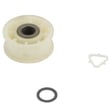
| Squealing or chirping | Idler pulley or rollers | Dryer idler pulley W10837240 |
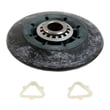
| Thumping or rumbling | Drum support rollers | Dryer drum support roller WPW10314173 |
| Long dry times | Airflow restriction or lint path issues | (inspect venting and lint ducting) |
A dryer that is venting properly and kept clean runs cooler and more efficiently. That reduces strain on the motor, heater system, thermostats, and drum support components, which is the biggest practical way to extend the service life of a WED6620HC1.
Last updated: January 2026
What is the most common problem with whirlpool dryers?
The most common Whirlpool dryer complaint we see (including on the Whirlpool WED6620HC1) is the dryer not starting. In many cases, the root cause is simple: the door is not fully closed, the controls are locked, or the dryer is not getting the correct power supply.
Start with these quick checks before assuming a failed part:
- Confirm the door is fully closed and latched.
- Touch and hold Start/Pause with your fingertip (not a fingernail).
- Check for Control Lock; if “Loc” shows, press and hold Control Lock for 3 seconds.
- Verify power: many electric dryers need a full 240V supply (a tripped breaker can leave the drum running but no heat, or prevent starting).
- If “PF” appears, clear it by touching Power and restart the cycle.
For model-specific operating and troubleshooting steps, use the WED6620HC1 use and care manual.
Even when the dryer starts, these are frequent performance complaints:
- Long dry times or “Check Vent” light (restricted airflow from lint screen or venting)
- No heat (power supply issue on electric models, or heating circuit problem)
- Noise or vibration (worn drum support components)
- Stops early or inconsistent dryness (sensor-related issues)
| Symptom | Common cause | First action |
|---|---|---|
| Won’t start | Door not shut, Control Lock, power issue | Check door, “Loc”, breakers |
| Takes too long | Lint screen or vent restriction | Clean lint screen, check vent airflow |
| “Check Vent” stays on | Crushed/kinked vent, clogged hood | Inspect vent run and outside hood |
| Loud rumble/squeal | Worn rollers or idler pulley | Inspect drum support system |
If your WED6620HC1 starts but makes loud thumping, squealing, or rumbling, the drum support system is a common wear area. A frequently replaced item is the dryer drum support roller WPW10314173.
Catching the “easy” causes first (door, Control Lock, airflow, and power) can save time and prevent repeat shutdowns. Good airflow also helps protect heating components and reduces drying time.
Last updated: January 2026
How to fix E1 error on dryer?
On the Whirlpool WED6620HC1 dryer, an E1-style error is typically shown as an “F# E#” service code (for example, F1 E1). Start by resetting power for 1 minute; if the code returns, the control has detected a condition that requires service per the WED6620HC1 use & care manual.
- Cancel the cycle: Touch POWER to stop/cancel.
- Hard reset: Unplug the dryer (or switch off the breaker) for 60 seconds, then restore power.
- Try a simple test cycle: Run a Timed Dry heated cycle for a few minutes.
- Watch the display: Note the exact code format (example: F1 E1, F3 E1).
In the WED6620HC1 troubleshooting guidance, an error that alternates F# and E# indicates the dryer control detected a fault that needs service.
| What you see on the display | What it generally indicates | What to do next |
|---|---|---|
| PF | Power failure interrupted the cycle | Touch POWER to clear; rerun cycle |
| L2 | Low/no line voltage condition | Check both breakers/fuses; verify 240 V supply |
| F# E# (example: F1 E1) | Control detected a fault requiring service | Reset once; if it returns, schedule service |
These do not “fix” an F# E# service code, but they can prevent related performance issues that sometimes trigger problems during operation:
- Clean the lint screen before every load; replace if damaged (see dryer lint screen W11758174).
- Confirm the door closes fully and the latch engages.
- Avoid overloading; tightly packed loads can cause abnormal cycle behavior.
- Make sure airflow is strong at the outside vent hood.
- If the display shows L2, check both household breakers/fuses (electric dryers often use two).
An E1-type service code on the WED6620HC1 is the dryer telling you it detected an internal problem (often control or sensing related). Resetting power is the safe first step; repeated codes help prevent wasted time and protect the dryer from repeated shutdowns.
Last updated: January 2026