Owner’s manual
 Error Codes



How to remove bottom grille on GE refrigerator?
On the GE GNE29GSKESS bottom-mount refrigerator, the bottom grille (base grille) is typically removed by pulling it straight out to release the retaining clips; some versions also use a couple of screws. Once it is off, you can access the front leveling legs and clean the condenser area more easily (see the GNE29GSKESS owner's manual for handling and moving guidance).
Quick steps to remove the bottom grille
- Unplug the refrigerator or switch off power at the breaker if you will be working near wiring.
- Open both fresh food doors for better access.
- Look along the top edge of the grille for screws; remove any screws with a Phillips screwdriver.
- Grip the grille at both ends and pull straight toward you to pop it off the clips.
- If it feels stuck, pull from one end, then the other; avoid twisting hard to prevent cracking.
- Set the grille aside, then reinstall by aligning it and pushing it back in until it snaps (and reinstall screws if used).
What you can do while the grille is off
Cleaning and airflow issues are common reasons to remove the base grille.
| Task | What to do | Why it helps |
|---|---|---|
| Clean dust/lint | Vacuum the front intake area and any reachable coil surfaces | Improves cooling efficiency and reduces run time |
| Check leveling | Adjust the front leveling legs as needed | Helps doors close and seal properly |
| Inspect for water | Look for signs of dripping or a puddle under the front | Can point to a defrost drain or water line issue |
Why it matters
A clogged intake area and poor airflow can make a bottom-mount refrigerator run warmer, run longer, or develop temperature swings. Removing the grille also makes it easier to safely move the refrigerator straight out when needed; our manual guidance emphasizes raising the leveling legs and pulling straight out to avoid floor damage.
Last updated: February 2026
What is the most common problem with a GE refrigerator?
The most common GE refrigerator complaint is not cooling properly (fresh food warm, freezer soft, or temperatures swinging). On your GE GNE29GSKESS bottom-mount refrigerator, the fastest path is to confirm airflow and temperature sensing first, then check the defrost system and fans using the owner's manual.
Most common issues we see (and what to check first)
- Not cooling or weak cooling: blocked vents, dirty condenser area, failed fan, or a control/sensor issue.
- Strange noises: evaporator fan hitting ice, worn fan motor, or normal defrost sounds.
- Ice maker or dispenser problems: low water flow, air in the line, clogged filter.
- Water leaking/puddles: clogged defrost drain, door left ajar, or condensation from poor sealing.
- Door not closing/sealing: gasket not sealing, bins/drawers out of position, cabinet not level.
- Lights not working: LED module failure or door switch related issues.
Quick troubleshooting checklist (10 minutes)
- Verify settings: set fresh food to about 37°F and freezer to about 0°F.
- Check airflow: make sure packages are not blocking return vents in the fresh food section.
- Listen for fans: you should typically hear a fan running when the compressor is on.
- Inspect door seal: look for gaps, rips, or areas that do not grip a dollar bill.
- Look for frost buildup: heavy frost on the back freezer panel points to a defrost problem.
Common parts tied to “not cooling” on GNE29GSKESS
| Symptom | Likely area | Example part on this model |
|---|---|---|
| Warm fresh food, freezer OK | Airflow/evaporator fan | Refrigerator evaporator fan motor WR60X26866 |
| Temps swing or read wrong | Temperature sensing | Refrigerator temperature sensor WR55X10025 |
| Frost buildup, weak airflow | Defrost system | Refrigerator defrost bi-metal thermostat WR50X10108 |
Why it matters
Cooling problems usually start as an airflow or defrost issue; fixing it early helps prevent food spoilage and reduces strain on the compressor and control board.
Helpful DIY guides
Last updated: February 2026
How do I find the model number on my GNE29GSKESS?
Your GE bottom-mount refrigerator’s model number is printed on the rating label; on most units like GNE29GSKESS, it’s located inside the fresh food compartment along a side wall or near the ceiling. Use the exact model number from that label when ordering parts or checking specifications in the GNE29GSKESS owner's manual.
Where to look on the refrigerator
Check these common rating-label locations first:
- Inside the refrigerator (fresh food) section on the left or right side wall
- On the ceiling area inside the fresh food compartment
- Behind a crisper drawer (look on the liner wall after pulling the drawer out)
- Along the door frame area (visible when the door is open)
- On the back exterior panel (less common, but worth a quick check)
What the label information means
The label usually includes more than just the model number. Here is what we recommend using:
| Label item | What to use it for |
|---|---|
| Model number (example: GNE29GSKESS) | Matching the correct parts diagrams and parts list |
| Serial number | Identifying production run details for service and compatibility |
| Electrical ratings | Verifying power requirements and safe troubleshooting |
Tips to avoid ordering the wrong part
Use these best practices when you write down the model number:
- Copy it exactly, including all letters and numbers
- Use the rating label, not the control panel display
- If a part has multiple versions, match by model number first, then confirm by part description
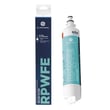
- When replacing maintenance items, match the part to your model (for example, the GE refrigerator water filter RPWFE)
Why it matters
GE often uses similar-looking designs across multiple refrigerator series; the exact model number ensures you get the right components (like a water filter, evaporator fan motor, or control board) that fit and function correctly.
Last updated: March 2026