Owner’s manual



Is Kenmore Elite high end?
Yes. Kenmore Elite is Kenmore’s premium line, and the Kenmore Elite 11044936201 front-loading (horizontal-axis) washer is built and equipped like a higher-end machine, with durability-focused design and feature sets that typically exceed standard Kenmore models.
What “high end” means for Kenmore Elite washers
High end usually comes down to build quality, performance, and long-term ownership value. For Kenmore Elite front-load washers like model 11044936201, that typically includes:
- Strong cleaning performance with efficient water use (front-load design)
- Higher spin speeds than many basic washers (better water extraction, shorter dry times)
- More cycle and option flexibility than entry-level models
- Quieter, smoother operation when properly installed and leveled
- Longer-lasting core components compared with many budget washers
Model-specific proof points (11044936201)
The documentation for this Kenmore Elite washer includes extended coverage on major components, which is a common “premium line” indicator.
| Component | What the manual indicates | Why it matters |
|---|---|---|
| Stainless steel wash drum | Limited lifetime coverage (parts) | Premium materials and long-term durability |
| Plastic tub | Limited 10-year coverage (parts) | Confidence in the outer tub assembly |
| Gearcase parts | Limited 5-year coverage (parts) | Supports long-term drive system reliability |
For full warranty terms and care guidance, use the 11044936201 owner’s manual.
Why it matters
If you are comparing washers, “Elite” generally signals better materials, more refined operation, and stronger long-term value. It also helps when choosing replacement parts because premium models often use more specialized components.
When “Elite” does not automatically mean “luxury”
Kenmore Elite is premium, but it is not the same category as true luxury brands with built-in customization or commercial-style platforms. In most homes, though, Elite is the “high end” tier within Kenmore.
Last updated: January 2026
What is the life expectancy of a Kenmore washer?
Most Kenmore washers last 10 to 15 years with normal household use. For the Kenmore Elite 11044936201 (horizontal-axis/front-load style), regular cleaning and basic preventive maintenance are the biggest factors in reaching the high end of that range; see the 11044936201 owner's manual for the care schedule.
Typical life expectancy (what we see most often)
- Average range: 10 to 15 years
- Heavy use (large family, daily loads): closer to 8 to 12 years
- Light use (few loads per week): often 12 to 15 years
- Best indicator: how well the washer drains, spins, and stays leak-free over time
| Usage pattern | Typical lifespan | What usually ends it first |
|---|---|---|
| Light (1 to 3 loads/week) | 12 to 15 years | Hoses, door boot leaks, pump wear |
| Normal (4 to 7 loads/week) | 10 to 15 years | Drain pump, inlet valve, door lock |
| Heavy (8+ loads/week) | 8 to 12 years | Bearings, pump, suspension, controls |
Maintenance that extends washer life
We recommend focusing on the items that most often shorten the life of a front-load washer:
- Clean the door gasket and leave the door ajar between loads to reduce odor and mildew.
- Use HE detergent and avoid overdosing; excess suds can stress the drain system.
- Check and replace water inlet hoses if they show bulging, cracking, or seepage.
- Keep the drain path clear (coins, lint, small socks) to prevent pump damage.
- Level the washer to reduce vibration and wear on suspension components.
When a repair is usually worth it
If the tub and motor system are in good shape, common repairs can add years of service.
- Won’t drain or drains slowly: inspect the drain path; the water pump 280187 is a common wear item.
- Won’t fill or fills slowly: check screens and water pressure; the washer water inlet valve WP8181694 may be the fix.
- Door won’t lock or cycle won’t start: the door lock WP8182634 is a frequent cause.
Why it matters
A realistic lifespan helps you decide whether to maintain, repair, or replace. On the 11044936201, preventing leaks and drain clogs protects high-cost components and keeps performance consistent.
Last updated: January 2026
How to force a Kenmore Elite washer to drain?
To force a Kenmore Elite washer model 11044936201 to drain, use the control-panel drain routine: press PAUSE/CANCEL, select DRAIN/SPIN, then press and hold START for about 1 second. This runs the drain pump and unlocks the door after the spin completes (if conditions are safe). See the 11044936201 owner's manual.
Fast steps (manual drain routine)
- Press PAUSE/CANCEL once to pause.
- If needed, press PAUSE/CANCEL again to cancel the cycle.
- Select DRAIN/SPIN.
- Press and hold START (about 1 second) to begin draining.
- Wait for the cycle to finish; the door unlocks after the spin completes.
If it still will not drain
A no-drain problem is usually a blockage, a kinked drain hose, or a failed drain pump.
- Check the drain hose for kinks, crushing, or being pushed too far into the standpipe.
- Make sure the hose routing leaves an air gap at the standpipe so water can flow out properly.
- Reduce the load size; heavy, waterlogged loads can slow draining.
- If you hear humming but no draining, the pump may be jammed or worn.
- If the washer drains slowly and leaves water behind, inspect the tub-to-pump path.
Parts commonly involved in a no-drain issue
| Symptom | Most likely area | Part to consider (if applicable) |
|---|---|---|
| Hums, no water movement | Drain pump jammed/failed | Water pump 280187 |
| Slow drain, intermittent drain | Hose restriction/leak | Washer tub-to-pump hose WPW10467168 |
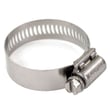
| Leaks at hose connection | Loose/weak clamp | Clamp WP285655 |
Why it matters
Forcing a drain the correct way protects the door lock system and helps prevent water from backing up or leaking onto the floor. Proper drain hose routing also reduces the chance of siphoning and repeat drain problems.
Last updated: January 2026
How many cubic feet is my Kenmore Elite washer?
The exact cubic-foot capacity for Kenmore Elite washer model 11044936201 is listed in the specifications section of the 11044936201 owner's manual. This model is a horizontal-axis (front-load) washer; capacity is measured as tub volume and is used to size loads correctly.
How to find the capacity for model 11044936201
Use the manual first because capacity may be shown as “capacity,” “tub volume,” or “IEC capacity,” depending on the document.
- Open the 11044936201 owner's manual and look for Specifications, Product data, or Features
- Match the model/serial tag on the washer (commonly inside the door opening) to 11044936201
- Record the value shown in cu. ft. (or convert if listed in liters)
- If multiple numbers are listed, use the one explicitly labeled capacity
Typical capacity ranges for horizontal-axis washers (for comparison)
These ranges help you sanity-check what you find in the manual; the manual value is the one to use for your washer.
| Washer type | Typical capacity range (cu. ft.) | Common load examples |
|---|---|---|
| Compact front-load | 2.0 to 2.6 | Small mixed loads, apartment use |
| Standard front-load | 3.0 to 4.5 | Towels, jeans, mixed family loads |
| Large front-load | 4.6 to 5.5 | Bulky items (model-dependent) |
Why capacity matters
Using the correct load size improves cleaning and reduces wear on key components like the drive system and drain system.
- Overloading increases vibration and out-of-balance spinning
- Too-large loads can slow draining and leave water behind
- Heavy loads add strain to the belt and pulley system
If you are asking because the washer is not draining well
Large loads can expose a weak drain system. If you have slow drain or standing water, check the drain path and pump.
- Look for clogs in the tub-to-pump hose and drain hose
- Listen for a grinding or buzzing pump (often indicates a jam)
- Replace a leaking or seized pump with the water pump 280187
Last updated: January 2026