Owner’s manual
 Error Codes



What does it mean bottom mount refrigerator?
A bottom-mount refrigerator (also called a bottom-freezer refrigerator) means the fresh-food section is on top at eye level, and the freezer is in a lower drawer. On the LG LFXS26596S, this layout is part of its French door, bottom-freezer design (see the LFXS26596S owner's manual).
In a bottom-mount design, you typically get easier access to everyday refrigerated items and a pull-out freezer below.
- Fresh food compartment on top (most-used items)
- Freezer compartment on the bottom (drawer-style access)
- French doors for the refrigerator section on this model family
- Better visibility for refrigerated foods without bending
- Freezer storage is often deeper, so organizing bins matters
| Feature | Bottom-mount (like LFXS26596S) | Top-freezer |
|---|---|---|
| Most-used items | Easier to reach | Requires bending more |
| Freezer access | Pull-out drawer | Swing door |
| Organization | Often needs bins/dividers | Often simpler shelves |
| Typical style | French door or single door | Traditional |
Choosing a bottom-mount refrigerator is mainly about convenience: you use the refrigerator section more often than the freezer, so putting fresh food up top reduces bending and makes daily loading and unloading easier.
Because bottom-freezer drawers get opened and closed a lot, good sealing is important for temperature stability and frost control. If you ever notice warm spots, condensation, or doors not closing well, inspect the door seals and alignment steps in the LFXS26596S owner's manual.
Last updated: January 2026
What's the most common problem with LG refrigerators?
For LG refrigerators like model LFXS26596S, the most common customer-reported issue is inconsistent cooling or temperature swings (food too warm, freezer not cold enough, or uneven temps). Ice maker and water dispenser problems are also frequent, often tied to water supply, filters, or airflow.
Temperature complaints usually come down to one of these conditions:
- Doors not sealing or not closing fully (warm air leaks in)
- Air vents blocked by food packages (poor airflow)
- Dirty condenser area causing long run times and weak cooling
- Unit in Demo/Display Mode (controls work but cooling is off)
- Water filter overdue, reducing water flow and affecting ice production
Use these steps before replacing parts:
- Confirm the control panel is not showing OFF (Demo/Display Mode)
- Set temps to the typical defaults: 37°F fresh food and 0°F freezer
- Make sure both doors close easily and align evenly
- Leave space around interior vents so air can circulate
- If ice is slow, verify the shutoff valve is fully open and water pressure is adequate
| Symptom | Most likely cause | What to check first |
|---|---|---|
| Fridge warm, freezer OK | Airflow issue | Vents blocked, evaporator fan running |
| Both sections warm | Demo mode or sealed system issue | Display shows OFF, listen for compressor |
| Ice maker not making ice | Water supply or filter | Valve open, filter age, freezer temp |
| Water dispenser weak | Filter or reservoir restriction | Replace filter, purge air |
If your issue matches a specific failure, these model-compatible parts are commonly involved:
- Refrigerator temperature sensor 6500JB2002E
- Refrigerator evaporator fan motor EAU63923603
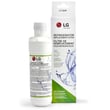
- LG lt1000p refrigerator water filter ADQ74793501
Stable temperatures protect food quality and reduce compressor run time. Catching airflow, door seal, or filter issues early can prevent bigger cooling problems and help your LG bottom-mount refrigerator run efficiently.
For model-specific operating details (temperature settings, Demo mode steps, ice maker notes), use the LFXS26596S manual.
Last updated: January 2026
Why is my LG refrigerator leaking from the bottom?
On the LG LFXS26596S, leaking from the bottom is most often caused by a clogged/iced defrost drain that overflows into the base, or a water supply leak from the dispenser/ice maker plumbing. Start by checking for a frozen drain path and any wet tubing connections behind the unit.
- Look for a sheet of ice or standing water under the crisper drawers (points to a defrost drain issue).
- Check the floor behind the refrigerator for drips at the water line connection and shutoff valve.
- Inspect the door gaskets for gaps, tears, or areas that feel loose (warm air can drive excess frost and meltwater).
- If you have an ice maker, check for water trails near the dispenser area and down the door.
- Verify the refrigerator is level and doors close fully; poor closing can increase frost and defrost water.
Defrost water should flow through a drain channel to a tube and into the drain pan. If the drain is blocked, water can spill and run out at the bottom.
- Clear visible debris and flush the drain with warm water.
- If the drain keeps freezing, the drain tube or routing may need attention.
If you need the model-specific diagrams and maintenance guidance, use the LFXS26596S manual.
A slow leak from the inlet valve, reservoir, or tubing connections can drip down and appear as a bottom leak.
- Pull the refrigerator forward and inspect the tubing and fittings.
- Tighten compression fittings carefully (do not overtighten).
- If a clip is missing or loose, secure the line.
Model-matched parts that can relate to bottom leaks include:
- Refrigerator water inlet valve MJX41869202
- Refrigerator water inlet valve assembly AJU73432806
- Refrigerator water reservoir AJL72911502
| What you see | Most likely source | Where to focus |
|---|---|---|
| Water under crispers, then leaking out | Defrost drain clogged/frozen | Drain channel and drain tube |
| Water only when dispensing or making ice | Water tubing/valve/reservoir leak | Rear connections, door tubing |
| Moisture and frost, then puddles | Door not sealing/closing | Gaskets, leveling, alignment |
Bottom leaks can damage flooring and can also signal airflow or defrost drainage problems that lead to ice buildup and warmer temperatures in the fresh-food section.
Last updated: January 2026
Why is my LG bottom freezer frosting up?
Frost buildup in the freezer of your LG LFXS26596S is most often caused by warm, humid air leaking in (door not sealing) or by a defrost/drain problem that lets moisture refreeze. Start with simple checks, then inspect the drain and defrost components using the LFXS26596S owner’s manual.
- Make sure the freezer drawer closes fully and isn’t being held open by food packages.
- Check the door gaskets for gaps, tears, or areas that feel loose.
- Reduce long door openings; humid air entering the freezer quickly turns into frost.
- Confirm the freezer is set near 0°F (the default for this model family).
- Look for a sheet of ice on the freezer floor; that often points to a drain issue.
When the defrost drain is blocked, defrost water can’t flow to the drain pan; it refreezes and can create a thick ice layer and recurring frost.
What to do (safe DIY steps):
- Unplug the refrigerator.
- Remove the freezer bin(s) and look for ice buildup at the bottom.
- Carefully melt ice with towels and time (avoid sharp tools).
- After thawing, check the drain opening for debris.
If the drain tube is damaged or won’t clear, the compatible replacement for this model is the refrigerator drain tube 5251JA3003D.
If frost is heavy on the back wall or returns quickly after a full defrost, the defrost system or airflow can be involved.
| Frost pattern | Most likely cause | What we check first |
|---|---|---|
| Frost mainly at door edges | Air leak | Door alignment, gasket condition |
| Frost on back wall | Defrost/airflow issue | Evaporator cover, fan operation |
| Ice sheet on freezer floor | Drain issue | Drain opening and drain tube |
Excess frost restricts airflow, makes the compressor run longer, and can lead to warmer temperatures, soft ice cream, and poor ice production.
Last updated: January 2026