Installation guide
 Owner’s manual
 Error Codes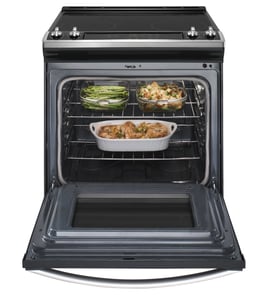



What does PF mean on Kenmore Elite oven?
PF on a Kenmore Elite range model 79046602502 means power failure: the control detected that power to the range was interrupted (for example, after an outage, a tripped breaker, or the cord being unplugged). Clear it by pressing the Clear/Off key as shown in the 79046602502 owner's manual.
How to clear PF and reset the clock
Use these steps after power is restored:
- Press Clear/Off once to acknowledge the PF message.
- Wait about 10 seconds; PF should disappear and you may hear a beep.
- Press Clock.
- Enter the correct time using the number pads.
- Press Start (or the key shown for “start/accept” in your control panel) to save.
What usually causes a PF message
PF is almost always caused by a brief loss of incoming power, not a failed oven part.
| Common cause | What to check | Typical fix |
|---|---|---|
| Power outage or flicker | Lights in home blinked | Clear PF and reset clock |
| Tripped breaker | Range breaker in panel | Reset breaker fully OFF then ON |
| Loose power cord/terminal connection | Power cord and rear connection area | Tighten/repair connection (power off) |
| Service work or moving the range | Range was unplugged | Clear PF and reset clock |
If PF keeps coming back
If PF returns repeatedly without an obvious outage, focus on the power supply connection.
- Check that the range cord is fully seated in the outlet.
- Inspect the outlet for heat damage or looseness.
- If you see burning, melting, or arcing at the power connection, stop using the range and have the connection repaired.
- If the cord connection at the range is suspect, the terminal block is a common repair point; see terminal block 5304409888.
Why it matters
A PF message can reset cooking settings and the clock. Clearing PF and confirming a solid 240V supply helps prevent nuisance shutdowns and protects the electronic control from repeated power interruptions.
Last updated: January 2026
What temperature is hold on a Kenmore oven?
On the Kenmore Elite range model 79046602502, the Warm & Hold feature maintains the oven at 170°F and is designed to keep cooked foods warm for serving for up to 3 hours before it shuts the oven off automatically. See the 79046602502 owner's manual for the exact control steps.
How Warm & Hold works on model 79046602502
Warm & Hold is a low-temperature mode meant for holding already-cooked food, not cooking or reheating from cold.
- Maintains 170°F once activated
- Can be used by itself or after Bake or Convection bake
- Can be set to start automatically after Timed Bake finishes
- Turns off automatically after 3 hours
- You can cancel it any time by pressing Cancel/Stop
Common reasons Warm & Hold does not seem to hold temperature
If food is cooling off faster than expected, the feature is usually working but heat is escaping or the load is too large.
- Door opened frequently (heat dumps quickly at 170°F)
- Food placed in the oven before the oven is fully stabilized
- Very large or very cold cookware pulling heat out of the cavity
- Oven door not sealing well (worn gasket)
- Temperature sensing issue causing uneven holding
Quick checks
| What to check | What you should see | What to do next |
|---|---|---|
| Display shows hold mode | “HLd” or a hold setting | Re-set Warm & Hold per the manual |
| Door seal condition | Gasket is flexible, not torn | Replace the seal if it is damaged |
| Temperature stability | Gentle, steady warmth | Avoid opening the door for 15 to 20 minutes |
Why it matters
Warm & Hold is set to a safe, low holding temperature for short-term serving. Knowing it is 170°F helps you choose the right setting: use Bake for reheating and Warm & Hold only for keeping finished dishes warm.
If you suspect the oven is not regulating temperature correctly, a failed sensor is a common cause; the model uses an oven temperature sensor such as the frigidaire range oven temperature sensor 316217002.
Last updated: January 2026
Why is my Kenmore Elite oven not working?
If your Kenmore Elite electric range model 79046602502 oven is not working, the most common causes are a power supply problem, an incorrect control setting, or a failed heating or sensing component. Use the troubleshooting section in the 79046602502 owner's manual to match your symptom to the right checks.
Quick checks first (no tools)
- Confirm the range is plugged in securely.
- Reset the double-pole breaker fully OFF, then ON (a half-tripped breaker can leave the oven weak or dead).
- After a power outage, turn the oven OFF, then reselect Bake or Broil and set a temperature.
- If the door is locked after self-clean, let the range cool completely, then cancel the cycle.
- Make sure you selected a cooking mode and temperature (not just the clock or timer).
Most likely part-related causes
- A failed oven temperature sensor can prevent heating or cause erratic temperatures; the model uses an oven sensor circuit that you can test with a meter. If needed, replace the frigidaire range oven temperature sensor 316217002.
- Heat damage or a loose connection at the power terminal block can interrupt power to oven circuits.
- A stuck door lock circuit can keep some ranges from heating normally after self-clean.
What to test (basic electrical)
Turn off power at the breaker before removing panels.
- Inspect the terminal block area for discoloration, melted wire, or loose screws.
- Check the oven temperature sensor resistance and compare it to the specification listed in the manual.
- Reseat wiring harness connections at the control if the oven heats intermittently.
Symptom-to-cause guide
| Symptom | Most common cause | Next step |
|---|---|---|
| Display works, no heat | Sensor, control, wiring, door lock | Test sensor, inspect connections |
| Entire range dead | Breaker, cord, terminal block | Reset breaker, inspect terminal block |
| Stopped after self-clean | Door lock system, overheated wiring | Cool down, cancel, check lock circuit |
Why it matters
Electric ovens need full 240V power and accurate temperature feedback to heat safely and evenly. A loose power connection or drifting sensor can stop heating, cause long preheat times, or create temperature swings.
Last updated: January 2026