Installation guide
 Owner’s manual
 Error Codes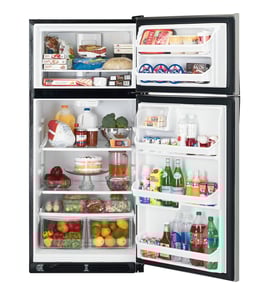


What is the upper part of a fridge called?
On the Frigidaire FFHT1621QW0 top-mount refrigerator, the upper section is the freezer compartment. It’s the coldest area of the appliance, designed to keep foods frozen and to support ice-making features on models equipped with an ice maker.
What the freezer compartment does
The freezer compartment is built to:
- Maintain freezing temperatures for long-term food storage
- Circulate cold air (shared cooling system) to help stabilize temperatures
- Support ice production if your refrigerator has an automatic ice maker
- Work with the refrigerator/freezer temperature control so changes affect both sections
Common names you may see
Different manuals and parts diagrams may use slightly different terms.
| What you call it | What it usually means | Where it is on FFHT1621QW0 |
|---|---|---|
| Freezer compartment | The frozen-food storage area | Upper section |
| Freezer section | Same as freezer compartment | Upper section |
| Freezer cabinet | The insulated freezer “box” | Upper section |
Why it matters
Knowing the correct name helps when you’re ordering parts, reading troubleshooting steps, or following setup instructions. For example, temperature adjustments on this style of refrigerator typically change temperatures in both the refrigerator and freezer compartments.
Helpful references for this model
- Use the FFHT1621QW0 owner’s manual for the exact terminology and control descriptions.
- Use the FFHT1621QW0 installation guide for placement, clearance, and leveling details that help doors close and seal properly.
Last updated: January 2026
Which is better top mount or bottom mount freezer?
For most households, a top-mount freezer like the Frigidaire FFHT1621QW0 is the better pick when you want simple reliability and strong energy efficiency; a bottom-mount is better when you want fresh-food items at eye level and bend less day to day. Use your priorities (cost, ergonomics, and access) to decide.
Quick comparison (what changes in real use)
| Feature | Top-mount freezer | Bottom-mount freezer |
|---|---|---|
| Fresh-food access | Lower shelves require more bending | Most-used items are higher and easier to reach |
| Freezer access | Easy, at chest/eye level | Lower, often a pull-out drawer |
| Energy use (typical) | Often lower | Often slightly higher |
| Price and complexity | Usually lower and simpler | Usually higher and more complex |
| Organization style | Traditional shelves/bins | Drawer-style storage, often better separation |
When we recommend a top-mount freezer
- You want a straightforward layout with fewer moving parts.
- You use the freezer often and want it higher.
- You want strong value and typically lower operating cost.
- You have a tighter kitchen budget or want simpler long-term maintenance.
- You prefer classic door storage and shelf access.
When we recommend a bottom-mount freezer
- You use the refrigerator section far more than the freezer.
- You want less bending for fresh-food access.
- You like pull-out freezer drawers for organizing frozen foods.
- You are willing to pay more for convenience and layout.
Why it matters
The “better” choice is the one that matches how you actually use the refrigerator. If you open the fresh-food door dozens of times a day, bottom-mount convenience can be worth it. If you want efficient, simple cooling with a familiar layout, top-mount models like FFHT1621QW0 are a strong fit.
Model-specific tip for FFHT1621QW0 owners
If you are comparing styles because of fit or installation concerns, follow the clearance, leveling, and final check steps in the FFHT1621QW0 installation guide. Proper leveling and door sealing help any style cool efficiently.
Last updated: January 2026
What is the most common problem with a Frigidaire refrigerator?
The most common problem we see on Frigidaire refrigerators like model FFHT1621QW0 is a cooling complaint (fresh food too warm, freezer not cold enough, or temperatures swinging). In many cases, the fix is basic maintenance or airflow restoration before any parts are replaced.
What to check first (fast, no-parts steps)
- Confirm the refrigerator is actually running and plugged in firmly.
- Make sure the temperature controls are not set to “0” or “OFF” (that stops cooling but does not shut off power to lights).
- Allow 24 hours after any control change for temperatures to stabilize.
- If it recently stopped cooling, wait about 20 minutes and recheck; it may be in a normal defrost cycle.
- Avoid blocking vents with food packages; restricted airflow mimics a “not cooling” failure.
Common causes behind “not cooling” symptoms
Cooling issues usually come from one of these areas:
- Air movement problem in the freezer (evaporator fan not moving air)
- Temperature sensing/control issue (thermistor or control not reading correctly)
- Sealing issue (warm air leaking in through a door gasket)
- Power or control setting issue (controls off, outlet problem, breaker/fuse)
Parts that commonly relate to cooling complaints
If the basic checks do not restore normal temperatures, these model-matched parts are often involved:
| Symptom you notice | Likely area | Example model-matched part |
|---|---|---|
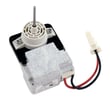
| Freezer cold but fridge warm | Airflow from freezer to fridge | Refrigerator motor 242077705 |
| Temps swing or seem inaccurate | Temperature sensing | Refrigerator temperature sensor 240597220 |
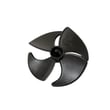
| Frost buildup, weak airflow | Fan area obstruction or damage | Refrigerator evaporator fan blade 242219302 |
Why it matters
A refrigerator that is even a few degrees too warm can shorten food life quickly. Catching airflow restrictions, control settings, and early fan or sensor problems helps prevent bigger failures like compressor strain.
Helpful references for this model
- Use the FFHT1621QW0 owner’s manual for control settings, safety steps (unplug before cleaning or replacing a light bulb), and the “before calling for service” checklist.
- For model-specific troubleshooting patterns, use Frigidaire refrigerator error codes.
Last updated: January 2026