 Installation guide
 Owner’s manual
 Error Codes


How to hard reset a Kenmore dryer?
To hard reset your Kenmore gas dryer model 11072102311, unplug the dryer (or disconnect power) for about 1 to 5 minutes, then restore power and try a cycle again. This clears many temporary control glitches, but it will not fix airflow, heat, or safety-switch problems.
- Turn the dryer off.
- Unplug the power cord (or switch the breaker off).
- Wait 1 to 5 minutes.
- Plug the dryer back in (or turn the breaker on).
- Close the door fully.
- Press and hold PUSH to START until you hear the dryer start and the drum begins moving.
For model-specific operating and safety notes, follow the steps in the 11072102311 owner's manual.
A “reset” often seems to help because the dryer is right on the edge of a real issue. On this model, the most common no-start or no-heat causes are basic and mechanical.
- Door not fully closed (the door switch must be made)
- Start button not held long enough
- Restricted venting or lint buildup (can cause long dry times and overheating shutdowns)
- Gas supply shutoff valve not open (gas dryers need the supply valve open)
- Blown house fuse or tripped breaker (power issue can mimic a control problem)
If the dryer will not start when the door is shut, a failed door switch is a frequent fix; see the dryer door switch WP3406107.
| What you see | What it usually points to | What to do next |
|---|---|---|
| Nothing happens when you press Start | Door switch, Start not held, power issue | Confirm door closes, hold Start, check breaker |
| Drum turns but no heat | Gas valve closed, burner ignition issue, airflow restriction | Open gas valve, verify strong airflow at vent outlet |
| Dry times suddenly much longer | Lint screen or vent restriction | Clean lint screen, inspect vent path |
A hard reset clears the control state, but airflow and heat problems can keep coming back and can shorten part life (thermostats, thermal cut-offs, igniter). Keeping the lint screen and venting clear is the fastest way to prevent repeat shutdowns and poor drying.
Last updated: January 2026
How to tell if a dryer start switch is bad?
A bad start switch on your Kenmore gas dryer model 11072102311 usually shows up as a dryer that has power but will not begin tumbling when you press and hold Start. The most reliable check is a continuity test with the dryer unplugged, following the start-button instructions in the 11072102311 owner’s manual.
- You press and hold Start and nothing happens (no motor hum, no drum movement).
- The dryer only starts if you wiggle or press the button unusually hard.
- The Start button feels loose, sticks, or does not “spring back” normally.
- The dryer stops responding even though the door is closed and the controls are set to On.
- Unplug the dryer (or switch off power at the breaker).
- Access the console area where the start switch is mounted (use the disassembly guidance in the 11072102311 installation guide).
- Pull the wires off the switch terminals (note their positions).
- Set a multimeter to ohms/continuity.
- Test the switch:
- Not pressed: meter should read open/infinite resistance.
- Pressed and held: meter should read near 0 ohms (continuity).
If the reading stays open when pressed, or it never changes, the start switch is bad.
Before replacing parts, we check these basics because they can mimic a bad start switch:
- Door fully closed (a failed door switch can prevent starting; see dryer door switch WP3406107)
- Start button pressed and held long enough (many models require about 3 seconds)
- Power supply present (outlet, fuse, breaker)
- Controls set to a running/On position
| Test result | What it usually means | Next step |
|---|---|---|
| Open when not pressed; continuity when pressed | Start switch is good | Check door switch, timer, motor, thermal cut-off |
| Open all the time | Start switch failed | Replace start switch (or console switch assembly) |
| Continuity all the time | Switch stuck/shorted | Replace switch and inspect wiring |
The start switch is the momentary “command” that energizes the motor circuit. If it fails, the dryer can have lights and control response but still never begin tumbling, so confirming continuity prevents unnecessary replacement of the motor, timer, or thermal fuse.
Last updated: January 2026
How to test a dryer temperature switch?
To test the temperature switch (thermostat) in your Kenmore gas dryer model 11072102311, we unplug power, access the thermostat, then use a multimeter to check continuity across the switch terminals at room temperature; most closed thermostats read near 0 ohms.
- Unplug the dryer before opening panels.
- Shut off the gas supply valve if you will be working near the burner area.
- Let the dryer cool completely; thermostats can stay hot after a cycle.
- Avoid pulling on wires; remove connectors by the terminal, not the wire.
- Digital multimeter with continuity or ohms (Ω)
- Nut driver or screwdriver (panel access)
- Phone camera (to record wire locations)
- Disconnect power and open the access panel to reach the temperature switch (often mounted on the blower housing or heater/burner duct).
- Label and remove wires from the thermostat terminals.
- Set the meter to continuity (beep) or lowest ohms.
- Touch one probe to each thermostat terminal.
- Interpret the reading:
- Beep or 0 to 1 Ω: switch is closed (typical at room temperature for many operating thermostats)
- OL or very high resistance: switch is open (could be failed, or could be a normally-open style depending on location)
| Meter result | What it usually means | What to check next |
|---|---|---|
| 0 to 1 Ω / beeps | Thermostat contacts closed | Look for airflow or burner issues if heat is still wrong |
| OL / no beep | Thermostat contacts open | Confirm you are testing the correct part; inspect for overheating and vent restriction |
| Reading jumps around | Loose terminal or failing contact | Recheck probe contact; inspect terminals for corrosion |
If the dryer overheats, cycles heat oddly, or shuts down, these parts are commonly inspected as a set:
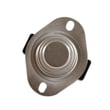
- Dryer operating thermostat WP3387134
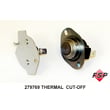
- Thermal cut-off and high-limit devices (often replaced together)
- Lint screen and exhaust venting (restricted airflow can mimic a bad thermostat)
A good temperature switch helps regulate drum temperature and protects components. When it fails or when airflow is restricted, you can see long dry times, overheating, or heat that cycles off too soon. For model-specific access steps and panel removal, follow the 11072102311 installation guide and the 11072102311 owner’s manual.
Last updated: January 2026
How much does it cost to replace a heating element in a Kenmore dryer?
For a Kenmore dryer, replacing a heating element typically costs $20 to $120 for the part and $150 to $350+ total if you hire a technician (labor and service call included). For Kenmore 11072102311 (a gas dryer), “no heat” is often caused by gas-heat components, not an electric heating element; use the 11072102311 installation guide troubleshooting checks first.
Costs vary by dryer design (electric vs gas), access, and whether you replace related wear items.
- DIY part only: $20 to $120 (most common range)
- DIY supplies: $0 to $25 (terminals, screws, vent tape as needed)
- Professional labor: $100 to $250+
- Service call/diagnostic: $50 to $120 (often applied to repair)
| Scenario | What you pay for | Typical total |
|---|---|---|
| DIY replacement | Part only (plus small supplies) | $20 to $145 |
| Pro replacement | Part + labor + service call | $150 to $350+ |
| “No heat” on gas dryer | Diagnosis + igniter/sensor/thermostat as needed | $150 to $400+ |
Kenmore 11072102311 is a gas dryer, so a “heating element” quote usually applies to electric dryers. On gas models, heat is produced by the burner assembly, and common no-heat culprits include:
- Burner igniter
- Radiant sensor
- Operating thermostat
- High-limit thermostat or thermal cut-off
- Gas valve coils/valve issues
If the dryer runs but does not heat, we use the same first checks the installer guide calls out (cycle selection, power supply, door closed, etc.).
If you are pricing the repair for this specific model, these are common heat-related parts to compare:
- Igniter 279311 (burner ignition)
- Dryer radiant sensor WP338906 (flame sensing)
- Dryer operating thermostat WP3387134 (temperature regulation)
- Dryer high-limit thermostat W11050897 (overheat protection)
Accurate pricing starts with the correct heat system. Quoting an electric heating element for a gas dryer can send you toward the wrong part, while the real fix is often a sensor, igniter, or thermostat.
Last updated: January 2026








