Owner’s manual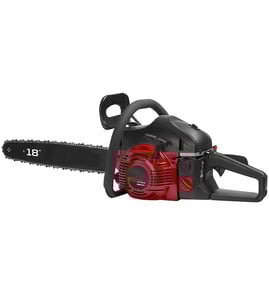






Do you use 40 1 or 50 1 gas in a chainsaw?
For the Craftsman chainsaw model 358351081, we use a 40:1 gas-to-oil mix. That means mixing 3.2 oz of 2-cycle air-cooled engine oil with 1 gallon of unleaded gasoline, as specified in the 358351081 operator’s manual.
Correct fuel mix for this model
Use these guidelines when you mix fuel for a 2-cycle Craftsman chainsaw:
- Mix 40 parts gasoline to 1 part 2-cycle oil (40:1)
- Use unleaded gasoline
- Use 2-cycle air-cooled engine oil (not automotive oil)
- Do not use boat/marine 2-cycle oil
- Shake the fuel container briefly after mixing so the oil blends evenly
Quick mix chart (40:1)
| Gasoline amount | 2-cycle oil needed |
|---|---|
| 1 gallon | 3.2 oz |
| 1/2 gallon | 1.6 oz |
| 1 quart | 0.8 oz |
Why 40:1 matters
A 2-cycle engine depends on oil mixed into the fuel for lubrication. Running 50:1 in a saw designed for 40:1 reduces lubrication and can accelerate wear in the piston, cylinder, and crank bearings.
If your saw is hard to start after fueling
Fuel mix issues often show up as hard starting, rough running, or stalling. Check these common causes:
- Old fuel (especially fuel left in the tank for weeks)
- Incorrect oil type (automotive or marine oil)
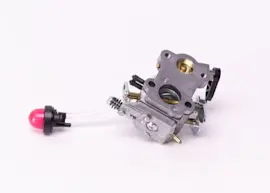
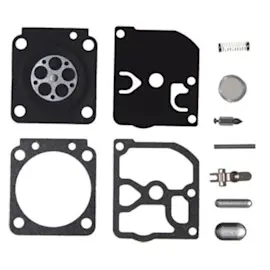
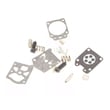
- Dirty carburetor passages or stiff diaphragms
- Cracked or leaking fuel line (a common cause of air leaks)
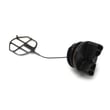
- Loose or damaged fuel cap seal
If you suspect a fuel delivery problem, the tips for a hard to start chainsaw guide is a good next step.
Last updated: January 2026
How to adjust L and H on a chainsaw?
On the Craftsman 358351081 gas chainsaw, adjust the carburetor L (low) and H (high) mixture screws in tiny steps to correct hesitation, bogging, smoking, or loss of cutting power. Warm the engine first, then tune L for acceleration and H by making a test cut, not by sound alone. See the Craftsman 358351081 owner's manual for screw locations and the factory preset procedure.
Before you touch the L and H screws
Many “carburetor” problems are caused by basic maintenance issues. Check these first:
- Use fresh, properly mixed fuel (old fuel causes hard starting and rough running)
- Clean or replace the air filter
- Check the fuel filter and fuel lines for restriction or cracking
- Make sure the saw is not flooded (wet spark plug, strong fuel smell)
- Confirm the chain is correctly tensioned and the bar is not binding
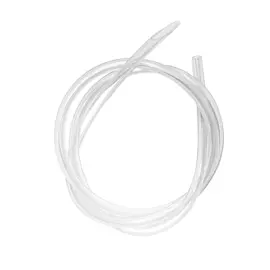
If the saw is leaking fuel or the fuel line is brittle, replace the line with the ayp lawn & garden equipment fuel line, large 530069216.
Where the screws are and what they do
Your carburetor has three adjustment screws:
- L: low-speed mixture (idle to acceleration)
- H: high-speed mixture (power under load while cutting)
- T: idle speed (sets idle RPM so the chain does not move)
They are typically located just above the primer bulb on this model.
Step-by-step adjustment (recommended order)
- Warm up: Start the saw and let it run about 3 minutes.
- Set idle speed (T): Adjust until the engine idles without stalling and the chain does not move.
- Adjust low-speed mixture (L):
- Snap the throttle and watch response.
- If it hesitates, bogs, or smokes, turn L clockwise in 1/16-turn increments until acceleration is clean.
- Adjust high-speed mixture (H):
- Make a test cut.
- Turn H in 1/16-turn increments based on cutting performance.
Quick guide: what to turn
| Symptom | Adjust | Direction | Increment |
|---|---|---|---|
| Chain moves at idle | T | Counterclockwise | Small steps |
| Won’t idle or stalls at idle | T, then L | T clockwise; L fine-tune | 1/16 turn on L |
| Hesitates on acceleration | L | Clockwise | 1/16 turn |
| Lacks power in the cut | H | Fine-tune during test cut | 1/16 turn |
Why it matters
Running too lean (often from over-tightening mixture screws) reduces lubrication and cooling in a 2-cycle engine. Correct L and H settings protect the cylinder and piston while keeping cutting power strong.
Last updated: January 2026
What model number is a Craftsman 16 36cc chainsaw?
For Craftsman chainsaws, the “16-inch bar” and “36cc” description is commonly associated with model 358.351161 (16-inch bar) in the same family as model 358.351081 (18-inch bar). To confirm your exact model number, match the number on the saw’s ID label to the model list in the 358351081 operator’s manual.
How to identify the correct model number on your saw
Use the saw’s ID label first; marketing descriptions (like “16 36cc”) are often shared across multiple models.
- Look for a model/serial label on the starter housing, rear handle area, or near the fuel tank.
- Write the model number exactly as shown (including dots, if present).
- Compare it to the model callouts in the manual: 358.351081 (18-inch bar) and 358.351161 (16-inch bar).
- If the label is worn, check for a stamped/printed number on the chassis or inside the top cover.
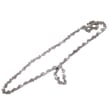
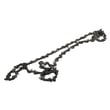
- Use the model number to select the correct bar, chain, and engine parts.
16-inch vs 18-inch in this Craftsman family
These two models are closely related; the bar length is a key differentiator.
| Model number | Bar length (as listed) | What it affects most |
|---|---|---|
| 358.351161 | 16 in. | Bar and chain fit, cutting capacity |
| 358.351081 | 18 in. | Bar and chain fit, cutting capacity |
Why it matters
The correct model number ensures you get parts that fit and function safely, especially wear items like the bar and chain, and service parts like fuel system components.
If you are troubleshooting hard starting or fuel issues while identifying the model, our tips for a hard to start chainsaw guide helps you narrow down common causes.
Last updated: January 2026