Installation guide
 Owner’s manual
 Error Codes


What's the life expectancy of a Maytag dryer?
A Maytag dryer typically lasts 10 to 13 years. With consistent venting and lint maintenance, many Maytag electric dryers like MED8100DW0 reach 15 years of service; the drum and drive motor are designed for long-term durability when the dryer is installed and maintained correctly (see the MED8100DW0 owner's manual).
Most household dryers fall into these ranges:
| Usage and care level | Typical lifespan | What usually ends the dryer’s life |
|---|---|---|
| Light use, excellent maintenance | 14 to 18 years | Wear parts (rollers, belt, idler), airflow issues |
| Average family use | 10 to 13 years | Heating and airflow components, drum support wear |
| Heavy use, poor venting/maintenance | 7 to 10 years | Overheating damage, repeated thermal fuse trips |
We see the biggest lifespan gains when you focus on airflow and friction wear points.
- Clean the lint screen before or after each load (as directed in the manual)
- Keep the area around the exhaust outlet free of lint and dust
- Have the interior cabinet and exhaust vent cleaned periodically by qualified service personnel
- Avoid overloading; it strains the drum support system and drive components
- Fix squealing, thumping, or rumbling early (often drum support wear)
If your MED8100DW0 is noisy, slow to dry, or overheating, these are frequent wear or protection parts:
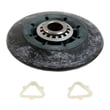
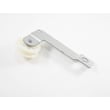
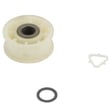
- Dryer drum support roller WPW10314173 (worn rollers can cause rumbling and extra motor load)
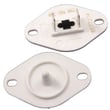
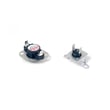
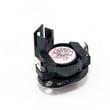
- Dryer thermal cut-off fuse kit 279973 (opens if the dryer overheats, often from restricted venting)
- Dryer thermistor WP8577274 (helps regulate temperature; failures can cause heat problems)
A dryer that takes longer to dry or runs hotter than normal wears out faster and can repeatedly trip safety devices. Good vent airflow and timely replacement of wear parts usually cost less than replacing the dryer.
Last updated: February 2026
Where can I find the model number on a Maytag dryer?
On your Maytag MED8100DW0 electric dryer, the model number is printed on the appliance identification label. We most often see that label on the door opening (door jamb) or on the cabinet frame just inside the door; some units also place it on the back near the top.
- Open the dryer door and look along the door opening (left or right door jamb)
- Check the cabinet frame just inside the door opening
- Look on the rear panel near the top edge
- If your dryer is stacked, check the door area first (easiest access)
The Use and Care information for Maytag dryers calls out having the model and serial number available when you need service or parts.
| What to record | Example format | Why it matters |
|---|---|---|
| Model number | MED8100DW0 | Ensures parts diagrams and parts match your exact dryer |
| Serial number | Letters and numbers | Helps confirm production series and correct substitutions |
| Purchase date | Month/day/year | Useful for service and warranty paperwork |
- Wipe the label gently with a dry cloth (lint can hide characters)
- Use your phone camera and zoom in; compare confusing characters (0 vs O, 1 vs I)
- Copy the model number exactly, including all letters and digits
Maytag dryers can look similar across series, but parts such as a thermistor, moisture sensor, or drum support roller can vary by model. Using the exact MED8100DW0 model number helps us match the right Maytag dryer parts the first time.
For more details on where Maytag lists identification information and what to record, check the MED8100DW0 owner’s manual.
Last updated: February 2026
What are the most common issues with MED8100DW0?
The most common issues we see with the Maytag MED8100DW0 electric dryer are no heat (even though the drum turns), long dry times from restricted airflow, and unusual noises or vibration from leveling or drum support wear. The owner's manual troubleshooting section covers these symptoms and quick checks.
- Dryer runs but won’t heat: a tripped breaker or blown fuse on one leg of the 240V supply (the drum can still turn with partial power).
- Clothes take too long to dry: blocked or crushed venting, too many vent turns, or an overloaded drum.
- Check Vent indicator lit: lint screen or vent restriction.
- Thumping/rattling/vibration: temporary flat spots on rollers after sitting, small objects at drum edges, or the dryer not level.
- Steam cycle humming/whining (if equipped): water pump or inlet valve running; louder after long periods of non-use.
- Clean the lint screen before every load.
- Run the dryer 5 to 10 minutes and check strong airflow at the outside exhaust hood.
- Verify the dryer is level; all four feet must be firmly on the floor (installation-related vibration is common).
- For “no heat”, check both household fuses or reset the double breaker (electric dryers require 240V).
- If Sensor cycles end early or under-dry, increase the dryness level or use Timed Dry for 5 to 10 minutes.
| Symptom | Commonly involved part | Example from this model’s parts list |
|---|---|---|
| No heat or overheating shutdown | Thermal cut-off or thermostat | Dryer thermal cut-off fuse kit 279973, dryer high-limit thermostat WP8557403 |
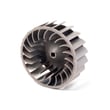
| Long dry times with good heat | Blower airflow issue | Dryer blower wheel WP697772 |
| Thumping/squealing | Drum support wear | Dryer drum support roller WPW10314173 |
Restricted airflow and overheating protection trips can turn a simple vent cleaning into repeated “no heat” complaints. Addressing airflow first also helps protect the heating circuit and improves drying performance.
Last updated: March 2026