Owner’s manual
 View engine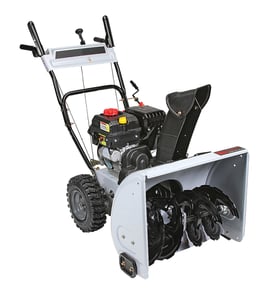




Should I spray my snowblower with WD-40?
Yes, you can spray a light coating on the snow-contact areas of your Craftsman 536886122 to help reduce clogging, but we recommend using a silicone-based spray (or another non-stick product) on the chute and auger housing rather than regular WD-40. Avoid spraying anything on drive components where slip is required.
Use a non-stick spray only on clean, dry metal where snow slides.
- OK: inside the discharge chute and chute deflector
- OK: inside the auger housing (the “bucket”)
- OK: painted exterior surfaces for light moisture protection (wipe excess)
- Not OK: friction wheel, disc drive plate, belts, pulleys, or any braking/friction surfaces
- Not OK: hot muffler area or directly on the engine while running
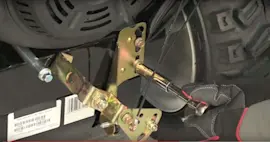
For model-specific safety and control locations, follow the guidance in the 536886122 owner’s manual.
Regular WD-40 can work briefly, but it tends to wear off quickly in wet snow. A silicone spray usually lasts longer and is less likely to attract grime.
| Product type | Best use on a snowblower | Notes |
|---|---|---|
| Silicone spray | Chute and auger housing | Longer-lasting “slick” coating |
| Regular WD-40 | Light moisture displacement on metal | Short-lived for anti-stick |
| Wax/non-stick spray | Chute and auger housing | Reapply as needed |
Clogging is usually a snow condition or adjustment issue, not just a lubrication issue.
- Run the engine at full throttle while throwing snow (control ground speed with the drive)
- Clear packed snow from the chute before it freezes
- Check skid shoe and scraper bar setup for your surface
- Inspect auger engagement and belt condition if discharge is weak
If discharge performance is poor and the auger system is slipping, the auger belt may be worn; the compatible replacement for this model is the auger belt 37X120MA.
Spraying the wrong area can cause drive slippage, poor traction, or belt contamination. Keeping sprays limited to the chute and auger housing helps snow flow while protecting the friction-drive system.
Last updated: January 2026
Is it cheaper to repair or replace a snowblower?
For a Craftsman snow thrower model 536886122, repair is usually cheaper when the issue is limited to normal-wear items (belts, friction disc, shear bolts) and the engine and auger housing are in good shape. Replacement often makes more sense when multiple major systems need work at once.
We typically recommend repairing when the total repair cost (parts + labor) is under about 50% of what you would pay for a comparable new snowblower. If you are over 50%, replacement is often the better value.
| If your estimate is... | Best choice | Why |
|---|---|---|
| Under ~25% of new | Repair | Strong value; extends life cheaply |
| ~25% to 50% of new | Usually repair | Worth it if the engine is healthy |
| Over ~50% of new | Consider replace | Cost risk rises fast |
These are typical high-impact, lower-cost fixes on a dual-stage unit like the 536886122:
- Replace a worn ground drive belt (loss of forward/reverse drive)
- Replace a worn auger belt (won’t throw snow)
- Replace a worn friction disc (slipping or no propulsion)
- Adjust control cables and belt guides
- Basic tune-up items (spark plug, oil change, fresh fuel)
For model-specific procedures and adjustment points, use the 536886122 owner’s manual.
- Snowblower drive belt 1733324SM (ground drive)
- Auger belt 37X120MA (auger/impeller drive)
- Frction disc 1501435MA (friction wheel assembly)
Replacement tends to win when you have stacked problems, such as:
- Engine issues plus drive issues (for example, hard starting plus no propulsion)
- Severe rust-through or structural damage (auger housing/frame)
- Repeated belt failures caused by bent pulleys, damaged bearings, or misalignment
- Repair requires extensive teardown and paid labor time
Snowblowers like the Craftsman 536886122 often fail in predictable wear areas first. Fixing a belt or friction disc can restore performance quickly, but chasing multiple major issues can turn into a high-cost repair with uncertain results.
Last updated: January 2026
Where is the model number on a Craftsman snowblower?
On Craftsman snow thrower model 536886122, the model number is typically on a product identification label on the rear of the unit, often on the back of the frame or the rear of the metal base near the wheels. You’ll usually see it printed as 536.886122 (with a dot) as shown in the 536886122 owner’s manual.
- Rear of the frame, behind the engine
- Rear of the metal base between or just above the wheels
- Lower handle to frame junction area
- Side of the frame near the auger housing
- Near the engine area (note: labels here may be for the engine, not the snowblower)
It’s common to find an engine tag and mistake it for the snowblower model. For model 536886122, the manual lists an engine model number 143.975001, which is used for engine-only parts.
| Number type | Identifies | Used for |
|---|---|---|
| Snowblower model number | The whole Craftsman unit | Parts diagrams and most replacement parts |
| Engine model number | The engine only | Carburetor, ignition, recoil starter parts |
- Wipe the label with a damp rag; avoid harsh solvents that can remove printing.
- Check for a second label under the handle area or near the axle.
- If you’re replacing common wear items, confirm fit by the snowblower model; for this model, examples include the snowblower drive belt 1733324SM and the auger belt 37X120MA.
Craftsman 22-inch dual-stage snow throwers can look similar, but belt sizes, chute hardware, and drive components can vary by model. Using 536886122 helps ensure the correct parts match the first time.
Last updated: January 2026