Error Codes


How do I tell if my dryer heating element is bad?
If your Kenmore dryer model 11061062000 runs but clothes stay damp or cold, the heating element is a top suspect. We confirm it by checking airflow first, then testing the element for continuity with a multimeter; an open circuit means the element has failed.
Quick symptoms to look for
- Dryer tumbles normally but produces little or no heat
- Cycles take much longer than normal to dry
- Clothes feel cool at the end of a heated cycle
- Burning smell or visible scorching inside the heater housing
- Breaker trips when heat should turn on (less common)
Before you test: rule out airflow problems
Poor venting can mimic a bad heater and can also cause repeated overheating failures.
- Clean the lint screen and confirm it is not torn or clogged
- Check the exhaust duct for kinks, crushing, or heavy lint buildup
- Make sure the outside vent hood opens freely
- Run a timed dry cycle and confirm strong airflow at the vent outlet
How to test the heating element (basic continuity check)
- Disconnect power (unplug the dryer; for electric dryers, verify power is off).
- Access the heater terminals (location varies by design).
- Remove at least one wire from the element terminal.
- Set a multimeter to continuity or resistance (ohms).
- Test across the element terminals.
What the meter results mean
| Meter result | What it usually indicates | Next step |
|---|---|---|
| Continuity present (finite resistance) | Element is not open | Check thermostats, thermal fuse, airflow |
| No continuity (open circuit) | Heating element is bad | Replace the element |
If you need the correct replacement for this model, use the exact part listed for your dryer: dryer heating element WP3387747.
Related parts that can stop heat
A good element still will not heat if a safety device is open.
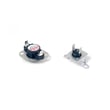
- Dryer thermal fuse WP3390719 (opens if the dryer overheats)
- Cut-off tmnl 279973 (thermal cut-off kit used in the heater circuit)
- Dryer high-limit thermostat WP3391914 (limits heater temperature)
Why it matters
Replacing the heating element without fixing restricted airflow often leads to repeat failures of the heater, thermal fuse, or high-limit thermostat. A quick vent inspection saves time and protects the new part.
Last updated: January 2026
How to hard reset a Kenmore dryer?
To hard reset a Kenmore dryer model 11061062000, we disconnect power long enough to clear the control and then restore power for a fresh start. If the dryer still will not run or heat after the reset, we troubleshoot airflow and safety devices next.
Hard reset steps (works for most Kenmore dryers)
- Turn the dryer OFF.
- Unplug the power cord (or switch the dryer breaker OFF).
- Wait 1 to 5 minutes.
- Restore power.
- Select a normal cycle and press Start.
If the reset does not fix it
A reset clears a temporary control glitch, but it will not bypass a failed safety part or a venting problem. Check these common causes:
- No heat or stops mid-cycle: restricted venting, overheating, or a blown thermal fuse
- Will not start: door not latching, failed door switch, or blown thermal fuse
- Long dry times: lint screen clogged, crushed exhaust duct, blocked outside hood
- Overheating smell: lint buildup in the blower housing or ducting
Parts that commonly stop the dryer after an overheat
If airflow is restricted, the dryer can overheat and open a safety circuit. These parts are common on Kenmore 110-series designs:
Quick comparison
| Symptom | Most likely area to check | Typical fix |
|---|---|---|
| Runs but no heat | Heating circuit | Test heater and safety devices; replace failed part |
| Won’t start at all | Door switch or safety circuit | Verify latch, test fuse/switch |
| Takes too long to dry | Venting and airflow | Clean lint path; correct ducting |
Why it matters
A hard reset is safe and fast, but repeated overheating usually points to a vent restriction. Fixing airflow protects the heating element, thermostats, and wiring, and helps the dryer dry faster with less wear.
Last updated: January 2026
How to tell if a dryer switch is bad?
A bad dryer switch on Kenmore model 11061062000 usually shows up as a dryer that will not start even though it has power. We confirm it by unplugging the dryer and checking the switch with a multimeter; the reading should change when the switch is pressed.
Quick symptoms to look for
- Dryer will not start, but the drum light and other functions may still work
- Start button feels loose, sticks, or does not “click” consistently
- Dryer starts only if you press and hold the button in a certain spot
- Intermittent starting (works sometimes, dead other times)
- No change in behavior after resetting the breaker
How we test a dryer switch (basic continuity check)
- Unplug the dryer (or switch off the breaker) before opening any panels.
- Access the switch (often in the control console area).
- Remove at least one wire from the switch terminal so you are not reading through the circuit.
- Set a multimeter to continuity or ohms (Ω).
- Test the switch:
- Not pressed: meter should read open/infinite resistance
- Pressed: meter should read closed/near 0 Ω
If the reading never changes, or stays open when pressed, the switch is bad.
What else can mimic a bad switch
A “no start” complaint is not always the start switch. Check these common causes first:
- Door not closing fully (latch/strike alignment)
- Blown thermal fuse (often caused by restricted venting) such as dryer thermal fuse WP3390719
- Failed drive motor such as drive motor 279787
- Loose wire connection at the switch or timer/control
Fast comparison table
| What you see | Most likely issue | What to do next |
|---|---|---|
| Button pressed, no click, no continuity change | Start switch | Replace the switch (match by model) |
| Dryer runs, but shuts off and will not restart | Overheat protection | Check venting, test thermal fuse |
| Door must be slammed to start | Door closure issue | Inspect strike and latch alignment |
Why it matters
A failing switch can look like a power problem, but it is usually a simple control-circuit failure. Testing the switch and the thermal fuse first helps avoid replacing larger parts unnecessarily.
Last updated: January 2026