Owner’s manual
 Error Codes

What is the advantage of a bottom mount fridge?
A bottom-mount refrigerator like the Maytag MFI2665XEB1 keeps the fresh-food compartment at eye and waist level, so you reach everyday items with less bending. The freezer stays below, which is convenient for bulk storage and helps keep frequently used foods easiest to access (see the owner's manual).
- Easier access to fresh foods (produce, dairy, leftovers) without crouching
- Better organization for items you use most often in the refrigerator section
- Freezer drawer/basket storage makes it simpler to separate meats, frozen meals, and ice
- Less strain on your back and knees compared with a top-freezer design
- Wide refrigerator shelves are easier to see and keep clean
Bottom-mount designs are a great fit for most kitchens, but these are the common compromises:
| Feature | Bottom-mount refrigerator | Top-freezer refrigerator |
|---|---|---|
| Fresh-food access | Best (at eye level) | Requires more bending |
| Freezer access | More bending | Easier reach |
| Organization | Often better in fridge section | Often simpler overall |
| Typical cost | Usually higher | Usually lower |
Most households open the refrigerator section far more than the freezer. With a bottom-mount layout, the foods you grab multiple times a day stay in the most comfortable reach zone, which improves convenience and reduces physical strain.
- Keep the most-used items on the middle shelves
- Use crisper drawers for produce to reduce clutter on main shelves
- Avoid overpacking the freezer drawer so it can close fully and seal well
Last updated: February 2026
Which is better, top mount or bottom mount refrigerator?
A bottom-mount refrigerator like the Maytag MFI2665XEB1 is usually better if you want everyday convenience because fresh-food shelves sit at eye level. A top-mount is usually better if you want a lower upfront cost and don’t mind bending more often for refrigerated items; see the owner's manual for your model’s features and layout.
| Feature | Top-mount (freezer on top) | Bottom-mount (freezer on bottom) |
|---|---|---|
| Most-used section | Fridge is lower | Fridge is higher (more convenient) |
| Freezer access | Easier | More bending unless it’s a pull-out drawer |
| Organization | Simpler shelves | Often better drawer-style storage |
| Typical price | Lower | Higher |
| Best for | Budget, basic needs | Convenience, fresh-food use |
- If you cook often and use fresh foods daily, bottom-mount usually feels easier.
- If you use the freezer more than the fridge, top-mount can be more comfortable.
- If you have back or knee pain, bottom-mount reduces bending for fridge items.
- If you want the simplest design with fewer features to manage, top-mount is often a good fit.
- If you want better separation and organization (bins, drawers, deli areas), bottom-mount tends to win.
Bottom-mount models are designed around how most households use a refrigerator: you open the fresh-food section far more than the freezer. That makes daily tasks like grabbing milk, produce, and leftovers faster and more comfortable.
A refrigerator that seals well and has stable temperatures runs more efficiently and keeps food fresher. If you notice warm spots, moisture, or doors that don’t close smoothly, check the door gaskets and door alignment steps in the owner's manual.
Why it matters: Choosing the right layout reduces daily bending and door-open time, which improves comfort and can help temperature stability.
Last updated: February 2026
Why does my Maytag bottom freezer build up ice on the bottom?
Ice building up on the bottom of your Maytag MFI2665XEB1 freezer almost always means the defrost drain is clogged. During defrost, meltwater cannot flow down the drain tube, so it refreezes on the freezer floor and can eventually leak out the front.
When the refrigerator goes into defrost, frost on the evaporator melts and should drain into a pan under the cabinet. If the drain hole or drain tube is blocked (often by ice, food particles, or sludge), water backs up and freezes into a sheet of ice at the bottom.
- Unplug the refrigerator and remove food from the freezer bottom.
- Take out the freezer drawer/bins so you can access the rear interior panel.
- Melt the ice on the freezer floor with a hair dryer on low or by placing towels and letting it thaw.
- Clear the drain hole under the evaporator area using hot water (a turkey baster works well).
- Flush until you hear water flowing into the drain pan underneath.
- Reassemble and restore power; confirm water drains during the next defrost cycle.
For panel removal details and safe access points, follow the steps in the MFI2665XEB1 owner's manual.
| Symptom | Most likely cause | What to do next |
|---|---|---|
| Ice sheet returns in 1 to 7 days | Drain tube still restricted | Repeat hot-water flush; keep flushing until flow is strong |
| Water drips into freezer from back wall | Drain trough iced over | Fully thaw the trough area; confirm drain hole is open |
| Frost buildup plus poor cooling | Evaporator fan or airflow issue | Check for blocked vents; use how to fix your evaporator cooling fan if the fan is noisy or not running |
| Door not sealing well | Warm air entering, creating excess frost | Inspect and clean gaskets; use how to fix a fridge door seal |
A clogged defrost drain can cause recurring ice, drawer rails freezing up, and water leaking onto the floor. Clearing the drain restores normal defrost water flow and prevents repeat freeze-ups.
Last updated: February 2026
Why is my Maytag refrigerator leaking water on the floor?
Water on the floor around your Maytag MFI2665XEB1 refrigerator almost always comes from a loose or leaking water supply connection, a cracked supply line, a clogged/iced defrost drain, or a problem in the ice maker or dispenser water circuit. We recommend checking the easy external causes first, then moving to internal drain and valve checks using the owner's manual.
- Make sure the household shutoff valve and the connection at the back of the refrigerator are tight and not seeping.
- Inspect the water supply line for kinks, rub marks, or cracks (especially where it passes behind the unit).
- Look for dripping at the rear lower area while the ice maker fills (this points to a supply or valve leak).
- Check the freezer floor for a thin sheet of ice or water under the bottom basket (often a defrost drain issue).
- Confirm the refrigerator is level and doors close fully; poor sealing can increase frost and drain icing.
| Where you see water | Most likely cause | What to do |
|---|---|---|
| Behind the refrigerator | Supply line or fitting leak | Tighten fittings; replace damaged tubing |
| Under the freezer (front) | Defrost drain clogged or frozen | Clear the drain path; melt ice buildup |
| Near the dispenser/ice bin area | Ice maker fill or dispenser circuit leak | Inspect tubing and fittings; check valve |
If your checks point to a component failure, these parts are commonly involved:
- Refrigerator inlet valve WPW10498990 (leaking valve body, weak/partial closing, or seepage)
- Refrigerator ice maker assembly WPW10300024 (leaks during fill or internal ice maker issues)
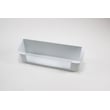
- Refrigerator ice container W11185686 (cracks or mis-seating can let meltwater escape)
For step-by-step guidance on water-system maintenance, we also recommend how to replace the water filter in a Maytag refrigerator.
Even a small leak can damage flooring and can also cause ice buildup in the freezer, poor ice production, and inconsistent cooling if airflow paths start icing over.
Last updated: February 2026