Owner’s manual
 Error Codes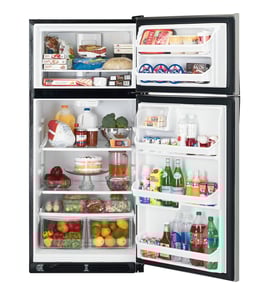




What is the upper part of a fridge called?
On the Kenmore 10662159111 top-mount refrigerator, the upper section is the freezer compartment (often just called the freezer). It’s the coldest area, designed to keep foods frozen and to support features like freezer shelving and, on some setups, an ice maker.
What you’ll typically find in the upper (freezer) section
In a top-mount design like model 10662159111, the freezer is the top cabinet and the fresh food (refrigerator) section is below.
- Freezer shelf or wire shelf for frozen foods
- Freezer vents that move cold air through the freezer
- Air return paths that help circulate air back through the system
- Door bins (varies by configuration)
- Ice maker area (if equipped)
For the exact feature layout and names used for your unit, use the 10662159111 owner's manual.
Freezer vs. refrigerator: quick comparison
| Section | Common name | Main purpose | Typical temperature |
|---|---|---|---|
| Upper compartment | Freezer | Long-term frozen storage | About 0°F |
| Lower compartment | Refrigerator (fresh food) | Chilled storage | About 37°F |
Why it matters
Knowing the correct name helps when you’re troubleshooting airflow, temperature issues, or ordering parts. For example, many cooling complaints start with restricted airflow in the freezer vents, since cold air is produced and distributed from the freezer area in most top-mount refrigerators.
Last updated: January 2026
How to tell cubic feet of Kenmore refrigerator by model number?
For Kenmore model 10662159111, the model number itself does not reliably state the exact cubic-foot capacity. The most accurate way is to look up the capacity in the 10662159111 owner's manual; if you need a quick estimate, measure the interior and calculate cubic feet.
Option 1: Find capacity in the manual (most accurate)
We recommend checking the specifications section in the 10662159111 owner's manual. This is the best source because it matches your exact Kenmore 106-series top-mount configuration.
What to look for:
- “Capacity” or “Total capacity” (cubic feet)
- Separate “Refrigerator” and “Freezer” capacities
- Model list that includes 106.6215* and 106.6216* families (your model fits this group)
Option 2: Estimate cubic feet by measuring (quick and practical)
If you cannot find the capacity quickly, you can estimate it from interior dimensions.
Steps
- Empty the compartment you are measuring (fresh food or freezer)
- Measure width x depth x height in inches (inside wall to inside wall)
- Multiply the three numbers to get cubic inches
- Divide by 1,728 to convert to cubic feet
| What you measure | Formula | Result type |
|---|---|---|
| Fresh food section | (W x D x H) ÷ 1,728 | cu ft (approx.) |
| Freezer section | (W x D x H) ÷ 1,728 | cu ft (approx.) |
| Total capacity | Fresh food + freezer | cu ft (approx.) |
How model numbers help (and where they do not)
Kenmore model numbers can hint at the manufacturer family (for example, many 106 models are Whirlpool-built), but the digits typically do not translate cleanly into a specific cubic-foot number.
Why it matters
Capacity affects shelf/bin fit, food storage planning, and expectations for cooling recovery after door openings. Knowing the correct cubic feet also helps when comparing replacement refrigerators.
Last updated: January 2026
What are the common problems with Kenmore Elite refrigerators?
Kenmore Elite refrigerators commonly have cooling complaints, frost buildup, ice maker issues, and unusual noises. On Kenmore model 10662159111, many “problems” are actually normal operation (like certain buzzing or gurgling sounds) or airflow and control-setting issues described in the 10662159111 owner's manual.
Most common symptoms and what usually causes them
- Not cooling or weak cooling: controls set incorrectly, blocked air vents, dirty condenser area, or a failed evaporator fan.
- Too much frost/ice: door left ajar, torn/warped door gasket, or a defrost system problem.
- Noisy operation: normal refrigerant and fan/compressor sounds, or a failing fan motor.
- Ice tastes bad or looks gray: new plumbing connections, ice stored too long, food odor transfer, or minerals in the water.
- Runs a lot: warm room, frequent door openings, large food load, or first 24 hours after installation.
Quick checks we recommend first (before buying parts)
- Confirm the refrigerator control is ON and set to a normal mid-range setting.
- Allow 24 hours after a new install or major temperature change for full cool-down.
- Make sure packages are not blocking interior vents; keep space around shelves for circulation.
- Listen for “normal sounds” (buzzing, pulsating, sizzling, popping) during ice maker fill and defrost.
- If ice tastes off, discard old ice, wash the bin, and let the ice maker produce fresh ice for 24 hours.
Normal sounds vs. problem sounds
| Sound | Often normal on 10662159111 | When it points to a problem |
|---|---|---|
| Buzzing during ice maker fill | Yes | Buzzing with no ice production and no water flow |
| Sizzling/gurgling in defrost | Yes | Loud grinding or constant squeal |
| Pulsating/humming | Yes | Repeated clicking with no cooling |
Parts that commonly fix real failures
If the checks above do not help, these parts are frequent culprits on top-mount refrigerators:
- No airflow in fresh food section: refrigerator evaporator fan motor WP2315539
- Intermittent cooling or warm temps: refrigerator electronic control board WPW10352689
- Heavy frost and warm fridge: refrigerator defrost heater WPW10316428 and refrigerator bi-metal thermostat WPW10392132
Why it matters
Cooling, frost, and noise complaints often share the same root causes: airflow restrictions, door sealing problems, or the defrost system not keeping the evaporator clear. Starting with control settings, airflow, and “normal sounds” prevents unnecessary part replacement.
Last updated: January 2026