Owner’s manual
 View engine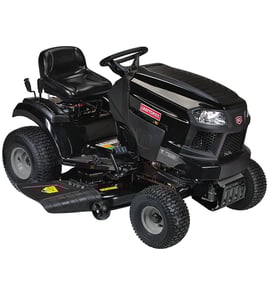


How to clean a Craftsman riding lawn mower carburetor without removing it?
On the Craftsman 917288520 riding lawn tractor, we clean the carburetor without removing it by safely accessing the air-intake throat, spraying carburetor cleaner in short bursts, and clearing debris from linkages and the bowl area. This improves starting and idle when varnish and dirt are minor.
Before you start (safety and setup)
- Park on a flat surface, set the parking brake, and let the engine cool.
- Remove the key and disconnect the spark plug wire to prevent accidental starting.
- Work outdoors or in a well-ventilated area; carb cleaner fumes are strong.
- Keep rags handy; overspray can loosen grime that needs wiping.
- Have a new air filter ready if yours is dirty or oil-soaked.
For control locations and air cleaner removal on this model, follow the 917288520 owner's manual.
Steps to clean the carburetor in place
- Remove the air cleaner assembly so you can see the carburetor throat.
- Clean the exterior first: brush off loose grass and dust around the carb body, throttle linkage, and choke linkage.
- Spray carb cleaner into the throat (where air enters) in short bursts.
- Move the throttle and choke by hand (engine off) to help cleaner reach sticky pivot points.
- If it will run: reconnect the spark plug wire, start the engine, and lightly spray into the throat while it idles (do not flood it). Then shut it down and reinstall the air cleaner.
- If it will not run: spray, wait 5 to 10 minutes, then try starting again. Repeat once.
What this method fixes (and what it will not)
| Symptom | In-place cleaning helps when | Usually needs deeper service when |
|---|---|---|
| Hard starting after storage | Light varnish in the throat | Main jet or emulsion tube is clogged |
| Surging at idle | Minor air/fuel restriction | Air leak, damaged gasket, or plugged passages |
| Stalling under load | Slight fuel delivery issue | Dirty fuel system, weak ignition, or compression issue |
Why it matters
A riding mower carburetor has small fuel passages that gum up quickly with old fuel. In-place cleaning is a fast first step; it often restores normal idle and throttle response without removing the carburetor.
If the engine still spins but will not start after cleaning, use our riding lawn mower engine spins but wont start video for a step-by-step diagnostic path.
Last updated: February 2026
How to tell if the carburetor is bad on a riding mower?
On a Craftsman riding mower like model 917288520, a “bad carburetor” usually shows up as hard starting, needing choke to keep running, surging or bogging under load, and poor throttle response that does not improve with adjustment. Confirm the basics (fresh fuel, spark, airflow) before replacing parts.
Quick symptoms checklist
- Engine starts only with choke, then dies when choke is opened
- Bogging or hesitation when you advance the throttle
- Surging (hunting up and down) at steady throttle
- Hard starting after sitting, even with a charged battery
- Black smoke or fuel smell (running rich) or popping/backfiring (running lean)
- Carb adjustments make little or only short-term improvement
Rule out common look-alikes first
Many “carb” complaints are caused by fuel quality, ignition, or air restriction. We check these in order:
- Fuel: Drain old gas; refill with fresh fuel. Replace a dirty in-line fuel filter if equipped.
- Air filter: Clean or replace; a clogged filter makes the engine run rich and bog.
- Spark: Inspect/replace spark plug; verify strong spark.
- Choke/throttle linkage: Make sure the choke plate fully opens and closes.
- Vacuum leaks: Check intake gaskets and mounting bolts for looseness.
For model-specific maintenance intervals and adjustment locations, use the 917288520 owner’s manual.
Simple carburetor tests you can do
| Test | What you do | What it suggests |
|---|---|---|
| Choke test | If it only runs with choke | Lean condition (often clogged main jet) |
| Throttle snap | Quickly open throttle | Stumble indicates fuel delivery issue |
| Bowl drain/flow | Verify steady fuel flow to carb | Weak flow points to tank/line/filter |
| Plug reading | Check plug after running | Sooty = rich; white/clean = lean |
Why it matters
A restricted or worn carburetor can make the engine run lean (overheating, poor power) or rich (fouled plug, heavy fuel use). Catching the real cause early prevents repeated no-starts and rough mowing performance.
Related DIY help
Last updated: February 2026
Is it hard to fix a carburetor on a lawn mower?
Fixing a carburetor on a Craftsman riding tractor like model 917288520 is usually a moderate DIY job: cleaning and adjusting is straightforward, but a full rebuild takes patience, careful part handling, and basic mechanical skill. Most “carb problems” are actually fuel, air, or linkage issues you can correct first.
What “fixing the carburetor” usually means
Before you plan a rebuild, we recommend checking the basics listed in the 917288520 owner's manual. Many running issues come from maintenance items rather than a failed carb.
Common carb-related tasks (easiest to hardest):
- Drain old fuel and refill with fresh fuel
- Clean or replace the air filter (restricted airflow mimics carb trouble)
- Clean the carb bowl and main jet (varnish from stale fuel is common)
- Replace the bowl gasket or needle and seat (if it floods or leaks)
- Rebuild the carburetor (multiple seals, jets, and adjustments)
- Replace the carburetor (fastest when internal passages are badly corroded)
Quick checks that save time
Do these first because they often solve “won’t start” or “runs rough” complaints:
- Verify the choke plate moves fully and is not sticking
- Confirm the throttle linkage and governor springs are connected correctly
- Check for fuel flow from the tank to the carb (clogged fuel line or filter)
- Inspect the spark plug condition (a fouled plug can look like a fuel issue)
- Make sure the engine is getting air (dirty filter, blocked intake)
Difficulty guide (DIY vs. service)
| Job | Typical difficulty | Best for |
|---|---|---|
| Clean bowl and jet | Easy to moderate | Most DIYers with hand tools |
| Rebuild carburetor | Moderate to hard | DIYers comfortable with small parts |
| Replace carburetor | Moderate | DIYers who want a quicker fix |
Why it matters
A carburetor that is dirty or leaking can cause hard starting, surging, stalling under load, black smoke, or fuel smell. Addressing fuel quality and airflow first prevents repeat problems and helps the engine run reliably.
Last updated: February 2026
What model number is the Craftsman 917288520?
The model number for this Craftsman front-engine lawn tractor is 917288520. You will typically find 917288520 on the product identification label (often under the seat, on the frame rail, or near the engine area); match that number when ordering parts or using the Craftsman 917288520 owner's manual.
Where to find the model number on the tractor
Check these common label locations on Craftsman riding mowers and tractors:
- Under the seat pan or on the seat support
- On the left or right frame rail near the rear wheels
- Under the hood near the engine compartment
- Near the steering column or dash support
- On the mower deck housing (less common for the main model label)
Why the exact model number matters
Craftsman tractors can look similar across multiple series, but parts like belts, blades, and steering links can vary by model. Using 917288520 helps ensure the correct fit for items such as a blade drive belt, mandrel parts, or electrical components.
Quick check: model number vs. part identifiers
| What you’re matching | Example | Used for |
|---|---|---|
| Model number | 917288520 | Finding diagrams, manuals, and the correct parts list |
| Part ID | 584453101 | Ordering a specific Sears PartsDirect part |
| Part number | 187281 | Manufacturer number printed on the part/packaging |
Helpful tip when ordering parts
If you are replacing a wear item, confirm the part by both the diagram location and the description. For example, the husqvarna lawn tractor blade drive belt 584453101 is a belt option shown for this model’s parts list.
Why it matters
A single digit off in the model number can route you to a different deck size, belt length, or wiring harness; that can cause poor performance, premature wear, or a no-start condition after repair.
Last updated: February 2026
What year did Craftsman make the 917288520?
Craftsman model 917288520 does not have a single “model year” printed in the model number; Craftsman used the 917-prefix across many years. The reliable way to identify the build timeframe for your exact tractor is to use the serial number and date codes shown on the tractor and engine, then confirm details in the 917288520 owner's manual.
How to find the build date on the tractor
Use the identification labels first; they tie your exact unit to the correct parts diagrams and specifications.
- Locate the model and serial tag (commonly under the seat, on the frame rail, or near the rear fender pan)
- Record the serial number exactly as shown
- Check the engine data plate for the engine model and date code (often the fastest way to narrow the timeframe)
- Note the mower deck size and configuration (deck variations affect belts, blades, and spindles)
- Compare your findings to the identification section in the manual
What “year made” usually means for Craftsman 917 models
For many Craftsman riding mowers, the model number identifies a configuration, while the serial number and engine codes identify when your specific unit was built.
| Identifier | Where to look | What it tells you |
|---|---|---|
| Model number (917288520) | Model/serial tag | Configuration family |
| Serial number | Model/serial tag | Production run for your unit |
| Engine date code | Engine data plate | Engine build timeframe |
Why it matters
The correct timeframe and configuration prevent mismatches when ordering common wear items like a ground drive belt, blade drive belt, and deck spindle components. For example, belt routing and deck hardware can vary by production run; confirming IDs helps you avoid the wrong fit.
If you are servicing the deck, match your deck components to the diagrams before ordering parts such as the lawn tractor mandrel housing 587819701.
Last updated: February 2026
Why is my Craftsman riding lawn mower carburetor leaking gas?
On Craftsman riding lawn tractor model 917288520, a carburetor that leaks gas is usually caused by fuel overflowing inside the carburetor (stuck float or worn needle and seat) or by a bad seal where the carburetor mounts to the engine. Use the 917288520 owner's manual for your model’s safety steps and access guidance.
Most common causes (and what to check first)
- Stuck float: Float hangs up and never shuts off fuel flow.
- Worn needle and seat: Fuel keeps flowing even when the bowl is full.
- Debris in the carburetor: Dirt or varnish holds the needle open.
- Loose mounting fasteners: Fuel seeps at the intake joint.
- Damaged carburetor gasket: Wetness appears between carburetor and engine.
- Cracked fuel line or loose clamp: Leak looks like it is “from the carb,” but it is running down onto it.
Quick diagnosis: where is the fuel coming from?
| Where you see fuel | Most likely issue | Typical fix |
|---|---|---|
| Dripping from carb bowl/vent | Float, needle and seat, debris | Clean or rebuild carburetor |
| Wet at carb-to-engine seam | Gasket or loose fasteners | Replace gasket, tighten evenly |
| Fuel on hose above carb | Fuel line, clamp, filter | Replace line/clamp, check routing |
Safe, practical steps we recommend
- Stop the engine immediately and let it cool.
- Turn the fuel shutoff valve off (if equipped) or clamp the fuel line.
- Remove the air cleaner cover; look for fuel pooling in the throat or air box.
- Tap the carb bowl lightly; if dripping changes, the float is sticking.
- If fuel continues to drip, remove and clean the carburetor; replace worn internal parts and the mounting gasket.
Why it matters
A leaking carburetor can flood the engine, cause hard starting, dilute engine oil with gasoline, and create a fire risk. Fixing the overflow or sealing issue restores proper fuel metering and protects the engine.
Last updated: February 2026