Owner’s manual
 Error Codes


What are the dimensions of a Kenmore Elite?
Kenmore Elite dimensions vary by model and style; for the Kenmore Elite bottom-mount refrigerator model 59678572801, the exact height, width, and depth are listed in the product specifications section of the 59678572801 owner's manual. Most bottom-mount refrigerators are roughly 30 to 36 inches wide and about 66 to 70 inches tall.
Use the model-specific specs so you can confirm fit with doors, cabinets, and ventilation clearance.
- Check the “Product dimensions” or “Product data sheets” section in the 59678572801 owner's manual.
- Measure your opening in three places (top, middle, bottom) to catch out-of-square cabinets.
- Measure depth two ways: cabinet-only depth and depth including handles.
- Plan for door swing and drawer pull-out clearance (especially for the freezer drawer).
- Leave airflow space at the top and back as recommended in the manual.
- Width: wall-to-wall opening, plus side clearance.
- Height: floor to cabinet top, plus top clearance.
- Depth: back wall to front edge of counters, then add handle projection.
These ranges help you estimate fit before you confirm the exact spec for 59678572801.
| Measurement | Typical bottom-mount range | What can change it most |
|---|---|---|
| Width | 30 to 36 in. | cabinet class, door style |
| Height | 66 to 70 in. | hinge design, leveling legs |
| Depth | 30 to 35 in. | handles, door thickness |
Correct dimensions prevent installation problems like doors hitting walls, drawers not opening fully, or blocked airflow that can cause warm temperatures and extra compressor run time.
Last updated: January 2026
What does er ff mean on Kenmore Elite refrigerator?
On Kenmore Elite refrigerator model 59678572801, the ER FF code points to a freezer evaporator fan problem (often called the freezer fan). When that fan cannot move cold air properly, the refrigerator section may warm up even if the freezer still feels cold. See the troubleshooting section in the 59678572801 owner's manual.
- Refrigerator section warming or uneven temperatures
- Little to no airflow from the refrigerator vents
- Fan noise that is unusually loud, intermittent, or missing
- Frost buildup on the freezer back wall (airflow restriction)
- Ice maker performance dropping because temperatures are unstable
- Reset power: unplug the refrigerator (or switch off the breaker) for 2 minutes, then restore power.
- Check airflow: make sure packages are not blocking freezer vents or the fan cover area.
- Inspect for heavy frost: if the freezer back wall is iced over, airflow can’t reach the fresh food section.
- Confirm door closure: a door not sealing can cause frost and fan issues.
If the code returns after a reset, these parts are common suspects on bottom-mount designs:
| Symptom | Most likely area | Example part for this model |
|---|---|---|
| No airflow, fan silent | Evaporator fan circuit | Refrigerator evaporator motor W11024089 |
| Heavy frost, airflow blocked | Defrost system | Refrigerator defrost heater WP67002493 |
| Temps read wrong, fan runs oddly | Temperature sensing | Refrigerator temperature sensor 12002355 |
The evaporator fan is what pushes freezer-made cold air into the refrigerator compartment. When airflow stops, food safety and ice production can be affected quickly, even if the compressor is still running.
Last updated: January 2026
What are the common problems with Kenmore Elite refrigerators?
Common problems we see on the Kenmore Elite 59678572801 bottom-mount refrigerator include not cooling or running too much, unusual noises, ice maker or water issues, and temperature or moisture complaints. Many “failures” trace back to power, control settings, airflow, or a worn component.
- Not running at all: power cord unplugged, dead outlet, tripped breaker, controls turned off
- Not cooling well: doors left open, heavy door opening, warm room, overloaded shelves blocking vents
- Runs constantly: normal after installation, warm kitchen, frequent door openings, large food load
- Noisy operation: normal sounds like buzzing (water valve), pulsating (fans/compressor), hissing/rattling (refrigerant or water lines)
- Ice maker problems: slow/no ice, leaking, or odd-tasting ice (often water supply or ice maker component related)
Start with these basics before replacing parts:
- Confirm the unit is plugged into a grounded 3-prong outlet and the outlet has power.
- Reset the household breaker or replace the fuse if needed.
- Verify the refrigerator controls are turned on and set correctly.
- After a new install or power interruption, allow up to 24 hours to cool completely.
- Make sure air vents are not blocked by food packages.
If basic checks do not help, these parts are frequent suspects on bottom-mount refrigerators:
| Symptom | Common part to inspect | Example part for this model |
|---|---|---|
| Warm fridge, weak airflow | Evaporator fan motor | Refrigerator evaporator motor W11024089 |
| Frost buildup, warming | Defrost heater | Refrigerator defrost heater WP67002493 |
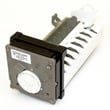
| Ice maker not producing | Ice maker assembly | Whirlpool refrigerator ice maker (D7824706Q) D7824706Q |
Catching airflow and cooling issues early helps protect food, reduces compressor run time, and can prevent secondary problems like frost buildup or water leaks.
For model-specific operating and troubleshooting steps (including power checks and normal sound descriptions), use the 59678572801 owner's manual.
Last updated: January 2026
Why is my Kenmore Elite refrigerator leaking water out of the bottom?
Water leaking from the bottom of your Kenmore Elite refrigerator model 59678572801 is usually caused by defrost water not draining correctly (then overflowing into the fresh-food section and down to the floor) or by a water-supply leak from the dispenser/ice maker line connections near the base grille. Use the 59678572801 owner's manual steps to narrow it down safely.
- Look for water only after defrost: puddles appear every day or two, often with frost buildup inside.
- Check the base grille area: water near the front can point to dispenser tube/line connections.
- Inspect the freezer floor: a sheet of ice under the bottom drawer often indicates a drain issue.
- Check ice maker/dispenser use: leaks that worsen after dispensing often point to the water system.
- Confirm doors close fully: warm air intrusion increases frost and can overwhelm the drain.
| Likely cause | What you typically see | What to do next |
|---|---|---|
| Clogged/iced defrost drain | Ice on freezer floor, water after defrost | Clear the drain path and flush with warm water; verify drain tube is open |
| Loose water line connection at base | Water on floor near base grille | Tighten tube connections; check for cracked tubing |
| Filter/dispenser system needs flushing | Drips after dispensing or after filter change | Flush the water system; hold the glass under the dispenser 2 to 3 seconds after releasing |
| Drain pan issue (rare) | Water under unit, not tied to dispensing | Inspect pan position and cracks; make sure unit is level |
If you confirm the leak is tied to cooling performance or heavy frost, the evaporator area may be involved. A weak or stalled fan can contribute to icing patterns.
A bottom leak is more than a nuisance: standing water can damage flooring, and a defrost drain problem can lead to recurring ice buildup that reduces airflow and cooling performance.
Last updated: January 2026