Owner’s manual
 Error Codes



Why is my Kenmore side by side ice maker not working?
If your Kenmore side-by-side refrigerator model 10650045711 ice maker isn’t making ice, the most common causes are the ice maker being turned off, low or blocked water supply, a clogged water filter, or a failed water inlet valve. We recommend checking the simple supply and control items first before replacing parts.
Quick checks for model 10650045711
- Confirm the ice maker is turned on (wire shutoff arm down, or the On/Off switch set to On, depending on which style your unit has). See the 10650045711 use & care manual.
- Make sure the household shutoff valve is fully open and the supply line is not kinked.
- Verify freezer temperature is cold enough for ice production (ice makers typically stop if the freezer is too warm).
- If you recently installed the refrigerator or changed the filter, flush the water system and allow time for ice production.
- Check for an ice plug in the fill tube (a frozen fill tube blocks water from entering the ice mold).
Water supply and filtration issues
A restricted water supply is a top reason an ice maker stops.
- If water flow at the dispenser is slow, replace the water filter and flush the system.
- If you have reverse osmosis, low pressure can reduce ice production.
What to expect after restoring water
| Situation | What’s normal | What to do |
|---|---|---|
| First start-up or water line just connected | Slow ice start | Allow 24 hours for first ice |
| After ice resumes | Small early batches | Discard first 3 batches |
| Low water pressure | Hollow or small cubes | Correct supply pressure/restriction |
When a part is likely the cause
If the ice maker is on and the freezer is cold but no water enters the ice mold, the inlet valve may not be opening.
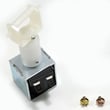
- Consider inspecting or testing the refrigerator water inlet valve WPW10179146.
- If the valve is working but the ice maker won’t cycle or harvest cubes, the ice maker module itself may be failing; the compatible replacement is the refrigerator ice maker assembly WPW10300022.
Why it matters
An ice maker problem is often a water-flow issue; fixing the supply, filter, or valve prevents repeat failures and helps protect the dispenser system from air pockets and inconsistent cube size.
Last updated: January 2026
How to find the size of a Kenmore refrigerator?
To find the “size” of your Kenmore refrigerator model 10650045711, we recommend measuring the exterior (width, height, depth) for fit, and using the model’s rated capacity (cubic feet) for storage. Exterior measurements do not convert reliably into storage capacity because insulation and internal components reduce usable space; see the 10650045711 use & care manual.
Measure the exterior size (fit in your kitchen)
Use a tape measure and record in inches:
- Width: left to right across the front (include handles if they stick out)
- Height: floor to top of cabinet (include hinge cover if it’s the highest point)
- Depth: front to back (measure cabinet-only and with handles)
- Door swing clearance: space needed to open doors fully
Quick measurement checklist
- Measure with doors closed.
- Measure in at least two spots (floors and walls can be uneven).
- If you’re moving it through a doorway, measure the doorway and compare to the refrigerator width and height.
Find storage capacity (cubic feet)
For model 10650045711, the most accurate way to confirm capacity is to use the model’s specifications listed in the 10650045711 use & care manual or the rating label (often inside the fresh food section).
If you only have interior measurements, you can estimate:
- Measure interior width, height, and depth (in inches) of each compartment.
- Multiply to get cubic inches.
- Divide by 1,728 to convert to cubic feet.
Why it matters
Exterior dimensions help you avoid delivery and installation problems; cubic feet tells you how much food the refrigerator can actually hold. Mixing the two often leads to incorrect capacity estimates.
Exterior size vs capacity (what each tells you)
| What you’re measuring | Unit | Best for | Not reliable for |
|---|---|---|---|
| Exterior width/height/depth | inches | Fit, clearance, delivery | Storage capacity |
| Interior compartment volume | cubic feet | Food storage space | Kitchen fit |
Last updated: January 2026
What is the code Sy Ef on a Kenmore refrigerator?
On Kenmore model 10650045711, the SY EF (or 5Y EF) code points to a problem in the evaporator fan circuit. In most cases, the freezer evaporator fan is not running as expected due to a failed fan motor, a wiring issue, or a control problem.
What to check first (safe, no-tools steps)
- Power reset: unplug the refrigerator for 2 minutes, then restore power.
- Confirm doors fully close; a door left ajar can affect airflow and fan operation.
- Listen for the evaporator fan: it typically runs when the compressor is running (door switch may need to be closed).
- Look for heavy frost on the freezer back wall; frost buildup can block the fan.
- Make sure vents are not blocked by food packages.
Likely causes and related parts
If the code returns after a reset, these are the most common repair paths:
- Evaporator fan motor failure: the motor is weak, noisy, or not turning.
- Fan blade damage/ice obstruction: blade cracked, rubbing, or frozen in place.
- Wiring/connector issue: loose plug, damaged harness, or intermittent connection.
- Control not powering the fan: less common, but possible.
For this model, the most directly related replacement parts are:
Quick symptom-to-cause guide
| What you notice | Most likely issue | What to do next |
|---|---|---|
| Freezer cold, fresh food warm | Evaporator fan not moving air | Check fan operation and frost pattern |
| Loud buzzing/grinding from freezer | Fan blade hitting ice or failing motor | Inspect blade and clear ice safely |
| Heavy frost on freezer back panel | Defrost system problem affecting airflow | Check defrost components and airflow |
Why it matters
The evaporator fan is what moves cold air from the freezer through the refrigerator section. When the fan circuit fails, temperatures rise, food can spoil, and the refrigerator may run longer than normal.
For control locations, airflow guidance, and troubleshooting steps specific to this Kenmore refrigerator, use the 10650045711 use & care manual.
Last updated: January 2026