Owner’s manual
 Error Codes



Do you remove cardboard from the bottom of a Whirlpool refrigerator?
On the Whirlpool GI6SARXXF02, we leave the cardboard-like cover at the bottom in place; it is there to protect and direct airflow over key components (like the condenser area) and removing it can cause poor cooling and overheating.
That panel is typically an air baffle and protective cover. It helps the refrigerator run efficiently and keeps debris away from moving or hot parts.
- Directs airflow across the condenser coils and compressor area
- Helps the condenser fan move air the right way
- Protects wiring and tubing from damage
- Reduces dust and pet hair buildup on components
- Helps prevent rattles from loose items contacting parts
You normally only remove the bottom cover temporarily for cleaning or service, then reinstall it.
| Situation | Remove it? | What to do |
|---|---|---|
| Routine operation | No | Leave it installed |
| Cleaning condenser area | Yes (temporary) | Unplug fridge, clean, reinstall |
| Diagnosing a cooling problem | Yes (temporary) | Access components, then reinstall |
| Panel is torn or missing | Replace/repair | Restore proper airflow and protection |
- Unplug the refrigerator or switch off power at the breaker.
- Pull the unit out carefully to avoid kinking the water line.
- Remove the lower rear access panel or toe grille as shown in the GI6SARXXF02 owner's manual.
- Vacuum dust from the condenser area; use a soft brush if needed.
- Reinstall the panel before plugging the refrigerator back in.
That cover is part of the refrigerator’s cooling airflow path. Leaving it off can make the compressor run longer, raise internal temperatures, and shorten the life of cooling-system parts.
Last updated: January 2026
How do I remove the base grille on my Whirlpool refrigerator?
On the Whirlpool GI6SARXXF02 bottom-mount refrigerator, the base grille (kickplate) typically releases from locking tabs or a few screws along the ends. We remove it by opening the doors, checking for screws first, then pulling the grille forward (and slightly up) to pop the tabs free.
- Unplug the refrigerator or switch off power at the breaker (recommended anytime you are working near wiring or the condenser fan).
- Open both fresh food doors so you can access the grille ends.
- Look at the left and right ends of the grille for fasteners.
- If you see screws, remove them with the correct driver (commonly Phillips or 1/4-inch hex).
- If you do not see screws, the grille is usually snap-in.
- Grip the grille near the ends and pull outward; if it resists, flex the grille slightly to release the locking tabs.
- Once the tabs release, pull the grille forward and set it aside.
| What you find | What it means | What to do |
|---|---|---|
| Screws at the ends | Grille is mechanically fastened | Remove screws, then pull grille forward |
| No screws, visible slots/tabs | Grille is snap-in | Pull outward and slightly up; flex gently to release tabs |
Removing the base grille gives you access to the condenser area for cleaning and inspection. Keeping that area clear helps the compressor and condenser run efficiently, which supports stable refrigerator temperatures.
- Line up the tabs with the frame slots.
- Press evenly near both ends until it snaps in.
- Reinstall any screws you removed.
For model-specific illustrations and the exact grille attachment style used on your unit, use the GI6SARXXF02 owner's manual.
Last updated: January 2026
How to get bottom freezer drawer out of whirlpool refrigerator?
To remove the bottom freezer drawer on your Whirlpool GI6SARXXF02 bottom-mount refrigerator, we pull the drawer fully open, lift the basket off the slide rails, then release the drawer front from the rail clips so the entire drawer assembly can lift out safely.
- Unplug the refrigerator or switch off power at the breaker.
- Remove food and ice to make the drawer lighter.
- Protect the floor with a towel or cardboard.
- Use a small flat-blade screwdriver only if needed to help release locking tabs.
- Open the freezer drawer fully so you can access the rails and basket.
- Remove the upper basket (if equipped): lift the basket straight up and out of the slide rails.
- Remove the lower basket: lift the rear of the basket up first, then pull it out.
- Release the drawer front from the rails:
- Look for the plastic locking tabs or clips where the drawer front attaches to each slide rail.
- Push the clip to release (one side at a time) while lifting the drawer front slightly.
- Lift the drawer front up and off the rails once both sides are released.
- Slide the rails back in carefully so they do not extend unexpectedly.
| What you see | What it means | What to do |
|---|---|---|
| Plastic tab/clip at the rail-to-drawer-front joint | Drawer front is locked to the slide rail | Press or pry the tab gently while lifting the drawer front |
| Drawer front lifts but one side stays stuck | One clip is still engaged | Re-seat the front, then release that side again |
| Rail feels gritty or binds | Rail may be dirty or damaged | Clean rails; inspect for bent sections before reassembly |
Removing the drawer the right way prevents cracked drawer fronts, bent slide rails, and poor door sealing that can cause frost buildup and temperature swings in the freezer.
- Set the drawer front back onto both rails evenly before snapping clips in.
- Confirm both sides lock in place by gently pulling up on the drawer front.
- If the drawer does not close smoothly, inspect the rails and consider replacing a worn slide component such as the refrigerator freezer slide rail W11658402.
For model-specific diagrams and handling notes, follow the freezer drawer removal guidance in the GI6SARXXF02 manual.
Last updated: January 2026
How to tell if a whirlpool fridge compressor is bad?
A failing compressor in your Whirlpool GI6SARXXF02 refrigerator usually shows up as poor cooling (fresh food and freezer warming), the unit running almost constantly, clicking or buzzing near the back, or repeated breaker trips. Confirm airflow and power-start components before replacing the compressor.
- Verify the temperature settings and give the refrigerator 24 hours to stabilize after changes.
- Make sure the condenser area is clean and the unit has proper airflow clearance.
- Listen for a repeating click every few minutes (often a start issue, not always a sealed-system failure).
- Check that the evaporator fan is running and vents are not blocked by food packages.
- Look for heavy frost on the freezer back panel (can point to a defrost or airflow problem).
| Symptom | What it often means | What to check next |
|---|---|---|
| Runs constantly, still warm | Not pumping efficiently or system restriction | Condenser cleanliness, airflow, frost pattern |
| Clicks, then stops | Start device/capacitor overload trip | Start components, wiring, compressor amps |
| Very hot compressor shell | Overload cycling or high load | Condenser fan/coil, ventilation |
| Breaker trips | Electrical short or locked rotor | Start components, compressor windings |
On GI6SARXXF02, these parts can cause compressor start or cooling complaints and are worth checking first:
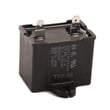
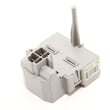
- Refrigerator run capacitor WPW10662129 (helps the compressor start)
- Refrigerator electronic control board WPW10285199 (can affect compressor run commands)
- Refrigerator damper control assembly WPW10196393 (can cause warm fresh food even if freezer is OK)
Compressor replacement is one of the highest-cost refrigerator repairs and typically requires sealed-system tools. Ruling out airflow issues, control problems, and start components first prevents unnecessary parts replacement and gets cooling restored faster.
For model-specific component locations and access steps, use the GI6SARXXF02 owner's manual.
Last updated: January 2026