Owner’s manual
 Error Codes


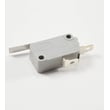
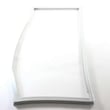
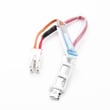
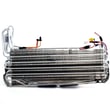
Why is my refrigerator not getting cold at the bottom?
In our Kenmore Elite 79574023410 bottom-mount refrigerator, the most common reason the bottom of the fresh-food section warms up is restricted airflow. Items blocking the return vents, frost buildup, or a weak fan/damper can keep cold air from circulating down to the lower shelves and crispers.
Quick checks we recommend first
- Make sure packages are not pressed against interior air vents (especially near the back wall).
- Confirm the doors close fully and the gaskets seal all the way around.
- Verify the controls were not recently changed; after adjustments, allow 24 hours for temperatures to stabilize.
- Look for heavy frost on the freezer back panel (a sign of a defrost problem).
- Listen for the evaporator fan running when the compressor is on (you may hear airflow).
For control ranges and airflow guidance specific to this model, use the 79574023410 use & care manual.
When it points to a part (common on this model family)
If vents are clear but the bottom stays warm, these components often cause poor lower-section cooling:
| Symptom you notice | Likely area to inspect | What it affects |
|---|---|---|
| Top shelves cool, bottom warm | Air diffuser / damper | Directs cold air into the refrigerator section |
| Freezer cold, fridge warm | Evaporator fan system | Moves cold air from freezer to fresh food |
| Frosted freezer back panel | Defrost system | Prevents ice from blocking airflow |
If you suspect an airflow control issue, check the refrigerator air diffuser ADJ73252235. If you see frost patterns or suspect a defrost failure, the refrigerator defrost heater MEE62225112 is one of the key components in the defrost circuit.
Why it matters
Bottom-warm conditions usually mean the refrigerator is cooling, but not distributing air correctly. Fixing airflow early helps prevent food spoilage, moisture buildup, and longer compressor run times.
Last updated: January 2026
How to tell if a Kenmore refrigerator compressor is bad?
On Kenmore Elite model 79574023410, a “bad compressor” usually shows up as poor or no cooling even though the unit has power, often with repeated clicking/overheating at the compressor area. Before condemning the compressor, we verify airflow, condenser cleanliness, and the compressor start components.
Signs that point to a compressor problem
Look for a combination of these symptoms (one symptom alone is not always enough):
- Refrigerator and freezer are both warm, but interior lights and display work
- Compressor is very hot to the touch and you hear repeated clicking every few minutes
- Unit seems to run constantly but temperatures never recover
- Breaker trips shortly after the compressor tries to start
- You hear a hum, then a click, and cooling stops (start attempt fails)
Quick checks we recommend first (before replacing the compressor)
These checks help rule out common look-alikes on 79574023410:
- Confirm control settings and allow 24 hours after any temperature change
- Clean condenser coils and make sure the condenser fan is running
- Listen for evaporator fan operation (air movement inside the freezer)
- Check door seals for gaps that cause nonstop running and warm temps
- Inspect start components for burn marks or rattling pieces
If the compressor is not starting, the most common “first parts to suspect” are the start relay and overload protector, not the sealed-system compressor itself.
Parts that are commonly involved
If diagnostics point to a start failure, these model-compatible parts are often involved:
| What you’re testing | What it does | Model-compatible example |
|---|---|---|
| Start device | Helps the compressor start | Refrigerator compressor start relay EBG60663230 |
| Overload protector | Protects compressor from overheating/overcurrent | Refrigerator compressor overload protector 6750CL0001D |
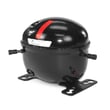
| Compressor | Pumps refrigerant through the sealed system | Refrigerator compressor TCA38091801 |
Why it matters
Replacing a compressor is a sealed-system repair; it is more complex than typical refrigerator part swaps. Confirming the start relay/overload and airflow issues first can save time and avoid replacing the wrong component.
Model-specific tip
Your 79574023410 Use & Care Guide includes a troubleshooting section and operating details that help confirm whether the refrigerator is actually calling for cooling and running normally; see the 79574023410 use & care manual.
Last updated: January 2026
Where is the water filter on a Kenmore bottom freezer refrigerator?
On Kenmore Elite model 79574023410, the water filter is located inside the refrigerator (fresh food) compartment, not in the freezer drawer. The exact mounting spot can vary within the compartment on this platform; confirm the precise location and access steps in the 79574023410 use & care manual.
How to locate it on model 79574023410
- Open the refrigerator doors (top section).
- Look for a labeled water filter cover or filter head inside the compartment.
- Check common interior areas: upper wall/ceiling area or side wall near the front.
- If your unit has a filter status light, it corresponds to this internal filter.
- If the filter is stuck, avoid forcing it; use steady, even pressure.
Replacement and reset basics
After installing the new filter, flush water to clear air and carbon fines, then reset the indicator as described for this model.
- Install the filter fully so it seats correctly.
- Dispense and discard several glasses of water until flow is steady.
- Reset the filter indicator by pressing and holding the Water Filter button for 3 seconds.
| Step | What you should see | What it means |
|---|---|---|
| Flush water | Brief sputter, then steady stream | Air is purged from the line |
| Reset indicator | “CHANGE” light turns off | Reset completed |
| Check for leaks | No drips at filter area | Filter is seated properly |
Compatible replacement filter for this model
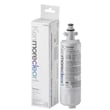
For Kenmore Elite 79574023410, the listed replacement water filter is genuine Kenmore refrigerator water filter 9690 AGF80300801.
Why it matters
Knowing the correct filter location and using the correct reset method helps maintain normal water dispenser flow and ice maker fill; it also prevents leaks caused by a filter that is not fully seated.
Last updated: January 2026