Installation guide
 Owner’s manual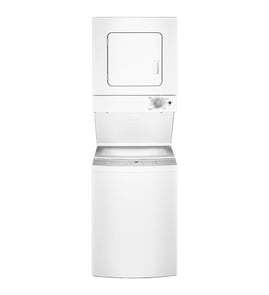


Are all washers and dryers 27 inches wide?
No. Many full-size washers and dryers are around 27 inches wide, but widths vary by design and capacity. For the GE GUD27GESN0WW stacked laundry center, the installation dimensions show a nominal 27-inch width, with a door-closed width of about 26-1/8 inches (including handle and knobs).
Typical washer and dryer widths
Most laundry appliances fall into a few common width groups:
- Compact units: typically under 25 inches wide
- Standard full-size units: typically around 27 inches wide
- Oversize or specialty models: can be wider than 27 inches
- Stacked laundry centers: often built to fit standard laundry alcoves, commonly near 27 inches
For exact fit details (including door swing and clearance), use the GUD27GESN0WW installation guide.
What the GUD27GESN0WW dimensions mean
The installation guide lists both “nominal” and “door closed” dimensions. Nominal is the class size (what it is marketed to fit), while door-closed dimensions reflect real-world clearance needs.
| Measurement type | What it helps you plan for | Example for GUD27GESN0WW |
|---|---|---|
| Nominal width | Rough space planning | 27-inch class |
| Door-closed width | Tight alcoves, trim, door clearance | About 26-1/8 inches |
| Clearance needs | Service access, airflow, safe operation | Depends on install type |
Fit and clearance checklist (before you buy or move it)
- Measure the tightest point of the opening (baseboards, door trim, valves)
- Plan for venting space behind the dryer (rear ducting can require extra clearance)
- Confirm front clearance for loading and door swing
- If installing in a closet, confirm the door is louvered/ventilated and sized for airflow
- Verify hookups: water inlets, drain outlet, vent location, and (if gas) gas inlet location
Why it matters
A “27-inch washer/dryer” label does not guarantee it fits a 27-inch opening. Real dimensions, door hardware, and required airflow clearances determine whether the laundry center installs safely and can be serviced.
Last updated: January 2026
What does load sensing mean on GE washer dryer combo?
On the GE GUD27GESN0WW laundry center, load sensing means the washer briefly spins and pauses at the start of a cycle to detect the load and set the wash action appropriately. This start-up behavior is normal and helps the machine wash efficiently.
What you’ll notice during load sensing
- The washer may spin, stop, then continue before the main wash begins.
- You may hear the motor change sound as the unit transitions into the cycle.
- The cycle may seem to “pause” briefly; the washer is checking the load.
- If you opened and closed the lid before starting, you may also see a short spray and delay.
What to do if it seems stuck
If the washer doesn’t move past the sensing phase after a few minutes, we recommend these quick checks:
- Confirm the lid is fully closed and latched.
- Redistribute items so the load is evenly placed around the basket.
- Avoid overloading; load items loosely so they can move freely.
- Press Start/Pause once to pause, then again to resume.
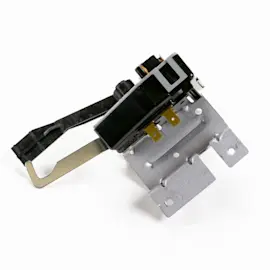
- If the lid won’t lock consistently, inspect the washer lid lock WH44X10288.
Load sensing vs. other “normal” pauses
| What you see | Most likely meaning | What to do |
|---|---|---|
| Spin then pause at the beginning | Load sensing | Wait; normal operation |
| Pauses during wash | Soak periods built into the cycle | Wait; normal operation |
| Blinking Spin light near end | Out-of-balance detected | Let it finish; then redistribute and run Drain & Spin |
Why it matters
Load sensing helps the GUD27GESN0WW wash with less water while still cleaning well. When the load is balanced and not overfilled, sensing completes faster and you get better agitation, rinsing, and spin performance.
For cycle behavior details and loading guidance, follow the GUD27GESN0WW owner’s manual.
Last updated: January 2026
Do stackable washers and dryers need 240V?
For the GE GUD27GESN0WW laundry center, the dryer section uses a 240V circuit when it is an electric dryer; the washer section uses 120V. Confirm the exact electrical requirements and outlet type in the GUD27GESN0WW installation guide before installing, moving, or changing wiring.
What voltage a stackable unit typically uses
Most stacked laundry centers are set up like this:
- Washer: 120V, standard household receptacle
- Electric dryer: 240V, dedicated dryer receptacle
- Gas dryer: 120V for motor and controls (plus a gas supply line)
- Breaker: dedicated circuit(s) are commonly required
- Cord/plug: must match the home receptacle type (3-slot or 4-slot where applicable)
Quick comparison: 120V vs 240V
| Section | Typical voltage | What it powers | What you may notice if incorrect |
|---|---|---|---|
| Washer | 120V | fill, agitate, drain, spin, controls | will not start, trips breaker |
| Electric dryer | 240V | heater and dryer operation | tumbles but no heat, will not run |
How to confirm what your unit needs
Use these checks before you wire or relocate the unit:
- Find the electrical requirements section in the GUD27GESN0WW owner’s manual.
- Verify whether your dryer is electric or gas; electric dryers use 240V.
- Check your breaker size and receptacle type; match the cord to the receptacle.
- If the dryer tumbles but does not heat, follow laundry center dryer won't heat troubleshooting to separate power-supply issues from heating-component failures.
Why it matters
Correct voltage prevents nuisance breaker trips and protects the GE controls, motor, and heater. It also ensures the dryer reaches full heat for normal drying performance.
Last updated: January 2026
What does GUD27GESN0WW stand for?
GUD27GESN0WW is the GE model number shown on the appliance ID tag for this stacked laundry center; we use that exact code to pull the correct parts diagrams, troubleshooting steps, and installation requirements for your unit. The letters and numbers function as an internal identifier, not a plain-English feature description.
What the model number means in practice
GE model numbers like GUD27GESN0WW are most useful for identification and parts matching.
We use the full model number to:
- Match the correct replacement parts (belts, lid lock, control boards)
- Pull the right wiring diagrams and component locations
- Confirm the correct installation requirements (venting, electrical, gas connections)
- Apply the correct troubleshooting steps and error code meanings
- Avoid ordering the wrong revision of a part
Where to find the model and serial number
For this GE laundry center, the model and serial number tag is located inside the dryer door opening.
Check these spots:
- Door frame area around the dryer opening
- The label just inside the dryer door
- The edge of the front panel near the door opening
GUD27GESN0WW vs. similar-looking model numbers
Some GE laundry center model numbers look nearly identical; one character difference can change the parts list.
| What you see on the tag | What to do | Why it matters |
|---|---|---|
| GUD27GESN0WW | Use it exactly as printed | Ensures correct parts and diagrams |
| GUD27GESNWW (no “0”) | Use it exactly as printed | Suffix differences can change compatible parts |
| Any missing letters/numbers | Recheck the tag and rewrite it | Prevents ordering the wrong component |
Helpful model-specific resources
- Use the GUD27GESN0WW owner’s manual for operating steps, cycle details, and troubleshooting tips.
- Use the GUD27GESN0WW installation guide for venting, hookups, and clearance requirements.
- Use GE error codes when the display or indicators point to a fault.
Why it matters
Using the exact model number from the ID tag prevents wrong-part issues on common repairs like a belt replacement, lid lock failure, or control board diagnosis.
Last updated: January 2026