Owner’s manual
 View engine



Where is the model number on a Craftsman rear tine tiller?
On the Craftsman rear-tine tiller model 917297040, the model number is printed on the product identification label. We most often see that label on the tine shield/guard area or on the frame near the engine and fuel tank; check your 917297040 owner's manual for the exact label location and diagram.
Common places to check first
- On the tine shield (tine guard) near the tines
- On the main frame rail (left or right side)
- Near the engine mounting area
- On or near the fuel tank area
- Near the belt guard or shift lever area
How to find it quickly (and avoid mix-ups)
- Clean off dirt and oil with a rag so the label text is readable.
- Look for a sticker or metal tag that includes a model number and sometimes a serial number.
- Write the model number exactly as shown (for this unit it is 917297040).
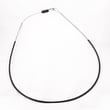
- Use that model number when ordering parts like the tiller clutch cable 532110675 or husqvarna rear-tine tiller drive belt 591372401.
What the label usually looks like
| What you may see | What it means | Why it matters |
|---|---|---|
| Model number | Identifies the exact tiller version | Ensures correct parts diagrams and fit |
| Serial number | Production identifier | Helps match production changes |
| Brand name (Craftsman) | Product line | Confirms you are on the right parts list |
Why it matters
Craftsman tillers can look similar across model series, but small differences in the drive system, belt guard, and tine assembly can change which parts fit. Using the model number from the label prevents ordering the wrong belt, cable, or hardware.
Last updated: January 2026
How often should I change the oil in my tiller?
For the Craftsman 917297040 rear-tine tiller, we change the engine oil after every 50 hours of operation or at least once a year (even if you do not reach 50 hours). We also check the oil level before starting and after each 5 hours of continuous use; see the 917297040 owner's manual.
Recommended oil-change schedule
Use this schedule to keep the engine protected during normal use.
- Change engine oil every 50 hours of operation
- Change engine oil at least once per year
- Check oil level before each use
- Check oil level after each 5 hours of continuous operation
- Change oil more often when operating under heavy load or high temperatures
Quick reference table
| Usage pattern | What we recommend |
|---|---|
| Regular seasonal use | Change oil every 50 hours |
| Light use (under 50 hours/year) | Change oil once per year |
| Hot weather or heavy load | Change oil more frequently |
| Long continuous run time | Check oil every 5 hours |
Oil type and viscosity basics
Your tiller uses high-quality detergent oil meeting API service classification SG-SL. We select viscosity based on temperature.
- SAE 30 is common for warmer conditions
- 10W-30 can help cold starts
- Multi-viscosity oils can increase oil consumption above about 40°F; check the level more often
Why it matters
Clean oil prevents accelerated wear and overheating. On a rear-tine tiller, low or dirty oil can quickly shorten engine life, especially when the tines are working hard in compacted soil.
Last updated: January 2026
What tiller is made in the USA?
If you’re specifically looking for a tiller made in the USA, Mantis is a commonly cited option for U.S.-manufactured tillers. For your Craftsman rear-tine tiller model 917297040, the best way to confirm country of origin is to check the ID plate and the documentation in the 917297040 owner's manual.
How to confirm where a tiller is made
We recommend verifying the country of origin on the machine itself because manufacturing locations can vary by model and production run.
- Check the product ID plate (often on the frame near the engine or transmission)
- Look for “Made in …” or “Assembled in …” wording
- Record the model and serial number before shopping for parts or service
- Review the warranty and product information sections in the 917297040 owner's manual
- If the label is missing, compare decals and hardware to the illustrated parts lists
What “made in” can mean (quick reference)
Country-of-origin labeling can be described in a few different ways.
| Label wording | What it usually indicates | What to do next |
|---|---|---|
| Made in USA | Manufactured in the U.S. | Confirm on ID plate for your exact unit |
| Assembled in USA | Final assembly in the U.S. | Check major component origins if it matters to you |
| No origin listed | Not stated on the label | Use the ID plate and manual details |
Why it matters
Country of origin can affect what you expect for parts sourcing, service support, and long-term maintenance. For example, wear items like belts, tines, and cables are considered normal maintenance on many tillers, and keeping the correct model number (917297040) helps ensure you get the right replacements.
Last updated: January 2026
What are common tiller problems?
Common problems on the Craftsman 917297040 rear-tine tiller include hard starting, rough running or surging, excessive vibration, and tines or wheels that do not engage consistently. Most issues trace back to basic maintenance (oil, spark plug, air filter) or drive components (belt, cable, linkage).
Most common symptoms and what they usually mean
- Engine won’t start or starts then dies: stale fuel, fouled spark plug, dirty air filter, choke or throttle set incorrectly
- Engine surges or runs rough: restricted airflow (dirty filter/screen), fuel delivery issue, carburetor mixture needs adjustment (common in cold weather or high altitude)
- Tines won’t turn or stall under load: worn drive belt, stretched/misadjusted clutch cable, debris binding the tines
- Hard to shift gears: transmission not fully unloaded; rocking the tiller slightly can help the gears mesh
- Excessive vibration: loose fasteners, damaged tines, or a developing mechanical problem (stop and inspect immediately)
Quick checks we recommend (safe, fast, and high value)
Before cleaning, inspecting, or adjusting anything, shut the engine off, wait for all moving parts to stop, and disconnect the spark plug wire.
- Verify engine oil level before each use
- Confirm throttle is set correctly; never use the choke to stop the engine
- Let the engine warm up a few minutes before engaging the tines
- Check that guards and shields are installed and secure
- Inspect bolts and mounting hardware for tightness (vibration is a warning sign)
Common causes and likely fixes
| Symptom | Likely cause | Typical fix |
|---|---|---|
| Tines do not engage | Worn belt or slipping drive | Replace the husqvarna rear-tine tiller drive belt 591372401 |
| Tines engage inconsistently | Cable out of adjustment or stretched | Inspect/replace the tiller clutch cable 532110675 |
| Rough running/surging | Air/fuel mixture off | Clean air path; adjust carburetor per the Craftsman 917297040 owner’s manual |
Why it matters
A rear-tine tiller puts heavy load on the engine and drive system. Keeping up with the maintenance schedule (oil checks, spark plug and air filter service, and periodic inspections) prevents stalling under load, poor tilling performance, and premature belt or cable wear.
Last updated: January 2026