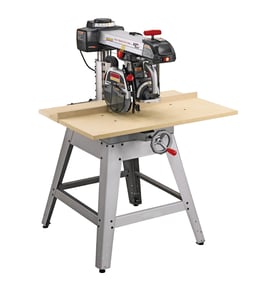

Are radial arm saws worth anything?
Yes. A Delta radial arm saw like model RS830 is worth money when it’s complete, runs smoothly, and has tight, accurate adjustments; most used radial arm saws sell locally in the $100 to $400 range, with higher prices for clean, well-tuned vintage machines and lower prices for worn or incomplete saws.
- Condition and completeness: guard, table/fence boards, yoke, elevation and arm locks, and hardware all present.
- Accuracy and smooth travel: arm locks firmly at 90 degrees, carriage rolls without slop, and the head doesn’t drift.
- Motor health: starts quickly, no burning smell, no excessive sparking at the brushes, and no loud bearing growl.
- Blade size and capacity: larger capacity and longer arm travel typically bring more demand.
- Local demand and pickup hassle: these are heavy tools; value drops when buyers must move it themselves.
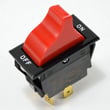
- Unplug it; inspect the cord, switch, and any cracked insulation.
- Spin the arbor by hand; it should feel smooth with no grinding.
- Check for play: grab the motor carriage and try to wiggle it; minimal movement is best.
- Verify the arm locks and bevel/miter scales move and clamp securely.
- Confirm the guard and anti-kickback components are installed and functional.
| Condition | What it usually looks like | Typical value |
|---|---|---|
| Project / incomplete | Missing guard or table parts, rough bearings, lots of play | $0 to $100 |
| Working / average | Runs, usable accuracy after tune-up, cosmetic wear | $100 to $250 |
| Clean / tuned | Tight adjustments, smooth travel, complete, ready to work | $250 to $400+ |
A radial arm saw can be excellent for repeatable crosscuts and dados, but only when it’s properly adjusted and used with the correct guarding and technique. A “cheap” saw that needs bearings, wiring repair, or missing safety parts often costs more in time and parts than it saves.
For basic electrical checks before you decide to repair or sell, we recommend using a meter to confirm the switch and cord are sound; see how to use a multimeter to test electrical parts video.
Last updated: February 2026
Why are radial arm saws no longer made?
Radial arm saws (including older models like the Delta RS830) largely disappeared from mainstream production because newer saw types deliver the same common cuts with simpler setups and fewer high-risk cutting scenarios. For most shops, sliding compound miter saws and table saws replaced the radial arm saw for speed, accuracy, and day-to-day safety.
Radial arm saws were once a do-it-all shop tool, but the market shifted toward specialized tools that are easier to use well.
- Sliding compound miter saws made crosscuts and miters faster to set up
- Table saws became the default for ripping with better guarding options
- Portable tools improved, so fewer people wanted a large, fixed saw station
- Many users only needed repeatable crosscuts, not the full radial arm range
A radial arm saw can be safe when it is tuned and used correctly, but certain operations are less forgiving than on other saw styles.
- Ripping on a radial arm saw can increase the chance of kickback if technique or setup is off
- Climb-cutting tendencies during some operations can pull the carriage toward the operator
- More adjustments (arm, yoke, bevel, miter) means more opportunities for misalignment
- Guarding and anti-kickback setups vary widely across generations and brands
| Task | Radial arm saw | Common replacement today |
|---|---|---|
| Crosscuts | Strong, especially with long support tables | Sliding compound miter saw |
| Ripping | Possible, but technique-sensitive | Table saw |
| Dados/rabbets | Capable with correct setup | Table saw with dado set (where allowed) |
Because radial arm saws are less common now, keeping a Delta RS830 running usually comes down to maintenance and correct setup: a flat table, a square fence, smooth carriage travel, and safe wiring. For electrical issues, we use the same fundamentals as other power tools: verify power, switches, cords, and connections.
- Unplug before adjustments or inspection
- Confirm the blade is sharp and correct for the cut (crosscut vs rip)
- Keep the arm and carriage locks working and tightened before cutting
- Check cord condition and strain relief for cracks or looseness
- Use proper work support to prevent binding and shifting
For diagnosing power and wiring problems safely, we recommend how to use a multimeter to test electrical parts video.
Last updated: February 2026
What is the best brand of radial arm saw?
There is no single “best” brand for every shop; the best radial arm saw is the one that stays accurate, has solid parts support, and fits your space and work style. For the Delta RS830 radial arm saw, Delta is a proven legacy brand, and condition plus alignment matter more than the logo.
A brand is only as good as the saw’s ability to hold settings and cut safely and repeatably.
- Rigid arm and column with minimal play (less flex equals straighter cuts)
- Smooth carriage travel with no binding or side-to-side slop
- Easy, repeatable miter and bevel adjustments that lock firmly
- Commonly available wear items (bearings, switches, cords, guards)
- Clear safety features and a guard system you will actually use
This is a practical way to compare what you will live with day to day.
| What matters most | Delta (like RS830) | Other legacy brands (varies by model) |
|---|---|---|
| Build and rigidity | Typically strong castings and solid frames | Ranges from very robust to lighter-duty |
| Parts availability | Often depends on exact model and production era | Same; older models can be hit-or-miss |
| Setup and tuning | Usually straightforward but requires patience | Similar; tuning is the deciding factor |
| Best use case | Crosscuts, dados, repetitive shop cuts | Same; condition matters more than name |
For a used radial arm saw, we focus on mechanical condition first, then brand.
- Check arm and column for looseness; any wobble shows up as inaccurate cuts
- Verify the carriage bearings roll smoothly and don’t “click” or grind
- Inspect the motor for unusual noise and excessive sparking at the brushes
- Confirm the fence and table can be replaced or rebuilt easily
- Make sure the guard, yoke lock, and return spring (if equipped) function correctly
Radial arm saws are powerful and versatile, but they demand accurate alignment and reliable locks. A well-tuned Delta RS830 will outperform a “better brand” saw that is worn, out of square, or missing safety hardware.
For help confirming you have the correct model before ordering parts, use how to find your appliance model number (and what it means for parts).
Last updated: February 2026