 Installation guide
 Owner’s manual


How to hard reset a Frigidaire dishwasher?
To hard reset your Frigidaire dishwasher model FPID2497RF6A, cancel the current cycle, then remove power for about 5 minutes and restore power. This clears a stuck control state and lets the control board restart cleanly; it does not fix an underlying fill, drain, or latch problem.
Reset steps (FPID2497RF6A)
- Press and hold Cancel for about 3 seconds to stop the cycle and start a pump-out.
- Wait for the dishwasher to stop running.
- Turn OFF power at the breaker (or unplug if accessible).
- Leave power off for 5 minutes.
- Restore power, then start a normal cycle.
If it still will not run after a reset
These checks catch the most common reasons a reset seems to “not work”:
- Make sure the door closes and latches firmly (a poor latch can prevent starting).
- Confirm the water supply shut-off valve is open and the unit can fill.
- If the unit cancels and pumps out but will not refill, check for a fill issue.
- If the unit runs but cleans poorly, check spray arms and loading.
| Symptom after reset | What it usually points to | What to check next |
|---|---|---|
| No response, no lights | Power supply issue | Breaker, junction box connections, wiring |
| Lights on, won’t start | Door not sensed closed | Latch alignment, door closure |
| Starts then stops, won’t fill | Fill system issue | Water supply, inlet valve, water pressure |
| Cancels and drains repeatedly | Drain or control issue | Drain path, control behavior |
Why it matters
A hard reset is a fast way to clear a paused cycle or control glitch, but if the dishwasher immediately repeats the same symptom, the root cause is usually a component or installation condition. For installation-related electrical and grounding requirements, follow the installation guide.
Parts that commonly relate to “won’t start” or “won’t fill” symptoms
If troubleshooting points to a component, these are common suspects for this model family:
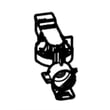
- Crosley dishwasher door latch assembly 111315040 (door-closed signal)
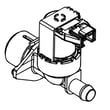
- Dishwasher water inlet valve 807445905 (fills the tub)
- Pressure switch A00055408 (water level sensing)
Last updated: January 2026
What causes power failure on a dishwasher?
On the Frigidaire FPID2497RF6A dishwasher, a sudden power failure is usually caused by a tripped breaker or loose power connection, a door that is not latching closed, or a control issue that stops the unit from running. Start with the simplest checks before replacing parts.
Quick checks we recommend first
- Reset the circuit breaker fully (OFF, then ON) and confirm the outlet has power.
- Make sure the door closes firmly; a misaligned latch can prevent operation.
- Turn off power at the breaker, then check the dishwasher junction box connections for tight wire nuts.
- Confirm the dishwasher is properly grounded and all wiring connections are enclosed in the junction box.
- Do not use an extension cord; plug-in power must be direct.
Model-specific electrical connection points to inspect
The FPID2497RF6A electrical junction box is typically located on the right underside of the dishwasher behind the kickplate area. The installation instructions also call out correct hot (black), neutral (white), and ground (green) connections using tight wire nuts and a UL-listed conduit connector.
Common causes and what they look like
| Symptom | Most likely cause | What to check next |
|---|---|---|
| Completely dead, no lights | Breaker tripped, outlet issue | Breaker, outlet, house wiring |
| Has lights but will not start | Door not latched, door switch not made | Latch alignment, strike position |
| Intermittent power loss | Loose wiring at junction box | Tighten wire nuts, secure cover |
| Powers on, then stops | Control or sensing issue | Run a test cycle per FPID2497RF6A installation guide |
Parts that commonly relate to “won’t run” symptoms
If power is present but the dishwasher will not run, a door-latch problem is a common culprit because the control will not allow a cycle to start with an open door signal.
- Crosley dishwasher door latch assembly 111315040: helps the door close and signal the control that the door is shut.
- Dishwasher control board assembly 97391199001605: can stop responding if it fails or if it is not receiving stable power.
Why it matters
Dishwashers are designed to shut down for safety if the door is not securely latched or if electrical connections are unsafe. Verifying the breaker, junction box wiring, and latch operation prevents repeat shutdowns and helps you avoid replacing parts unnecessarily.
Last updated: January 2026
What is the most common problem with a Frigidaire dishwasher?
For the Frigidaire FPID2497RF6A dishwasher, the most common customer-reported issue is poor draining (water left in the bottom after the cycle). In many cases, the cause is a drain-path restriction, a kinked drain hose, or a drain/pump component problem that prevents proper pump-out.
Quick checks we recommend first
- Cancel the cycle and start a drain function (if your model has it) to see whether you hear the drain pump running.
- Check the sink/disposer connection for a clog (and confirm the disposer inlet plug was removed if it is a new install).
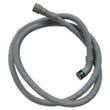
- Inspect the drain hose for kinks or crushing behind the dishwasher.
- Make sure the dishwasher is level and securely fastened; an installation issue can contribute to drainage and door sealing problems.
- Confirm the water supply is turned on and there are no leaks at connections.
Parts that commonly affect draining
If the drain path is clear but the dishwasher still leaves water behind, these model-compatible parts are common suspects:
What to look for (symptom-to-cause guide)
| What you notice | Most likely area to check | Typical fix |
|---|---|---|
| Standing water after cycle | Drain hose, sink/disposer connection | Clear blockage, correct hose routing |
| Hums but drains slowly | Sump area, flapper valve | Clean sump area, replace flapper valve |
| Intermittent fill/drain behavior | Water-level sensing | Check pressure switch and air path |
Why it matters
A dishwasher that does not drain can redeposit dirty water on dishes, cause odors, and strain the pump system over time. Fixing drainage early usually prevents bigger repairs later.
Installation details that can contribute to drainage issues
During installation, the drain, water, and electrical connections need to be routed correctly, and the unit should be checked for kinks and proper operation through at least one fill and pump-out. For model-specific installation routing and connection locations, use the FPID2497RF6A installation guide.
Last updated: January 2026
How do I fix a Frigidaire Gallery dishwasher that won't drain?
For a Frigidaire FPID2497RF6A dishwasher that will not drain, we focus first on the drain path: confirm the drain hose is routed correctly (high loop), then clear kinks and clogs, and finally check the pump-out performance. Most no-drain problems are caused by hose routing or a blockage.
Step-by-step checks (start with the easiest)
- Turn off power at the breaker and shut off the water supply before handling hoses.
- Verify the drain hose has a high loop at least 32 inches (80 cm) above the floor to prevent backflow and improve drainage.
- Inspect the hose for sharp bends or kinks; straighten the run and make sure the dishwasher is not resting on the hose.
- If connected to a garbage disposer, remove the disposer inlet knockout plug (a common cause of “won’t drain” after installation).
- If connected to a sink drain, make sure the drain connection enters above the trap (not into a horizontal section between sink drain and disposer).
- Clean the dishwasher’s bottom filter area and remove any debris that could restrict pump-out.
What to look for under the sink
Use this quick guide to match the symptom to the most likely fix.
| What you see | Most likely cause | What we do next |
|---|---|---|
| Water backs up into tub after draining | Missing/low high loop or no air gap where required | Re-route hose to proper high loop; follow FPID2497RF6A installation guide |
| Dishwasher hums but little or no water leaves | Clog in hose, disposer inlet, or drain path | Disconnect and flush hose; clear disposer inlet |
| Drains sometimes, not always | Intermittent restriction or water-level sensing issue | Check hose routing first; then consider pressure switch A00055408 |
Why it matters
Correct drain hose routing (including the 32-inch high loop) prevents dirty water from flowing back into the dishwasher and helps the drain pump move water out efficiently. A small kink or an unremoved disposer plug can stop draining completely.
If it still will not drain
- Cancel the cycle and listen for pump-out; you should hear a steady drain sound.
- Recheck clamps for overtightening that can deform the hose end.
- If the drain path is clear and routing is correct, inspect the sump area for debris; a damaged sump seal can also contribute to poor pump-out.
Last updated: January 2026





