Installation guide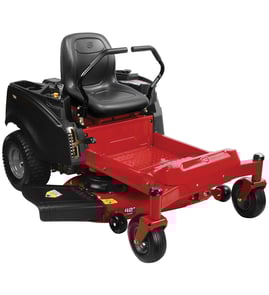

How to fix an uneven riding mower deck?
An uneven cut on your Husqvarna RIDER riding lawn mower is usually fixed by setting the mower on a level surface, then adjusting the cutting unit’s ground pressure and rake angle (pitch) so the deck follows the ground evenly and slopes slightly forward.
Safety and setup first
- Park on a flat, hard surface.
- Apply the parking brake.
- Set the cutting height to the lowest setting.
- Make sure tires are properly inflated and matched side-to-side (uneven tire pressure mimics a crooked deck).
- Remove heavy debris packed under the cutting unit before measuring.
Step 1: Set the cutting unit ground pressure
The cutting unit should follow the surface without pressing too hard. Use bathroom scales under the front edge of the cutting unit frame and adjust the screws behind the front wheels on both sides.
- Target ground pressure: 12 to 15 kg (26 to 33 lb)
- Turn the left and right adjusting screws to bring the reading into range
- Recheck after each adjustment
| What you see | Likely cause | What to adjust |
|---|---|---|
| Scalereading is too high | Deck pushing down too hard | Back off (reduce) ground pressure screws |
| Scalereading is too low | Deck not tracking ground well | Increase ground pressure screws |
| Left and right differ | Deck loading unevenly | Balance both side screws |
Step 2: Check and adjust rake angle (pitch)
We set pitch by measuring from the ground to the front and rear edges of the cutting unit hood.
- The deck should slope forward slightly
- The rear edge should be 2 to 4 mm (0.08 to 0.16 in) higher than the front edge
How to adjust pitch
- Remove the front hood and right-hand fender
- Loosen the nuts on the lift strut
- Turn the strut:
- Counterclockwise to lower the rear edge
- Clockwise to raise the rear edge
- Tighten the nuts and re-measure
Why it matters
Correct ground pressure and pitch reduce scalping, improve cut quality, and help the belt, gauge wheels, and lift linkage wear evenly.
For diagrams and the exact adjustment locations, use the installation guide.
Last updated: February 2026
Is 500 hours a lot for a Husqvarna riding mower?
Yes. For a Husqvarna RIDER riding lawn mower, 500 hours is a high-use point for typical homeowner service; it usually means you should expect more frequent maintenance and some wear-part replacements, but it is not automatically “worn out” if it has been serviced on schedule.
What 500 hours usually means
At around 500 hours, we treat the mower as being in its maintenance-heavy phase. You will commonly see wear in drive and cutting components, plus more sensitivity to adjustments.
- Plan on replacing wear items (belts, blades, idlers) as needed
- Expect more frequent deck leveling and cutting-height checks
- Watch for steering and wheel-play developing over time
- Electrical issues become more common (switches, connections, fuses)
- Hydrostatic drive performance becomes more noticeable (creep in neutral, weaker pull)
Quick checks to judge condition (more important than the hour number)
Use these checks before buying or deciding what to repair:
- Cold start: starts cleanly without excessive cranking
- Neutral test: mower does not creep when set to neutral
- Blade engagement: engages smoothly without squeal or heavy vibration
- Cut quality: even cut with no scalping (deck level and gauge wheels matter)
- Tire pressure: set evenly; the setup spec shown is 60 kPa (9 PSI)
Service schedule guidance for this model family
Your installation documentation for RIDER 15 Pro and RIDER 16 H calls out the value of regular service and specifically notes having the machine serviced every 300 hours. Use that as a practical benchmark: at 500 hours, the mower should already have had at least one major interval service, and it is approaching the next. See the installation guide for the setup and service journal details.
Typical “expect repairs” items by hours
| Hour range | What we commonly see | What to do |
|---|---|---|
| 0 to 200 | Normal break-in wear | Keep blades sharp; check belt tension and fasteners |
| 200 to 500 | Wear parts start stacking up | Inspect deck drive belt, pulleys, spindles; check safety switches |
| 500+ | Condition varies widely by care | Budget for drivetrain and deck work; verify neutral and cut quality |
Why it matters
Hours tell you how much the mower has been used; maintenance tells you how well it has been cared for. A 500-hour RIDER that has had consistent oil changes, correct tire pressure, and regular deck adjustments can still be a dependable machine, while a neglected one can become expensive quickly.
Last updated: February 2026
Why does my Husqvarna mower leave a strip of grass?
Your Husqvarna RIDER riding lawn mower leaves a strip of uncut grass when the cutting deck is not tracking the ground evenly or the deck pitch and ground pressure are out of adjustment. Correcting deck setup (ground pressure, pitch, and gauge wheel use) typically eliminates the striping.
Most common causes (and what to check first)
- Deck pitch (rake angle) is off: the deck should slope slightly forward.
- Ground pressure is incorrect: too much or too little deck “float” can leave a narrow strip.
- Cutting height set too high for conditions: tall or wet grass shows missed strips more.
- Blade condition: dull, bent, or nicked blades tear instead of cutting cleanly.
- Mowing pattern and speed: turning too tightly or mowing too fast can cause uneven overlap.
Set the deck up to prevent striping
We follow the setup targets in the installation guide for the RIDER cutting unit.
1) Check and adjust cutting unit ground pressure
The cutting unit should follow the surface without pressing too hard.
- Place the mower on a level surface.
- Use bathroom scales under the front edge of the cutting unit frame.
- Adjust the two ground-pressure screws (behind the front wheels, one per side).
- Target ground pressure: 12 to 15 kg (26 to 33 lb).
2) Check and adjust deck pitch (rake angle)
- Park on a level surface.
- Measure ground-to-deck at the front edge and rear edge of the cutting unit hood.
- Correct pitch: rear edge 2 to 4 mm (0.08 to 0.16 in) higher than the front.
If pitch is wrong, adjust the lift strut (loosen nuts, turn strut, then re-check).
Quick reference targets
| Setup item | Target | What it affects |
|---|---|---|
| Ground pressure | 12 to 15 kg (26 to 33 lb) | Deck follows terrain evenly |
| Deck pitch | Rear 2 to 4 mm higher than front | Prevents “skipping” and striping |
Why it matters
When ground pressure and pitch are correct, the cutting deck stays stable over bumps and dips, the blades maintain consistent cutting height, and you avoid the single uncut “stripe” that shows up between passes.
Last updated: February 2026
How to manually push a riding lawn mower?
To manually push your Husqvarna RIDER riding lawn mower, use the hydrostatic transmission release lever so the drive is released with the engine off. Once the release lever is set, you can roll the mower by hand for short moves, then return the lever to drive.
Steps to push a Husqvarna RIDER safely
- Park on a flat surface, lower the cutting height, and stop the engine.
- Remove the key and wait for all moving parts to stop.
- Apply the parking brake while you locate the transmission release lever.
- Set the release lever to the released position (the operator procedure is to press it down and forward).
- Release the parking brake and push the mower slowly by hand.
- After moving it, return the release lever to the drive position before normal operation.
Where the release lever is and what it does
The RIDER uses a hydrostatic drive; the release lever mechanically releases the transmission so the machine can be moved with the engine switched off.
Use the installation guide as your model reference for control locations and safe handling notes for the RIDER.
Do’s and don’ts
- Do move it only short distances and at walking speed.
- Do use a helper on ramps or uneven ground.
- Do not push on steep slopes.
- Do not force the mower if it will not roll; re-check that the release lever is fully set.
- Do not leave the mower stored with the transmission released.
Quick reference
| Task | Correct setup | Result |
|---|---|---|
| Move with engine off | Parking brake on, set release lever, then brake off | Mower rolls by hand |
| Normal mowing | Release lever returned to drive | Wheels drive normally |
| Loading onto trailer | Release lever set, use ramps and a spotter | Better control |
Why it matters
Pushing a hydrostatic mower without releasing the transmission makes it hard to move and can strain the drive system. Using the release lever reduces resistance and keeps the drivetrain operating as designed.
Last updated: February 2026