Installation guide
 Owner’s manual
 Error Codes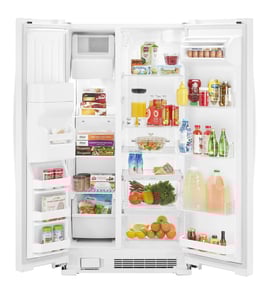

Does KitchenAid make a 33 inch wide refrigerator?
Yes. KitchenAid makes 33-inch wide refrigerators in multiple styles (such as French door and bottom-freezer). Your KitchenAid KSRB25FKSS01 is a side-by-side model; for exact width and clearance needs, use the measurements and installation clearances in the KSRB25FKSS01 installation guide.
How to confirm a 33-inch fit in your kitchen
Even when a refrigerator is marketed as “33-inch wide,” you still need clearance for doors, handles, and airflow.
- Measure the cabinet opening width at the front and back
- Check side clearance for door swing and bin access
- Confirm top clearance for ventilation
- Verify depth clearance (standard-depth vs counter-depth)
- Plan for water line routing if you have an ice maker or dispenser
Typical sizing: what “33-inch wide” usually means
These are common planning ranges for 33-inch class refrigerators (final specs vary by model).
| What you’re measuring | Typical planning range | Why it matters |
|---|---|---|
| Cabinet opening width | 33 in to 34 in | Allows leveling and door swing clearance |
| Side clearance | 1/8 in to 1 in per side | Prevents rubbing and improves airflow |
| Top clearance | 1/2 in to 1 in | Helps heat escape and improves efficiency |
| Depth (standard-depth) | Often 33 in to 36 in | Impacts walkway and door clearance |
Why it matters
A refrigerator that is “33-inch wide” can still bind in the opening if the floor is uneven, the cabinet is out of square, or the doors need extra swing room. Using the model’s installation clearances helps prevent delivery-day surprises and cooling performance issues.
Helpful related DIY guidance
If your new or existing KitchenAid refrigerator uses a water filter, our step-by-step guide helps you keep water and ice flowing properly: how to replace the water filter in a KitchenAid refrigerator.
Last updated: January 2026
How much freezer space is in a side-by-side?
Most side-by-side refrigerators, including KitchenAid model KSRB25FKSS01, typically have about 7.5 to 10 cubic feet of freezer space (with total capacity often around 22.5 to 31 cubic feet). For the exact capacity for your unit, check the KSRB25FKSS01 owner's manual.
Typical freezer capacity ranges
Side-by-side designs split the cabinet vertically, so the freezer is usually narrower but tall.
- Typical freezer capacity: 7.5 to 10 cu. ft.
- Typical total capacity: 22.5 to 31 cu. ft.
- Storage space feels larger when shelves and bins are adjusted for your food
- Airflow matters; don’t pack items tightly against vents
Quick comparison: side-by-side vs other common styles
| Refrigerator style | Typical freezer space | What it’s best for |
|---|---|---|
| Side-by-side | 7.5 to 10 cu. ft. | Easy access to frozen foods at eye level |
| Top freezer | 4 to 7 cu. ft. | Budget-friendly, simple layout |
| Bottom freezer | 5 to 9 cu. ft. | More fresh-food space at eye level |
How to make your freezer space more usable
We recommend these practical steps to get the most out of the freezer section:
- Keep similar items together (meat, vegetables, prepared foods)
- Use bins or baskets to prevent small items from getting lost
- Leave space for air circulation so temperatures stay even
- Freeze items flat first (bags of food stack better)
- Avoid overloading the door bins with heavy items
Why it matters
Freezer capacity affects how much food you can store safely and how well the freezer maintains temperature. The manual also notes that a full freezer stays cold longer during a power outage, which can help protect food quality.
Last updated: January 2026
What is the most common problem with a KitchenAid refrigerator?
For KitchenAid side-by-side refrigerators like model KSRB25FKSS01, the most common problems we see are ice maker and water dispensing issues (no ice, slow fill, hollow cubes) and cooling complaints tied to airflow or defrost problems. These often trace back to water supply conditions, a restricted water path, or frost buildup affecting airflow.
Most common symptoms customers report
- Ice maker not making ice or making small/hollow cubes
- Water dispenser flow is slow or stops
- Freezer is cold but fresh food section is warm (airflow issue)
- Frost buildup on the freezer back wall (defrost issue)
- Water leaking inside the refrigerator or onto the floor
Quick checks that solve many “common problems”
Start with the basics before replacing parts:
- Confirm the household water supply is on and the line is not kinked
- Verify water pressure is in the typical operating range (many KitchenAid systems specify 30 to 120 psig)
- Replace the water filter on schedule and fully seat it in the housing
- Clear ice clumps in the ice bin and make sure the dispenser door closes fully
- Listen for the evaporator fan; poor airflow can mimic a cooling failure
| Problem area | What you notice | Common next step |
|---|---|---|
| Water supply/filter | Slow water, small cubes | Check pressure, replace/filter-seat, purge air |
| Ice maker system | No ice, irregular harvest | Inspect fill, mold, and shutoff arm; test ice maker |
| Defrost/airflow | Warm fridge, frosty freezer panel | Check for frost pattern and defrost components |
Parts that commonly relate to these symptoms (KSRB25FKSS01)
If troubleshooting points to a failed component, these are frequent culprits for this model:
- Refrigerator inlet valve W10408179 (controls water flow to ice maker and dispenser)
- Whirlpool refrigerator ice maker assembly 2198597 (complete ice maker module)
- Refrigerator defrost bi-metal WPW10225581 (helps protect and control defrost heating)
Why it matters
Ice and water problems can look like “the refrigerator is failing,” but they are often caused by a simple restriction (filter, kinked line) or a single replaceable part (inlet valve, ice maker). Cooling complaints can also be secondary to airflow restrictions from frost buildup.
Helpful model-specific resources
- Use the KSRB25FKSS01 owner's manual for operating guidance, water supply parameters, and maintenance intervals.
- If you are replacing or reconnecting the water line, follow the KSRB25FKSS01 installation guide to avoid leaks and low flow.
- For filter-related issues, follow how to replace the water filter in a KitchenAid refrigerator.
Last updated: January 2026