Error Codes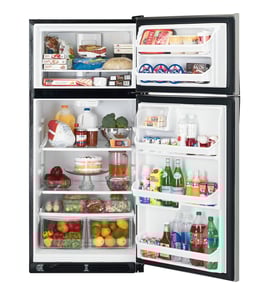






Which is better, top mount or bottom mount refrigerator?
For most households, a top-mount refrigerator like the Whirlpool ET8CHKXKQ06 is the better value: it typically costs less to buy and maintain, and it is usually more energy-efficient. A bottom-mount is better when you want fresh-food items at eye level and easier access.
| Feature | Top-mount (freezer on top) | Bottom-mount (freezer on bottom) |
|---|---|---|
| Upfront cost | Usually lower | Usually higher |
| Energy use | Often lower | Often higher |
| Fresh-food access | Requires more bending | More convenient, eye-level |
| Freezer access | Easier | Requires bending |
| Repairs | Often simpler, fewer premium features | More features can mean more parts to service |
- Choose top-mount if you want the best overall value, simpler design, and strong reliability.
- Choose bottom-mount if you cook often and want the refrigerator section (milk, produce, leftovers) easiest to reach.
- If you use the freezer daily, top-mount can feel more convenient.
- If you have back or knee discomfort, bottom-mount can reduce bending for fresh-food access.
- If you want fewer “extras” to maintain, top-mount models are typically more straightforward.
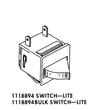
“Better” usually comes down to how you use the refrigerator. Layout affects daily comfort, while design complexity affects long-term maintenance. For example, if you are keeping an older top-mount running, a simple fix like replacing a failed door light switch can restore normal use quickly (see refrigerator light switch W11384469).
If you are comparing features that add maintenance (like ice makers and water systems), use how to prevent water dispenser and ice maker problems to understand what to watch for and how to reduce clogs, leaks, and slow ice production.
Last updated: January 2026
How wide is a 24.5 cu ft refrigerator?
A 24.5 cu ft refrigerator is typically about 35 to 36 inches wide (most are built to fit a standard 36-inch opening). Your Whirlpool ET8CHKXKQ06 is a top-mount model, and top-mount widths commonly fall in the 28 to 33-inch range rather than 36 inches.
Refrigerator width is driven more by door style and cabinet design than by cubic feet alone.
| Refrigerator type | Typical width | Notes |
|---|---|---|
| French door (standard-depth) | 35 to 36 in | Most common for 24 to 26 cu ft |
| Side-by-side | 32 to 36 in | Often near 36 in |
| Top-mount (like ET8CHKXKQ06) | 28 to 33 in | Many are narrower than 36 in |
| Counter-depth (varies) | 35 to 36 in | Shallower cabinet, similar width |
Use these checks to avoid clearance problems with doors, hinges, and airflow.
- Measure the cabinet opening width at the front and back (walls are not always square).
- Leave at least 1 inch total side clearance if possible for easier installation.
- Plan for door swing clearance (handles and hinges can add width when opened).
- Confirm you have enough depth for the doors to open fully without hitting a wall.
- If your current unit is ET8CHKXKQ06, measure its cabinet width and compare to the new model.
A “36-inch wide” refrigerator often needs more than 36 inches of real-world space once you account for hinges, handles, leveling, and door swing. Getting the width right prevents poor door sealing, warm spots, and installation headaches.
If you are shopping because of cooling or ice issues (not just size), start with Whirlpool refrigerator error codes.
Last updated: January 2026
What is the biggest problem in a Whirlpool refrigerator?
The biggest problem we see in Whirlpool refrigerators like model ET8CHKXKQ06 is not cooling properly. Loss of cooling is usually caused by airflow issues (dirty condenser coils or a failed evaporator fan), a defrost problem, or a door seal leak that lets warm air in.
- Dirty condenser coils: reduces heat removal and raises cabinet temperatures.
- Evaporator fan issue: if the fan is noisy, stalled, or not moving air, the fresh food section warms up.
- Frost buildup from a defrost failure: heavy frost blocks airflow through the evaporator.
- Door gasket leak or door not closing: warm air intrusion creates temperature swings and frost.
- Compressor start problems: clicking, short cycling, or no start can point to a start device issue.
| What you notice | Most likely area | What to do next |
|---|---|---|
| Freezer cold, fridge warm | Airflow from freezer | Listen for fan; check vents for blockage |
| Frost wall in freezer | Defrost system | Defrost fully, then monitor for return of frost |
| Clicking every few minutes | Start device/compressor circuit | Inspect start components; consider service |
| Water under fridge or inside | Defrost drain or water line | Clear drain path; check for ice blockage |
If you confirm a specific failure, these model-matched parts are often involved:
- Evaporator motor WPW10189703 (drives the evaporator fan for airflow)
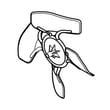
- Refrigerator evaporator fan blade WP2163777 (moves air across the evaporator)
- Refrigerator defrost bi-metal WP2321800 (defrost safety thermostat)
A refrigerator can run continuously and still not cool if airflow is restricted or warm air is leaking in. Catching the root cause early helps protect food, reduces energy use, and prevents ice buildup that can damage components.
For model-specific troubleshooting steps and fault patterns, we use Whirlpool refrigerator error codes as a starting point.
Last updated: January 2026
What are the disadvantages of a top mount fridge?
Top-mount refrigerators like the Whirlpool ET8CHKXKQ06 are reliable and efficient, but the main disadvantages are convenience and organization: fresh-food items sit lower (more bending), freezer access is higher, and many models have fewer built-in storage and dispenser features.
- More bending for fresh food: the refrigerator compartment is below the freezer, so you reach down more often.
- Less “eye-level” organization: compared with many bottom-freezer designs, shelves and bins can feel less optimized for grab-and-go access.
- Fewer premium features on many top-mounts: external water and ice dispensers are less common.
- Freezer can be less accessible for some users: lifting heavier frozen items down from the top can be awkward.
- Door storage limits: tall bottles and bulky items can crowd door bins depending on the layout.
| Feature | Top-mount refrigerator | Bottom-freezer refrigerator |
|---|---|---|
| Fresh-food access | Lower (more bending) | Higher (less bending) |
| Freezer access | Higher | Lower |
| Typical organization | Simpler | Often more flexible |
| Dispenser options | Less common | More common |
Sometimes the frustration is not the design, it is a fixable problem:
- If the door does not seal well, you can get temperature swings, moisture, or frost; see how to fix a fridge door seal.
- If you see water pooling inside or under the unit, it is often a defrost drain issue; see how to get rid of refrigerator puddles.
- If the interior light stays on (warming the cabinet), a failed refrigerator light switch W11384469 can be the cause.
Top-mount designs put the freezer at a comfortable height for frequent frozen-food use, but they trade that for more bending and sometimes fewer convenience features. Knowing the tradeoffs helps you decide whether to adjust storage habits or address a door-seal, drainage, or lighting issue.
Last updated: January 2026