 Installation guide



What's the life expectancy of a Maytag dryer?
A Maytag dryer typically lasts 10 to 13 years; a Maytag commercial gas dryer like model MLG24PDAWW2 commonly reaches 12 to 15 years in normal use when airflow is kept clear and wear items are replaced before they damage the drum or motor. See the MLG24PDAWW2 installation guide for setup details that help prevent early failures.
- Vent restriction (long runs, crushed flex duct, clogged hood) increases heat stress.
- Lint buildup inside the cabinet reduces airflow and can overheat components.
- Worn drum support parts cause drag, noise, and motor strain.
- Door switch and latch wear can cause intermittent no-start issues.
- Gas ignition wear (igniter, coils, sensor) can cause no-heat or short-cycling.
| Use level | Typical life | What you usually see first |
|---|---|---|
| Light (few loads/week) | 13 to 18 years | Rollers/belt noise, door switch issues |
| Moderate (daily) | 10 to 15 years | Ignition parts, thermal cut-off events |
| Heavy/commercial (many cycles/day) | 7 to 12 years | Rollers, seals, motor wear, ignition parts |
- Clean the lint screen every load; confirm the screen and grille seat correctly.
- Inspect and clean the full vent path regularly (dryer outlet to exterior hood).
- Listen for thumping/squealing; replace wear parts early to protect the drum.
- Keep the dryer level; misalignment increases roller and seal wear.
- If heat becomes inconsistent, test ignition components before replacing major assemblies.
Replacing these often restores performance and prevents secondary damage:
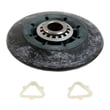
- Dryer drum support roller WPW10314173 (noise, thumping, drum drag)
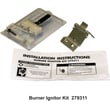
- Igniter 279311 (no heat, burner not lighting)
- Dryer gas valve coil kit WPW10328463 (heats once then stops, intermittent heat)
- Dryer thermal cut-off kit WP8573713 (no heat after overheating event)
Most dryers are replaced because of airflow-related overheating or ignored wear noise, not because the cabinet “wears out.” Keeping airflow strong and addressing roller or ignition issues early is the fastest way to extend the service life of the MLG24PDAWW2.
Last updated: February 2026
Where to find part number on Maytag dryer?
On your Maytag MLG24PDAWW2 gas commercial dryer, the most reliable place to find the identifying numbers you need for parts is the serial-rating plate in the dryer door well. Use the model and serial number from that plate to match the correct replacement part.
Check these common label locations first (start with the door opening):
- Dryer door well (door opening area): look for the serial-rating plate
- Inside the door opening on the front panel
- Side panel or rear panel label (less common on commercial units)
- Control console area (sometimes behind an access panel)
For ordering the right parts, we use these identifiers:
- Model number (example: MLG24PDAWW2) to ensure the part fits your exact dryer design
- Serial number to confirm production series when a part changed over time
- Part number (printed in parts lists and on some parts) to match the exact replacement
| Number type | Where you find it | What it’s used for |
|---|---|---|
| Model number | Serial-rating plate in the door well | Identifies the exact dryer model for fit |
| Serial number | Serial-rating plate in the door well | Confirms version/production range |
| Part number | Parts diagram/list; sometimes printed on the part | Identifies the replacement component |
Commercial Maytag dryers can have part variations by production run. Using the model and serial number from the door-well serial-rating plate helps us match the correct Maytag parts the first time.
For model-specific identification details and service notes, use the MLG24PDAWW2 installation guide.
Last updated: February 2026
Why is my Maytag dryer leaking water from the bottom?
On the Maytag MLG24PDAWW2 gas commercial dryer, water leaking from the bottom is almost always condensation, not a plumbing leak. The most common causes are a restricted exhaust vent, a cold or uninsulated vent run, or the dryer being installed where it is exposed to water or weather; all of these let moisture collect and drip down.
- Clean the lint screen and confirm the screen housing is not packed with lint.
- Inspect the entire vent run for crushing, kinks, or heavy lint buildup.
- Confirm the dryer is exhausted outdoors (not into a wall, attic, or crawlspace).
- Make sure the dryer is level; a tilt can make condensation run to the front or bottom.
- Verify the installation location is dry; this model must not be installed where it can be exposed to water or weather (see the installation guide).
| What you notice | Most likely cause | What to do first |
|---|---|---|
| Water appears after a long cycle | Vent restriction causing humid air to linger | Clean and shorten the vent run where possible |
| Water only in cold weather | Cold vent pipe causing heavy condensation | Insulate the vent in unheated spaces |
| Water near the front/bottom edge | Dryer not level or airflow restricted | Level the dryer; recheck venting |
| No heat and damp loads | Burner not igniting consistently | Check ignition components such as the igniter 279311 and dryer radiant sensor WP338906 |
A wet base area usually points to poor airflow. Poor airflow increases dry times, can cause overheating, and can lead to repeated shutdowns from safety devices such as a thermal cut-off.
- Unplug the dryer before opening panels.
- Do not crush or kink the vent or flexible gas line during inspection.
- If you smell gas, stop and have the gas supply and connections checked.
Last updated: February 2026








