Installation guide
 Owner’s manual
 Error Codes


How can I tell how many cubic feet my Kenmore refrigerator is?
To estimate the cubic feet of your Kenmore refrigerator model 25354622400, measure the inside height, width, and depth of each compartment (fresh food and freezer), multiply to get cubic inches, then divide by 1,728 to convert to cubic feet. For measurement points and layout, use the 25354622400 owner's manual.
How to measure cubic feet (simple method)
Measure the usable interior space, not the exterior cabinet.
- Empty or move items so you can measure straight lines.
- Measure fresh food compartment: height x width x depth (in inches).
- Measure freezer compartment: height x width x depth (in inches).
- Multiply each set to get cubic inches.
- Add the two results together.
- Divide total cubic inches by 1,728 to get cubic feet.
Quick formula and example
| What you calculate | Formula | Notes |
|---|---|---|
| Compartment volume (cu in) | H x W x D | Use inches, measure inside walls |
| Total volume (cu in) | Fresh food + freezer | Add both compartments |
| Cubic feet (cu ft) | Total ÷ 1,728 | 12 x 12 x 12 = 1,728 |
Example: If a compartment measures 60 x 18 x 16 inches, that is 17,280 cu in; 17,280 ÷ 1,728 = 10 cu ft.
Tips to get a more accurate number
- Measure to the inside liner, not to shelves or bins.
- If the back wall is curved, measure depth at the midpoint and use that.
- Subtract obvious unusable space (large air channels or fixed housings) by measuring around them.
- If you want the manufacturer-rated capacity, check the model specifications section in the 25354622400 installation guide.
Why it matters
Knowing cubic feet helps us match the right refrigerator parts and accessories (like shelves, door bins, and water filtration components) and it also helps when comparing replacement refrigerators by capacity.
Last updated: January 2026
What is the code Sy Ef on a Kenmore refrigerator?
On Kenmore refrigerator model 25354622400, the SY EF code points to a cooling airflow problem, most commonly the evaporator fan circuit (fan not running, fan blocked by ice, wiring issue, or a control sensing error). Restoring normal airflow usually clears the code.
What to check first (quick, safe steps)
- Power reset: unplug the refrigerator (or switch off the breaker) for 5 minutes, then restore power.
- Listen for the evaporator fan: it should run when the unit is cooling (often you can hear it from the freezer side).
- Check for ice buildup on the freezer back wall; heavy frost can block airflow and stop the fan.
- Make sure vents are not blocked by food packages in the freezer or fresh food section.
- Confirm doors are closing and sealing; warm air leaks can drive frost and airflow faults.
Common causes and what they mean
| Likely cause | What you may notice | Typical fix |
|---|---|---|
| Evaporator fan blocked by ice | SY EF plus warm fridge, frost on back wall | Defrost the ice, then address the defrost issue if it returns |
| Evaporator fan motor or blade issue | No fan sound, poor cooling | Inspect fan area; replace failed fan components |
| Wiring/connection problem | Intermittent code, fan cuts in and out | Check harness connections and damaged wires |
| Defrost system problem | Repeated frost buildup | Test defrost thermostat/heater/control as needed |
Parts that are often involved on this model
If you find heavy frost or a fan that is not running, these parts are commonly checked during diagnosis:
- Refrigerator evaporator fan blade 5308000010 (damaged or slipping blade can reduce airflow)
- Refrigerator defrost bi-metal thermostat 5303918214 (can contribute to recurring frost if it fails)
Why it matters
SY EF is important because the refrigerator depends on steady evaporator airflow to move cold air from the freezer to the fresh food section. When airflow drops, temperatures rise, food spoils faster, and frost can build up even more.
Where to find model-specific guidance
For control display behavior, airflow locations, and service-safe handling steps, follow the 25354622400 owner's manual. If you need door removal, leveling, or installation clearances that affect sealing and airflow, use the 25354622400 installation guide.
Last updated: January 2026
Why is the ice maker not working on my Kenmore side-by-side refrigerator?
On Kenmore refrigerator model 25354622400, the most common reasons the ice maker stops working are the wire shutoff arm being in the OFF (up) position, the household water valve being closed, the freezer not being cold enough, or a restricted water supply or filter. Use the steps below to pinpoint the cause using the 25354622400 owner's manual.
Quick checks that fix most “no ice” problems
- Confirm the ice maker wire signal arm is down (ON).
- Make sure the household water line valve is fully open.
- Verify the freezer temperature is cold enough for ice production (target about 0°F).
- Check whether the water dispenser still dispenses water; this helps separate a water-supply issue from an ice-maker issue.
- Look for ice clumps in the bin that can jam the mechanism; remove the bin and shake to loosen cubes.
- If cubes are hollow/small, replace the water filter because restriction is likely.
What your symptoms usually mean
| Symptom | Most likely cause | What to do next |
|---|---|---|
| No ice at all | Wire arm OFF or water valve closed | Set arm to ON; open valve |
| No ice and no water at dispenser | Water supply problem | Check valve, line, and saddle valve restriction |
| Water dispenses but no ice | Freezer too warm or ice maker issue | Confirm freezer temp; check for jams |
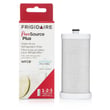
| Small or hollow cubes | Restricted filter | Replace Kenmore refrigerator water filter WFCB |
Water filter and water supply issues to focus on
A clogged filter can reduce flow to the ice maker and cause slow fill, hollow cubes, or no ice. The manual also notes that a restricted valve (especially a self-piercing saddle valve) can clog and block water flow.
- Replace the filter on schedule (commonly every 6 to 9 months under normal conditions).
- After a filter change, flush water for a few minutes to purge air from the line.
- If you suspect a dispenser or chute jam, follow the steps in how to disassemble a Kenmore refrigerator dispenser.
Why it matters
An ice maker depends on two things: a cold-enough freezer and steady water flow. Fixing the root cause (temperature, water supply, or a restriction like a clogged filter) prevents repeat failures and protects dispenser components from damage.
Last updated: January 2026