





Does the US use 110v or 220V?
In the U.S., most standard household outlets supply about 120 volts (often called 110V), while higher-voltage circuits supply about 240 volts (often called 220V) for large appliances. For your Speed Queen SWT220WM washer, the correct voltage depends on how it’s wired and the plug type.
- 120V (110V): Most wall outlets for everyday devices
- 240V (220V): Dedicated circuits for high-draw appliances (commonly electric dryers, ranges)
- Both voltages are present in most homes because the electrical service provides split-phase power
- Outlet shape matters: 120V and 240V receptacles are physically different
Check these items before plugging in or changing anything:
- The plug style (a 120V plug is different from a 240V plug)
- The dedicated breaker size and labeling in your electrical panel
- Any rating label on the washer cabinet (often lists volts and amps)
- Whether the washer is installed in a laundry room with a dryer outlet nearby (do not assume they match)
| Common name | Typical actual voltage | Where it’s used most | Outlet type |
|---|---|---|---|
| 110V | ~120V | General outlets | Standard 3-prong/grounded |
| 220V | ~240V | Large appliances | Larger, dedicated receptacle |
Using the wrong voltage can prevent the washer from running, trip the breaker, or damage electrical components. If you’re troubleshooting power issues on SWT220WM, start with the home supply and cord connection before replacing parts.
If you’re also seeing operational problems (won’t start, won’t spin, unusual behavior), follow our step-by-step guidance in how to fix Speed queen washer problems.
Last updated: February 2026
What are the common problems with Speed Queen washers?
Common problems we see with the Speed Queen SWT220WM washer include not draining, not spinning, leaking, excessive vibration, and lid or control-related no-start symptoms. Many issues come from clogs, load balance, or worn mechanical parts; targeted troubleshooting usually identifies whether you need a simple adjustment or a replacement part.
- Won’t drain / water left in tub: drain hose kink, blockage, or a failing pump
- Won’t spin or weak spin: drive system wear, transmission/gear case issues, or an out-of-balance load
- Leaking: worn tub gasket or other sealing surfaces
- Loud noise / banging: unlevel washer, overloaded tub, or worn drive components
- Lid issues: lid not closing smoothly or hinge wear that prevents proper operation
- Redistribute the load and try a spin again (bulky items can throw off balance).
- Confirm the washer is level and all feet are firmly on the floor.
- Inspect the drain hose for kinks, crushing, or a clog at the standpipe.
- Check fill hoses for seepage at the connections and tighten if needed.
- Listen for the pump during drain; a loud hum with no draining often indicates a blockage or pump problem.
If troubleshooting points to a worn or leaking component, these model-matched parts are common fixes:
| Problem | Likely part area | Example part for SWT220WM |
|---|---|---|
| Leak at tub or base | Tub sealing | Washer tub gasket 36425 |
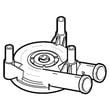
| Won’t drain | Drain system | Washer pump 205218P |
| Won’t spin / agitation issues | Drive system | Washer gear case 38165P |
| Lid won’t close smoothly | Lid hardware | Washer lid hinge bearing 33446 |
Drain, spin, and leak problems can quickly lead to bigger repairs (water damage, worn bearings, or transmission strain). Catching a clog or gasket leak early helps protect the tub assembly, drive block, and gear case.
For model-specific DIY guidance, we use the troubleshooting flow in how to fix Speed queen washer problems to narrow the issue by symptom (drain, spin, leak, noise) before ordering parts.
Last updated: February 2026
What is the average lifespan of a Speed Queen washing machine?
Most Speed Queen washers, including the Speed Queen SWT220WM, typically last about 20 to 25 years in normal household use when they are installed correctly, kept level, and maintained (hoses, seals, and drive components). That is longer than many residential washers, which commonly run 10 to 12 years.
Lifespan depends most on load size, cycle frequency, water quality, and whether the washer is kept level to prevent excess vibration.
- Typical Speed Queen top-load lifespan: 20 to 25 years
- Typical residential washer lifespan (many brands): 10 to 12 years
- Heavy-use situations (large family, daily loads): expect the lower end of the range
- Light-use situations (few loads per week): expect the higher end of the range
| Usage pattern | What it means | Typical outcome |
|---|---|---|
| Light use | 2 to 4 loads/week | Often reaches 20 to 25 years |
| Average use | 4 to 7 loads/week | Commonly 15 to 25 years |
| Heavy use | 8+ loads/week | Commonly 10 to 20 years |
On a long-lasting washer, the “end of life” is often a few key wear parts, not the whole machine. For SWT220WM, common wear areas include sealing surfaces, drain components, and drive system parts.
- Leaks from aging seals or gaskets (tub and hose connections)
- Drain problems from a worn pump or restrictions
- Spin or agitation issues from drive system wear
- Excess vibration that accelerates wear if the washer is not level
- Lid hardware wear over time
Model-matched parts we list for SWT220WM that can help extend service life include the washer pump 205218P, washer gear case 38165P, and washer tub gasket 36425.
A longer-lived washer usually costs less per year to own, but only if you prevent avoidable wear. Keeping the SWT220WM level, avoiding chronic overloads, and fixing small leaks early helps protect the tub bearings, gear case, and base.
- Keep the washer level and stable to reduce vibration during spin
- Avoid overloading; heavy, wet loads strain the drive and suspension
- Replace fill hoses proactively if they show bulging, cracking, or seepage
- Address leaks quickly to prevent rust and bearing damage
- Use the right amount of detergent to reduce residue and odors
For more model-relevant troubleshooting patterns, use our DIY guide: how to fix Speed queen washer problems.
Last updated: February 2026


