Installation guide
 Owner’s manual
 Error Codes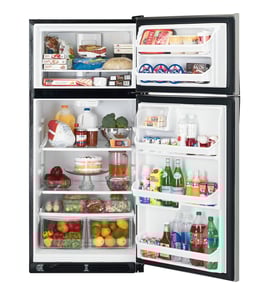




What are the disadvantages of a top mount fridge?
A top-mount refrigerator like the Frigidaire FRT18L4JBP puts the freezer at eye level and the fresh-food section lower, so daily fridge access often means more bending. Top-mount designs also tend to offer fewer convenience features than many bottom-freezer models.
Common drawbacks you may notice
- More bending for fresh food: produce drawers, deli items, and beverages sit lower in the cabinet.
- Less “grab-and-go” organization: many top-mount layouts have fewer adjustable bins and specialty zones.
- Fewer built-in features: water and ice dispensers are less common on basic top-mount designs.
- Door-swing clearance needs: you may need extra space at the hinge side to open the door fully.
- Temperature sensitivity in tough locations: placing the refrigerator in very hot or very cold areas can affect cooling performance.
What to check before deciding (quick comparison)
| What matters most | Top-mount refrigerator | Bottom-freezer refrigerator |
|---|---|---|
| Fresh-food access | Lower, more bending | Higher, easier access |
| Freezer access | Higher, easier access | Lower, more bending |
| Typical feature set | Basic, fewer add-ons | Often more feature-rich |
| Space planning | Door swing and clearances still important | Door swing and clearances still important |
Setup tips that reduce the “downsides”
We recommend using the clearances and leveling guidance in the installation guide so the doors close easily and you get proper airflow.
- Leave typical installation clearance of 3/8 inch at the sides and top and 1 inch at the back.
- Level the cabinet so it tilts slightly back (about 1/4 inch) to help doors self-close.
- Do not block the toe grille; airflow at the front bottom helps the refrigerator run correctly.
- If your hinge side is against a wall, plan extra space so the door can open wide enough for drawers.
Why it matters
Most “top-mount complaints” come down to ergonomics and layout. If you access fresh food far more than frozen food, the lower refrigerator compartment can feel inconvenient even when the unit is cooling perfectly.
Last updated: January 2026
Is a top mount or bottom mount fridge better?
A top-mount refrigerator like the Frigidaire FRT18L4JBP is usually the better choice when you want simpler design, easier service access, and a lower purchase and repair cost; a bottom-mount is better when you want the fresh-food section at eye level and use the refrigerator more than the freezer.
Quick comparison
| Feature | Top-mount (freezer on top) | Bottom-mount (freezer on bottom) |
|---|---|---|
| Fresh-food access | More bending | Less bending |
| Freezer access | Easier, at chest height | Often a pull-out drawer |
| Typical cost | Lower | Higher |
| Repair complexity | Often simpler | Often more complex |
| Best for | Frequent freezer use | Frequent fresh-food use |
How to choose for your kitchen and habits
- If you use frozen foods often, a top-mount keeps the freezer at a comfortable height.
- If you cook with fresh ingredients daily, a bottom-mount keeps the refrigerator shelves closer to eye level.
- If you want fewer “extras” to maintain, top-mount designs are typically more straightforward.
- If you have back or knee discomfort, bottom-mount designs reduce bending for everyday items.
- If you are tight on space, focus on door swing and clearances; your model needs typical clearances of 3/8 inch at the sides and top and 1 inch at the back for airflow.
Setup details that matter either way
Good installation and leveling affects door sealing, temperatures, and energy use.
- Level the cabinet so all corners sit firmly on the floor.
- Tilt the refrigerator slightly back so doors close freely.
- Do not block the toe grille; airflow is essential.
- After changing temperature controls, wait 24 hours before making more adjustments.
For step-by-step leveling, clearances, and door swing guidance, use the FRT18L4JBP installation guide and the FRT18L4JBP owner's manual.
Why it matters
Choosing the right mount style reduces daily strain, helps you organize food the way you actually use it, and can lower long-term maintenance costs by matching features to your needs.
Last updated: January 2026
What should go on the top shelf of your fridge?
In a Frigidaire FRT18L4JBP top-mount refrigerator, the top shelf is typically best for ready-to-eat foods and items that do not need the coldest temperatures, such as leftovers, drinks, and deli items, because temperatures can run slightly warmer and more consistent than the door.
Best foods for the top shelf
- Leftovers in sealed containers
- Ready-to-eat foods (deli meats, prepared meals)
- Drinks (especially items you open often)
- Yogurt and soft cheeses
- Desserts and snacks
What to avoid storing on the top shelf
Some foods keep better in colder zones (often lower shelves or the back of the refrigerator section).
- Raw meat, poultry, or seafood (store on a lower shelf to reduce drip risk)
- Milk if your fridge runs warm at the top (many households prefer a colder interior shelf)
- Highly perishable items that spoil quickly
Quick placement guide
| Fridge area | Temperature behavior (typical) | Best for |
|---|---|---|
| Top shelf | Slightly warmer, steady | Leftovers, ready-to-eat foods, drinks |
| Lower shelves/back | Colder | Milk, eggs, highly perishable foods |
| Crisper drawers | Humidity-controlled | Produce (use humidity controls) |
| Door bins | Most temperature swing | Condiments, juices, butter |
Why it matters
Using the top shelf for ready-to-eat foods helps keep frequently used items easy to reach while reserving colder areas for the most perishable foods. It also supports steadier temperatures by keeping the door for items that tolerate temperature changes.
Model-specific tips
- After changing temperature controls, wait 24 hours before making more adjustments (this helps you avoid chasing temperature swings). See the FRT18L4JBP owner's manual.
- Keep air circulation clear; avoid overpacking shelves so cold air can move properly.
Last updated: January 2026
What is the most common problem with a Frigidaire refrigerator?
For the Frigidaire FRT18L4JBP top-mount refrigerator, the most common problem we see is cooling trouble (warm fresh food section, weak freezer performance, or temperature swings). The most frequent causes are restricted airflow from dirty coils, a failing evaporator fan, or air leaks at the doors; basic power and control settings also cause many “no cool” calls.
Quick checks we recommend first
- Confirm the refrigerator is plugged in firmly and the outlet has power.
- Make sure the temperature controls are not set to “0” (that stops cooling but does not shut off power).
- Allow 24 hours after any control change for temperatures to stabilize.
- Listen for the evaporator fan running when the unit is cooling (a failed fan often causes warm refrigerator temps).
- Check door closing and sealing; gaps let warm, moist air in and can lead to poor cooling and frost.
For model-specific operating and control details, use the FRT18L4JBP owner’s manual.
Most common symptoms and likely causes
| Symptom | Most common cause | What to do next |
|---|---|---|
| Refrigerator warm, freezer OK | Airflow issue in fresh food section (fan/vents blocked) | Check vents for blockage; inspect fan operation |
| Freezer warm, refrigerator warm | Dirty condenser area, sealed-system issue, or compressor not running | Clean condenser area; verify power and controls |
| Frost buildup, temps drift | Door not sealing or defrost problem | Inspect gasket; check defrost system components |
| Unit “doesn’t run” | Control set to “0”, defrost cycle, or power supply issue | Wait 20 minutes; check breaker/fuse and settings |
Parts that commonly relate to cooling complaints
If you confirm a cooling or frost issue, these model-matched parts are often involved:
- Refrigerator evaporator fan motor 241854301 (moves cold air through the compartments)
- Refrigerator defrost heater 242044008 (melts frost off the evaporator)
- Refrigerator defrost bi-metal thermostat 5303918634 (helps control defrost heating)
- Frigidaire refrigerator door gasket (black) 242193212 (prevents warm air leaks)
Why it matters
Cooling problems can quickly lead to food spoilage and can force the compressor to run longer than normal. Fixing airflow restrictions and door sealing early usually restores stable temperatures and reduces energy use.
Last updated: January 2026