Installation guide
 Owner’s manual
 Error Codes


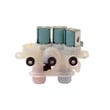
How many cubic feet is a Kenmore Model 11026132411 washer?
Kenmore washer model 11026132411 is a top-loading high efficiency, low-water washer; its exact tub capacity in cubic feet is listed in the product specifications section of the 11026132411 owner's manual. If you are comparing washers, most Kenmore top-load HE models in this family commonly fall in the mid-capacity range.
Where to find the exact capacity
Capacity is typically shown in the specifications section (often near the model list and feature overview) of the Use & Care Guide.
- Look for a “Specifications” or “Washer dimensions/capacity” heading
- Check for wording like “basket volume” or “tub capacity”
- Confirm you are reading the entry for model 11026132411 (not a close variant)
- If you only see dimensions, use them for fit checks, not capacity
Typical capacity range for this washer type
For Kenmore 110-series top-load HE, low-water washers, capacity is usually in a practical “everyday family load” range.
| Washer type | Typical capacity range (cu. ft.) | Best for |
|---|---|---|
| Top-load HE, low-water (like 11026132411) | 3.2 to 4.3 | Mixed loads, towels, bedding (size depends on model) |
| Compact top-load | 1.5 to 2.8 | Small spaces, light loads |
| Large-capacity top-load | 4.4 to 5.5+ | Bulky items, larger households |
Why it matters
Capacity affects how full you can load the basket while still getting proper turnover and cleaning. Overloading can lead to poor wash performance, out-of-balance spinning, and extra wear on suspension and drive components.
Related fit and performance checks (quick)
If you are sizing for a laundry space or troubleshooting performance, these checks help:
- Verify the washer is installed on a level floor to reduce vibration
- Use HE detergent only (this model is designed for it)
- Avoid packing items down; load loosely for better turnover
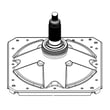
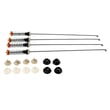
- If the washer shakes or bangs, inspect suspension parts such as the damper assembly W11130359
Last updated: February 2026
How to identify a Kenmore washer model?
Your Kenmore washer model number is printed on the appliance’s model and serial tag. For Kenmore model 11026132411, you’ll typically find that tag under the lid on a top-load washer, inside the lid opening, or on the back panel near the power cord or control area; use the exact number to match parts and manuals.
Where to look on Kenmore washers
- Top-load washers: under the lid, around the tub opening (rim) or on the underside of the lid
- Front-load washers: inside the door opening, along the door frame, or behind the door
- All styles: back panel near the power cord, or along the cabinet edge near the control console
- If the tag is hard to read: wipe it with a damp cloth and use a flashlight at an angle
What the model number looks like (and why it matters)
Kenmore model numbers often start with 110 and are usually 11 characters (or more). Using the full model number helps us match the correct Kenmore washer parts list, wiring, and troubleshooting steps in the 11026132411 use and care guide.
Quick ID checklist
| What to capture | Example for this washer | Why we need it |
|---|---|---|
| Model number | 11026132411 | Ensures correct part fit |
| Serial number | (from the same tag) | Helps with production variations |
| Type | Top-loading HE low-water washer | Narrows down diagrams and procedures |
Tips to avoid ordering the wrong part
- Match every digit in the model number (no missing or swapped numbers)
- Use the model number to confirm the correct diagrams before buying
- If you’re troubleshooting installation-related issues (noise, vibration, leaks), follow the leveling and hose guidance in the 11026132411 installation guide
Why it matters
Kenmore washers can look similar across multiple series, but small design changes affect fitment for common items like a lid lock, drain pump, or water valve. The exact model number is the fastest way to get the right replacement part the first time.
Last updated: February 2026
How do I troubleshoot my 11026132411?
For Kenmore washer model 11026132411, start troubleshooting by matching the symptom (won’t fill, won’t drain, off-balance, or poor rinse) to the checks in the owner's manual. Most issues come from load balance, water supply restrictions, or drain hose installation.
Quick checks we recommend first
- Confirm both hot and cold faucets are fully on and hoses are not kinked.
- Check inlet valve screens for debris that can restrict filling.
- Redistribute the load in loose heaps around the washplate; avoid single bulky items.
- Use only HE detergent and measure correctly; too many suds can cause odd behavior.
- Run DRAIN & SPIN after rebalancing if the load is still wet.
- Verify the washer is level and the feet are firmly on the floor with jam nuts tightened.
Symptom-based troubleshooting
| Symptom | Most common cause | What to do |
|---|---|---|
| Washer won’t run or fill | Water supply issue | Turn on both faucets, straighten hoses, clean inlet screens |
| Vibration, rocking, “walking,” or stops with lights flashing | Not level or load off balance | Level the washer, tighten feet, redistribute load |
| Loads still wet after spin | Tight packing or low spin cycle | Re-load loosely, choose a higher spin, run DRAIN & SPIN |
| Long drain or drain error (F9E1 / “drn” / “dr”) | Drain hose install or restriction | Correct standpipe setup, remove clogs, keep hose height within limits |
Drain and installation items that matter
Drain problems are often caused by how the drain hose sits in the standpipe. The installation instructions call out key limits, including avoiding an overly deep standpipe insertion and keeping the drain height within the allowed range; use the installation guide to confirm your setup.
Why it matters
This Kenmore high-efficiency, low-water top-load design relies on correct leveling, proper drain plumbing, and balanced loads. When any of those are off, the washer can pause, drain slowly, or leave clothes wetter than normal.
Last updated: March 2026