Owner’s manual
 Error Codes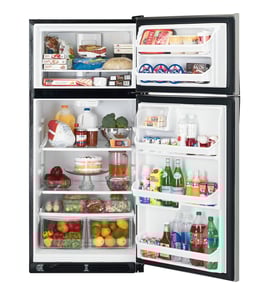




What is the upper part of a fridge called?
On the Kenmore refrigerator model 10660932900 (a top-mount design), the upper compartment is the freezer compartment. It is the section designed to keep foods frozen, and it also supplies cold air that helps cool the fresh-food (refrigerator) section.
In a top-mount refrigerator like model 10660932900, the freezer is more than storage; it is part of the cooling airflow path.
- Keeps food at freezing temperatures for longer-term storage
- Sends cold air down to the refrigerator section through vents
- Supports ice production if your unit is equipped with an ice maker
- Shares airflow with the refrigerator section, so blocked vents can cause temperature issues
These names often show up in instructions and parts diagrams.
| Term | What it usually means | Where you will see it |
|---|---|---|
| Freezer compartment | Upper frozen-food section | Features and use instructions |
| Refrigerator compartment | Lower fresh-food section | Temperature control guidance |
| Freezer vents / air vents | Openings that move cold air between sections | Air circulation and cooling issues |
| Temperature control | Control that affects both sections on many models | Control section in the manual |
Because air circulates between the freezer and refrigerator sections, the freezer area and its vents directly affect fresh-food temperatures. If packages block vents, airflow is restricted and you can see warm refrigerator temps, frost buildup, or moisture problems.
- Keep freezer vents clear of boxes and bags
- Allow airflow space around the refrigerator during installation (side, top, and back clearances)
- After changing settings, give temperatures time to stabilize before adjusting again
- If you notice heavy frost or warming, check for vent blockage first
For the exact feature names and airflow guidance used for Kenmore model 10660932900, use the 10660932900 owner's manual.
Last updated: January 2026
How to tell cubic feet of Kenmore refrigerator by model number?
For Kenmore refrigerator model 10660932900, the most reliable way to get the exact cubic-foot capacity is to look it up in the product specifications section of the 10660932900 owner's manual. If you cannot find the capacity listed there, you can still estimate it by measuring the usable interior space and converting cubic inches to cubic feet.
- Check the specifications section in the 10660932900 owner's manual.
- Look for a rating label inside the fresh food compartment (often on a side wall or near the crisper area); it sometimes lists capacity.
- Search by the full model number 10660932900 when comparing listings or spec sheets.
- If you only need an estimate, measure the interior and calculate cubic feet.
- Empty the compartment enough to measure.
- Measure the usable interior (ignore door bins and rounded corners):
- Width (inches)
- Depth (inches)
- Height (inches)
- Multiply:
width x depth x height = cubic inches. - Convert:
cubic inches ÷ 1728 = cubic feet.
| What you have | What to do | Result |
|---|---|---|
| Interior measurements in inches | Multiply W x D x H | Cubic inches |
| Cubic inches | Divide by 1728 | Cubic feet (approx.) |
Knowing cubic feet helps us match the right refrigerator parts and accessories (like shelves, bins, and temperature controls) and it also helps when planning kitchen fit and airflow clearances. Your manual also lists important installation spacing guidance for ventilation and door swing.
If you are trying to identify features tied to your model family (including display or diagnostic behavior), use our Kenmore 106 model refrigerator error codes reference as a companion to the manual.
Last updated: January 2026
Is there a way to reset a Kenmore Elite refrigerator?
Yes. For Kenmore model 10660932900, the most reliable reset is a power reset: turn the temperature control to OFF, disconnect power, then reconnect power and set the control back to your normal setting. This clears many control and cooling glitches.
- Turn the refrigerator control (thermostat/refrigerator control) to OFF.
- Unplug the refrigerator (or switch off the circuit breaker).
- Wait 5 to 10 minutes.
- Restore power.
- Set the control back to the desired temperature setting.
We follow this approach because the manual specifically calls out turning the control OFF, disconnecting power, then reconnecting power and resetting the control. See the 10660932900 owner's manual.
A reset helps most when the issue is a temporary control-board or power glitch. If the refrigerator still is not operating normally, check these basics:
- Confirm the cord is fully plugged into a grounded 3-prong outlet.
- Check the house breaker or fuse; reset/replace if tripped or blown.
- Make sure the temperature control is not still set to OFF.
- Wait 30 minutes after restoring power; the unit may be in an automatic defrost cycle.
- Listen for normal fan/compressor sounds; longer run times can be normal on efficient models.
| Symptom after reset | Most common cause | What we do next |
|---|---|---|
| No lights, no cooling | No power to unit | Check outlet, breaker/fuse, power cord |
| Lights work, not cooling yet | Defrost cycle or warm load | Wait 30 minutes, recheck temps |
| Warm fridge, freezer OK | Airflow issue | Check vents for blockage, door closing |
| Clicking or pulsing sound | Normal compressor/fan behavior | Monitor temps for a few hours |
Resetting correctly prevents nuisance problems (like controls stuck in an odd state) and avoids misdiagnosing a real failure. If the refrigerator is still warm after several hours, the next step is targeted diagnosis of airflow and cooling components such as the evaporator fan motor.
Last updated: January 2026