 Installation guide
 Owner’s manual


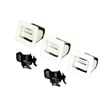
How do I know if my dryer start switch is bad?
If your Kenmore electric dryer model 11063942101 will not start even though the door is closed and power is on, the start switch is a top suspect. We confirm it by checking the switch for continuity with a multimeter while pressing the PUSH TO START button, then comparing results to the wiring diagram in the 11063942101 owner's manual.
Quick checks before testing the switch
These items commonly prevent starting and are called out in the installation checks:
- Make sure the controls are set to a running or “On” position (not Off).
- Press the Start button firmly.
- Confirm the dryer is plugged into a grounded outlet.
- Verify the electrical supply is connected; many electric dryers use two fuses or breakers.
- Check the house fuse is intact and tight, or the circuit breaker has not tripped.
- Confirm the dryer door fully closes and latches.
How to test the start switch (PUSH TO START)
- Unplug the dryer (or switch off both breakers).
- Access the console and locate the start switch terminals (use the 11063942101 owner's manual for access and wiring reference).
- Set your multimeter to continuity (or lowest ohms).
- Test across the correct switch terminals:
- Button not pressed: meter should show open (no continuity).
- Button pressed: meter should show closed (continuity, near 0 ohms).
What the results mean
| Test result | What it indicates | Next step |
|---|---|---|
| Continuity only when pressed | Switch is working | Check door switch, timer, thermal fuse, motor circuit |
| No continuity when pressed | Start switch is bad | Replace the start switch (or console switch assembly, depending on design) |
| Continuity all the time | Switch is stuck closed | Replace the switch |
Why it matters
A failed start switch stops the motor circuit from energizing, so the dryer will appear “dead” even with good power. Ruling out power supply and door closure first prevents unnecessary parts replacement.
Last updated: February 2026
How do I tell what model my Kenmore dryer is?
Your Kenmore dryer’s model number is printed on the model and serial number label; on model 11063942101, that label is located at the top inside the dryer door well. Once you have the full model number, we can match the correct parts, diagrams, and specifications using the 11063942101 owner's manual.
Where to look (fastest checks)
- Open the dryer door and look along the top edge inside the door opening (door well area).
- Write down the complete model number and serial number exactly as shown.
- If the label is hard to read, use a flashlight and take a clear photo, then zoom in.
- Keep the model and serial number with your purchase info for future service and parts lookup.
What the model number tells you
Kenmore model numbers help identify the design family and the correct replacement parts for your exact dryer.
| What you record | Example for this page | Why it matters |
|---|---|---|
| Model number | 11063942101 | Ensures parts fit your exact Kenmore electric dryer |
| Serial number | (varies) | Helps identify production details for service |
| Purchase date | (varies) | Useful for maintenance history and service calls |
Tips for using the model number to get the right parts
- Match parts by model number first, then confirm by part name and diagram location.
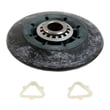
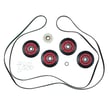
- For common wear items (noise, poor tumbling), a kit like the dryer repair kit 4392067 often covers multiple drum support components.
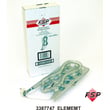
- For no-heat symptoms, common electrical-heat parts include the dryer heating element WP3387747 and the dryer thermal fuse WP3390719.
Why it matters
Kenmore dryers can look similar across series, but internal components (heating circuit, drum support, switches) can differ. Using the exact model number prevents ordering the wrong heating element, timer, or support parts.
Last updated: February 2026
Is it worth replacing the heating element in a dryer?
Yes, it’s usually worth replacing the heating element in a Kenmore 11063942101 electric dryer when the dryer still runs and the rest of the machine is in good shape; a heating element repair typically costs far less than replacing the entire dryer and often restores normal heat quickly.
When replacing the heating element makes sense
We recommend heating-element replacement when you confirm the dryer tumbles but produces little or no heat, and basic power and airflow checks look good.
- The drum turns normally, but clothes stay cold or take much longer to dry
- You have proper power to the dryer (many electric dryers use two fuses or breakers)
- The vent is not crushed, kinked, or clogged with lint
- The dryer is otherwise reliable (no loud bearing squeal, severe vibration, or repeated shutdowns)
- You want a repair that’s straightforward and commonly successful
A common replacement for this model is the dryer heating element WP3387747.
Quick checks to do before buying parts
The installation instructions for this model recommend a simple heat check after the dryer runs for about 5 minutes.
- Start the dryer and let it run about 5 minutes
- Open the door and feel for heat
- If there’s no heat, verify both breakers (or fuses) are on and tight
- Check airflow at the outside hood (you should feel strong air movement)
- Clean the lint screen and confirm it seats fully
For model-specific guidance and safety notes, use the 11063942101 installation guide.
Cost and outcome comparison
| Option | Typical result | Best for |
|---|---|---|
| Replace heating element | Restores heat when the dryer runs but won’t heat | Dryer is mechanically sound |
| Fix power/venting issue | Restores heat without major parts | Breaker tripped, poor airflow |
| Replace dryer | New appliance, higher cost | Multiple major failures |
Why it matters
A no-heat complaint is often caused by a failed heater or a power/airflow problem. Checking breakers and venting first prevents repeat failures and helps the new heater last longer.
Last updated: February 2026
What is an F1 code on a Kenmore dryer?
On a Kenmore electric dryer like model 11063942101, an F1 error code points to a problem with the electronic control (control board) or its wiring. The most reliable fix is to reset power, then inspect harness connections; if the code returns, the control typically needs service or replacement.
What to do first (safe, quick checks)
- Unplug the dryer or switch the breaker OFF for 5 minutes, then restore power.
- If the code returns immediately, stop the cycle and leave the dryer powered off.
- Check that the dryer is installed in a suitable location; very low temperatures can cause odd cycle behavior (see the 11063942101 installation guide).
- Confirm the dryer is level; poor leveling can affect sensor-cycle operation.
- If you recently moved the dryer, recheck the terminal block cover and cord strain relief for looseness.
Likely causes of an F1 code
| Likely cause | What it means | Typical symptom |
|---|---|---|
| Control board fault | Internal failure on the main control | F1 appears at start or mid-cycle |
| Loose wire harness | Connection issue between control and components | Intermittent F1, random beeps |
| Power supply issue | Unstable voltage or incorrect supply | F1 after storms, breaker trips |
How we recommend diagnosing it
- Disconnect power.
- Access the control area using the disassembly guidance in the 11063942101 owner’s manual.
- Reseat wire harness plugs at the control board (a photo before unplugging helps).
- Restore power and run a timed dry test.
If the F1 code returns after reseating connections, the control board is the primary suspect.
Why it matters
An F1 code is a control-level fault; continuing to run the dryer can lead to repeated shutdowns, incomplete drying, or additional electrical damage. Addressing it early helps protect the motor, heater circuit, and wiring.
Last updated: February 2026
What is the life expectancy of a Kenmore dryer?
A Kenmore electric dryer like model 11063942101 typically lasts 10 to 13 years. With consistent lint and vent cleaning, correct installation, and avoiding overloads, many dryers reach 15 years or more before needing major repairs.
What affects dryer lifespan the most
- Airflow and lint control: Clean the lint screen every load and keep the exhaust vent clear.
- Heat stress: Restricted venting makes the heater and thermostats run hotter and fail sooner.
- Drum support wear: Rollers, idler pulley, and belt wear causes noise and strain on the drive motor.
- Electrical supply: Loose terminal connections or incorrect cord/plug setup can shorten component life.
- Usage habits: Frequent heavy loads and overdrying accelerate wear.
Maintenance schedule we recommend
Use the care steps in the 11063942101 owner's manual and follow this simple routine:
| Task | How often | Why it matters |
|---|---|---|
| Clean lint screen | Every load | Maintains airflow and drying performance |
| Check vent for crushing/kinks | Monthly | Prevents overheating and long dry times |
| Clean exhaust vent ducting | About every 2 years (more with heavy use) | Reduces heat buildup and lint blockage |
| Clean inside dryer cabinet | About every 2 years (qualified service) | Removes lint near motor and heater |
Parts that commonly wear as a dryer ages
If your 11063942101 is getting loud, taking longer to dry, or stopping mid-cycle, these are frequent wear items:
- Dryer repair kit 4392067 (common wear set for drum support and belt-related parts)
- Dryer heating element WP3387747 (no heat or weak heat symptoms)
- Dryer thermal fuse WP3390719 (dryer won’t run if the fuse is blown)
Why it matters
A dryer that is maintained for airflow usually lasts longer, dries faster, and puts less stress on high-cost parts like the drive motor and heating system. Good venting also helps the dryer operate within normal temperature limits.
Last updated: February 2026








