Installation guide
 Owner’s manual
 Error Codes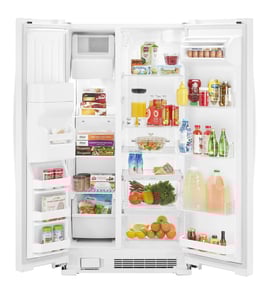


How big is the FFHS2611LWD?
The Frigidaire FFHS2611LWD is a full-size 36-inch class side-by-side refrigerator. For exact cabinet dimensions (height, width, depth) and the door-swing clearance you need, we recommend using the measurements listed in the installation guide.
What “big” usually means for this model
When customers ask how big the FFHS2611LWD is, they typically mean one or more of these:
- Overall width (fits between cabinets)
- Overall height (fits under soffits or upper cabinets)
- Overall depth (fits your kitchen walkway)
- Depth with doors open (drawer access and door swing)
- Installation clearances (airflow and hookups)
Installation clearances you should plan for
For FFHS2611LWD installation, the guide calls out clearances for airflow and connections:
- Sides and top: 3/8 inch
- Rear: 1 inch
- Plan space so doors can fully open for drawer and freezer basket access
These clearances matter even if the cabinet “fits” the opening.
Quick clearance summary
| Location | Recommended clearance |
|---|---|
| Sides | 3/8 inch |
| Top | 3/8 inch |
| Rear | 1 inch |
Why it matters
Correct sizing prevents common problems like doors that cannot open fully, poor air circulation that hurts cooling performance, and difficult access to the water line and electrical connection.
Related sizing tip (water line access)
If your refrigerator has an ice maker or water dispenser, plan room to pull the unit out for cleaning and service. The water supply guidance and routing details are covered in the owner's manual.
Last updated: February 2026
Is Frigidaire Gallery high end?
Frigidaire Gallery is not a luxury, high-end line; it is a strong mid-range tier with upgraded styling and features compared to basic Frigidaire models. For your Frigidaire FFHS2611LWD side-by-side refrigerator, “Gallery” typically signals a step up in design and convenience, not a premium-pro-only category.
How Frigidaire lines typically compare
Frigidaire generally positions its refrigerator families like this:
| Line | Typical market position | What you usually get |
|---|---|---|
| Frigidaire (base) | Value / entry | Core cooling, simpler controls |
| Frigidaire Gallery | Mid-range | More features and finishes, more configurations |
| Frigidaire Professional | Premium (not ultra-luxury) | Pro styling, higher-end feature sets |
What “Gallery” means in day-to-day use
When a refrigerator is in the Gallery line, we typically see benefits that matter for everyday ownership:
- More convenience features (ice and water dispenser options, storage flexibility)
- More design-focused finishes and handles
- More electronic controls and sensors compared to entry-level units
- A broader parts ecosystem for features like dispensers and ice makers
For model-specific operation and features, use the FFHS2611LWD owner's manual.
Why it matters when you are troubleshooting or buying parts
“Mid-range” often means more feature-related service calls than a basic model, especially around the ice maker and dispenser system. If you are diagnosing water or ice issues on the FFHS2611LWD, these parts are commonly involved:
- Frigidaire refrigerator water inlet valve assembly 242252702 (controls water flow to dispenser and ice maker)
- Refrigerator temperature sensor 240597220 (helps regulate temperatures)
- Refrigerator air damper control assembly 242303001 (manages airflow between compartments)
Quick tip: confirm what you own
If you are unsure whether your unit is “Gallery,” check the model tag and match it to the documentation and parts list for FFHS2611LWD. The installation guide also includes setup checkpoints (leveling, door seal contact, water connection) that affect performance.
Last updated: February 2026
What is the lifespan of a Frigidaire fridge?
A Frigidaire refrigerator typically lasts 13 years. For your Frigidaire FFHS2611LWD side-by-side refrigerator, good airflow, correct temperature settings, clean condenser coils, and tight door seals are the biggest factors that help you reach (or beat) that average.
Typical lifespan and what affects it
Most refrigerators fail early for a few common reasons. Focusing on these items usually delivers the biggest payoff:
- Condenser coil cleanliness (dust buildup makes the compressor work harder)
- Door gasket condition (air leaks cause long run times and temperature swings)
- Evaporator fan airflow (poor circulation leads to warm spots and frost issues)
- Stable temperatures (avoid frequent setting changes and overloading shelves)
- Water and ice system health (leaks or valve issues can create corrosion and icing)
Quick maintenance schedule (simple and effective)
Use this as a practical baseline for FFHS2611LWD ownership.
| Task | How often | What you are preventing |
|---|---|---|
| Vacuum/brush condenser area | Every 6 months | Overheating, compressor strain |
| Check door seal grip and alignment | Every 3 to 6 months | Warm air leaks, frost, high energy use |
| Replace water filter (if equipped) | Every 6 months | Low flow, taste/odor issues, valve strain |
| Confirm freezer and fresh food temps | Monthly | Food spoilage, ice maker problems |
Parts that commonly impact longevity
If you are troubleshooting performance issues, these model-matched parts are often involved:
- Air leaks: Refrigerator door gasket (white) 241786013 or Frigidaire refrigerator freezer door gasket, black 241786014
- Warm refrigerator section: Refrigerator air damper control assembly 242303001
- Noisy or weak airflow: Refrigerator evaporator fan blade 5308000010
- Water dispenser or ice maker not filling: Frigidaire refrigerator water inlet valve assembly 242252702
Why it matters
A refrigerator that runs longer than it should (because of dirty coils, air leaks, or restricted airflow) puts extra load on the sealed system and compressor. Keeping the cabinet sealed and the cooling system breathing normally is the most direct way to protect long-term reliability.
For model-specific operating guidance and normal sounds to expect, follow the care and use recommendations in the FFHS2611LWD owner's manual.
Last updated: February 2026
What is the most common problem with a Frigidaire refrigerator?
The most common problem we see on a Frigidaire side-by-side like model FFHS2611LWD is a cooling complaint: the freezer stays cold but the fresh food section warms up. This usually traces to restricted airflow (dirty condenser coils, a weak evaporator fan, or a stuck air damper) or a defrost issue causing frost buildup.
Most common symptoms customers notice
- Freezer temperature seems normal, but the refrigerator side is too warm
- Food spoils early or milk feels “not quite cold”
- Frost or ice buildup in the freezer (often behind the rear panel)
- Refrigerator runs a lot (compressor cycles frequently)
- Ice maker or water dispenser performance is inconsistent
Quick checks that solve many “warm fridge” calls
Start with these basics from the setup and care guidance in the owner's manual and installation guide:
- Confirm doors seal fully and close on their own; warm air leaks drive temperature problems
- Make sure the front water filter is fully seated and flush (some models)
- Verify temperature settings for fresh food and freezer are set correctly
- Clean the condenser area; a dirty condenser makes the unit run longer and cool worse
- Listen for the evaporator fan in the freezer; no fan airflow usually means poor fridge cooling
Parts that commonly cause the issue on this model
If the checks above do not restore normal temperatures, these model-matched parts are frequent fixes:
| Problem pattern | Likely system | Example part on this model |
|---|---|---|
| Freezer OK, fridge warm | Airflow from freezer to fridge | Refrigerator air damper control assembly 242303001 |
| Warm temps, weak/no airflow | Evaporator fan system | Refrigerator evaporator fan blade 5308000010 |
| Temps swing or seem inaccurate | Temperature sensing/control | Refrigerator temperature sensor 240597220 |
| Water/ice issues alongside cooling complaints | Water supply to ice maker/dispenser | Frigidaire refrigerator water inlet valve assembly 242252702 |
Why it matters
A side-by-side cools the fresh food section by moving cold air from the freezer. When airflow is blocked (frost, fan problem, damper problem) or heat cannot be rejected (dirty condenser), the refrigerator side warms first even though the freezer still feels “fine.”
Last updated: February 2026