Owner’s manual
 Error Codes


What is a bottom mount fridge freezer?
A bottom-mount fridge freezer (like the LG LFC25765ST) is a refrigerator design where the fresh-food compartment is on top and the freezer is in a lower drawer. This keeps everyday refrigerated items at eye level and puts frozen foods below.
How a bottom-mount layout is set up
Most bottom-mount refrigerators are organized like this:
- Upper section: refrigerator compartment with shelves, bins, and crisper drawers
- Lower section: pull-out freezer drawer (often with an upper and lower basket)
- Airflow system: cold air is circulated between compartments to maintain set temperatures
- Door style: many bottom-mount models are French door on top with a freezer drawer below
For model-specific features and controls on the LG LFC25765ST, we recommend checking the LFC25765ST manual.
Why people choose a bottom-mount refrigerator
Bottom-mount designs are popular because they make the refrigerator section easier to use day to day.
Benefits
- Less bending for fresh foods, drinks, and produce
- Better visibility and organization for refrigerated groceries
- Freezer drawer can hold bulky items (pizza boxes, bags of frozen food)
- Often pairs well with French door storage up top
Tradeoffs
- You bend more to access freezer items
- Freezer drawers can be heavier when fully loaded
- Some items can be harder to see if stacked in baskets
Quick comparison: bottom-mount vs top-mount
| Feature | Bottom-mount | Top-mount |
|---|---|---|
| Fresh food access | Easier (eye level) | Requires bending |
| Freezer access | Requires bending | Easier (eye level) |
| Organization | Often more flexible | Often simpler |
Why it matters
Choosing a bottom-mount refrigerator can improve everyday convenience because the items you use most (fresh foods) are positioned where you can reach them quickly. It can also influence how you organize food, manage airflow, and maintain consistent temperatures.
Last updated: January 2026
Why is my LG refrigerator leaking from the bottom?
On the LG LFC25765ST bottom-mount refrigerator, a leak from the bottom is most often caused by a defrost drain that is clogged or frozen, which makes water overflow into the fresh food section and down to the floor. Less commonly, a water supply connection or valve can seep and run down the cabinet.
Quick checks we recommend first
- Unplug the refrigerator or turn off power at the breaker before removing panels.
- Pull the unit forward and look for water trails from the back vs. the front.
- Check if the leak happens only during/after defrost (intermittent puddles) or constantly.
- Inspect the freezer floor for a sheet of ice (classic sign of a blocked defrost drain).
- If the unit has an ice maker, check the fill tube area for ice buildup.
Most common cause: clogged defrost drain
During defrost, meltwater should flow through the drain hole, down the drain tube, and into the drain pan. If the drain is blocked, water backs up and can leak out at the bottom.
What to do
- Remove food and drawers as needed to access the freezer rear panel.
- Melt any ice around the drain trough using warm air (hair dryer on low) and towels.
- Flush the drain with hot water (a turkey baster works well) until it flows freely.
- If the drain tube is split, loose, or repeatedly clogs, replace the refrigerator drain tube 5251JA3003D.
For panel removal and access points specific to this model, use the LFC25765ST manual.
Other common leak sources (water/ice models)
If the puddle is near the back of the refrigerator or you see dripping at the lower rear:
- Water inlet valve seeping or cracked
- Loose water line fitting
- Ice maker fill tube leaking or freezing and overflowing
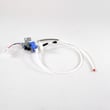
A common part to inspect for seepage is the refrigerator water inlet valve assembly AJU55759303.
Symptom-to-cause guide
| What you notice | Most likely cause | Where to look |
|---|---|---|
| Ice sheet on freezer floor | Defrost drain clogged/frozen | Freezer drain trough and tube |
| Puddle at back near wall | Water line/valve leak | Lower rear, valve area |
| Leak only when using ice maker | Fill tube or valve issue | Behind ice maker, rear inlet |
Why it matters
Bottom leaks can lead to hidden ice buildup, odors, and floor damage. Clearing the drain early also helps prevent repeat freezing and keeps defrost water moving into the drain pan as designed.
Last updated: January 2026
What is the problem with the LG bottom freezer refrigerator?
On the LG LFC25765ST bottom-mount refrigerator, a very common complaint is a cooling imbalance: the refrigerator section runs warm while the freezer stays cold. That pattern usually points to restricted airflow, an evaporator fan problem, or a defrost issue that blocks air movement.
Quick checks we recommend first
- Make sure food packages are not blocking the air vents in the fresh food section.
- Confirm both doors close fully and the gaskets seal all the way around.
- Set temperatures to typical targets: 37°F for fresh food and 0°F for freezer.
- Listen for the evaporator fan running when the compressor is running.
- Check for heavy frost on the freezer back wall (often tied to defrost trouble).
What the symptoms usually mean
| What you notice | Most likely area | What to check next |
|---|---|---|
| Fridge warm, freezer cold | Airflow from freezer to fridge | Vents, damper path, evaporator fan |
| Frost on freezer back panel | Defrost system | Frost pattern, fan airflow, defrost components |
| Temps swing up and down | Temperature sensing/control | Sensor readings, control response |
| No ice or slow ice | Water/ice system | Fill tube freezing, inlet valve flow |
Parts that often relate to these symptoms on this model
If testing points to a failed component, these parts are commonly involved on the LFC25765ST:
- LG refrigerator evaporator fan motor 4681JB1027C (circulates cold air through the compartments)
- Refrigerator defrost sensor assembly 6615JB2005N (helps the control manage defrost temperature)
- Refrigerator water inlet valve assembly AJU55759303 (can affect ice maker fill and water flow)
Why it matters
When the freezer stays cold but the refrigerator warms up, food can enter the unsafe temperature range. Restoring airflow and correcting frost buildup early also reduces long run times and helps protect the compressor.
Model-specific guidance
For control settings, airflow locations, and any diagnostic steps specific to this refrigerator, use the LFC25765ST manual.
Last updated: January 2026